
TL;DR:
- Early-stage Australian startups benefit from flexible, no-contract remote IT support with Australian certifications and fixed pricing. Such support suits founders needing quick fixes without committing to long-term agreements and can be upgraded to technical leadership when required. Myitbutler offers certified, Australian-based helpdesk services that align with startup needs within their budgets.
For early-stage Australian startups, the best balance of cost, response time, and local compliance comes from a lean, Australian-standard remote on-demand IT partner with no long-term contracts. That's Myitbutler. If you need architecture ownership or a full engineering team, a fractional CTO or managed remote team is the right upgrade instead.
The short version:
- Myitbutler gives Australian startups flexible, no-contract remote IT support backed by CCNA and CompTIA Security+ certifications, Australian time-zone coverage, and transparent fixed pricing.
- On-demand support suits founders who need fast fixes, vendor liaison, and security basics without committing to a full-time hire or a 12-month contract.
- Upgrade to a fractional CTO or embedded engineering partner when you need someone to own your product architecture or lead technical hiring.
Table of Contents
- Which provider model suits your startup right now?
- What each option actually looks like in practice
- How to choose the right IT support for your startup
- What pricing and SLAs look like in Australia
- What on-demand tech support actually covers
- How we selected providers and why Myitbutler is recommended
- Key takeaways
- Why Australian remote IT support matters more than founders realise
- Myitbutler: remote IT support built for Australian startups
- Useful sources
- FAQ
Which provider model suits your startup right now?
The table below compares the five main service models an early-stage Australian startup will encounter. Myitbutler leads as the recommended option; the remaining models are listed by typical fit for founders at the pre-seed to Series A stage.
| Provider | Best for | Service model | Pricing model | Response time / SLA | Technical scope | Security & certifications | Contract flexibility | Australia / timezone |
|---|---|---|---|---|---|---|---|---|
| Myitbutler | Early-stage AU startups needing flexible remote IT | Remote on-demand + managed liaison | Fixed / hourly, no long-term contract | Documented SLAs, AU business hours + multi-timezone | Helpdesk, sysadmin, vendor liaison, security assessments | CCNA, CompTIA Security+, PRINCE2 | No lock-in, month-to-month | Australian company, global delivery |
| Outsourced helpdesk networks | High-volume ticket handling at scale | Outsourced helpdesk (24/7) | Per-ticket or per-seat | Fast at volume; less startup-specific | Tier 1–2 helpdesk | Varies by provider | Often annual contracts | Global; AU timezone varies |
| Fractional CTO / embedded engineering | Architecture ownership, technical hiring | Embedded leadership + engineering | Retainer or equity/hybrid | Async; weekly cadence typical | Deep devops, architecture, product delivery | Depends on individual | Flexible; project-based | Depends on partner location |
| Local MSP franchises | On-site hardware or AU-centric compliance | On-site + remote hybrid | Monthly retainer | Business hours; on-site SLAs | Helpdesk, hardware, basic sysadmin | MSP-level; varies | 12-month typical | Strong AU presence |
| Managed remote team platforms | Predictable monthly engineering capacity | Retained remote team | Monthly retainer | Depends on team structure | Mid-to-senior engineering | Varies | 3–12 month minimums | Global; AU coverage varies |
Three quick picks:
- Best low-cost on-demand: Myitbutler — fixed pricing, no contract, AU-standard security.
- Best for rapid scaling: Outsourced helpdesk networks when ticket volume outgrows a single provider.
- Best for embedded technical leadership: Fractional CTO or embedded engineering partner when you need someone accountable for architecture and hiring.
What each option actually looks like in practice
Myitbutler
Myitbutler is an Australian company with extensive enterprise experience, delivering remote IT support to startups, distributed teams, and international organisations. Services cover on-demand troubleshooting, device provisioning, vendor liaison, cloud admin, security assessments, and ongoing IT supervision. Certifications include CCNA, CompTIA Security+, and PRINCE2 — the kind of credentials that matter when an investor or enterprise client asks about your security posture.
Pricing is transparent and fixed, with no long-term contracts. Onboarding typically involves a short discovery call, a trial task to validate fit, and a simple onboarding agreement. Communication runs through WhatsApp, email, and Zoom, which works well for founders spread across time zones.
Key facts for founders:
- No lock-in: month-to-month or per-session engagement.
- Documented SLAs covering urgent and standard requests.
- Multi-timezone support from an Australian base.
- Suited to pre-seed through Series A teams of 2–50 people.
Outsourced helpdesk networks
Large outsourced networks — including providers like Teleperformance, Concentrix, Taskus, Founderver (formerly Sitel), Supportninja, Sutherland, Alorica, and Genpact — are built for volume. They handle thousands of tickets per day across global clients, which means per-ticket costs can be low. The trade-off is that startup-specific context gets lost quickly; you are one small account in a very large queue.
Providers such as Helpware, Unity Communications, Qualfon, and Fusion BPO Services sit in a mid-tier: more attentive than the enterprise giants, but still oriented toward process-driven helpdesk work rather than the ad-hoc, context-rich support an early-stage founder usually needs. Crescendo.ai adds an AI-assisted layer to helpdesk triage, which can reduce response times on common queries.
Typical trade-offs:
- Strong 24/7 availability and ticket-volume capacity.
- Less flexibility on scope; most contracts are annual.
- AU timezone coverage is inconsistent across providers.
Fractional CTO and embedded engineering partners
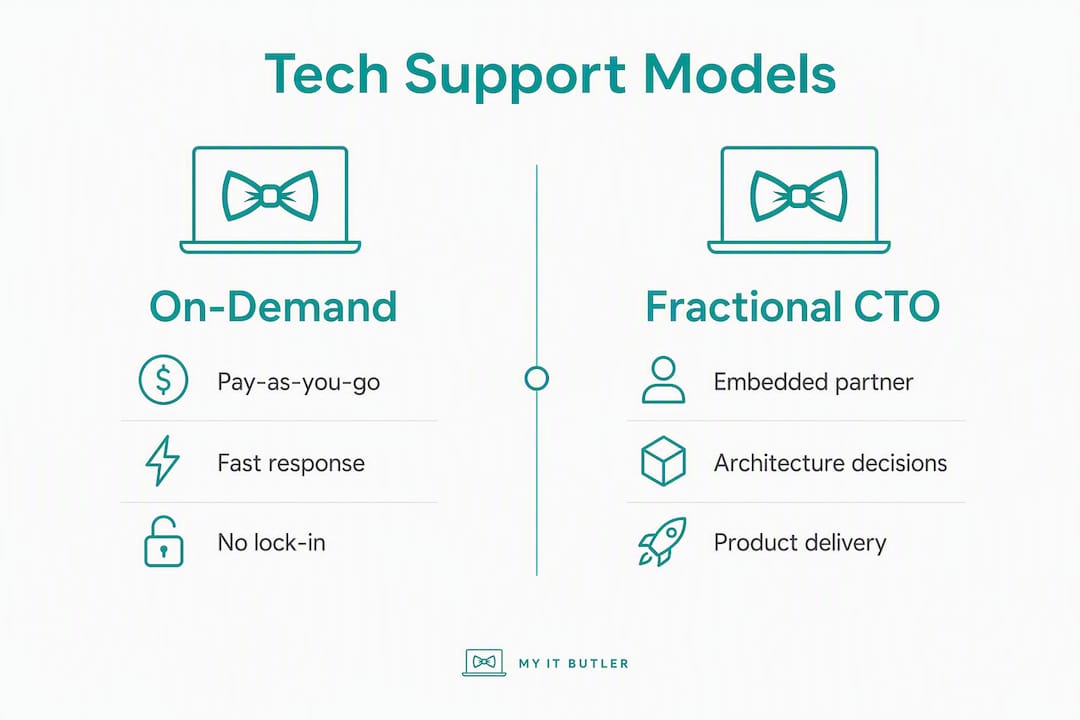
A fractional CTO embeds into daily operations and takes accountability for architecture decisions, technical hiring, and product delivery — not just advice. This is the right model when your startup has raised a seed round, is building a product, and needs someone who owns outcomes rather than just fixes incidents.

Providers like Plaxonic Technologies, BetterWay Devs, Remote Team Solutions, and Tech2Globe operate in this space, offering embedded engineering capacity at various price points. CrewBloom and Influx lean toward staffing vetted remote talent rather than outcome ownership, which sits between pure helpdesk and true fractional CTO engagement.
Partnership structures can be contract, equity, or hybrid — useful for founders with limited runway who need engineering depth without immediate full payroll costs.
Who this suits: Post-seed startups building a product, not just running operations.
Local MSP franchises
Local MSPs make sense when you have physical hardware on-site, need someone to walk the floor occasionally, or operate under an Australian compliance framework that requires local presence. The downside is cost: monthly retainers for local MSPs typically run higher than remote-only options, and 12-month contracts are standard. For a pre-revenue startup, that commitment is hard to justify.

Managed remote team platforms
Platforms that supply vetted remote engineers on retainer give founders predictable monthly capacity. The catch is minimum terms — usually three to twelve months — and a higher monthly floor than on-demand support. They suit founders who have validated their product and need sustained engineering output, not occasional fixes.
Pro Tip: Before signing any retainer, ask for a two-week paid trial task. A provider confident in their work will agree. One that pushes back on a trial is telling you something important.
How to choose the right IT support for your startup
Work through these criteria before you speak to any provider.
- Define your technical scope. Do you need helpdesk triage, sysadmin work, vendor management, security assessments, or all of the above? Write it down before the first call.
- Set your response-time requirement. A two-hour SLA for critical issues is reasonable for most startups. If you need 24/7 coverage, confirm it is included, not an add-on.
- Check Australian timezone support. If your team is AU-based or your clients are, a provider operating from a misaligned timezone adds friction every time something breaks at 9 AM Sydney time.
- Ask about certifications. CCNA and CompTIA Security+ are the baseline for a provider handling your network and security. PRINCE2 signals project management discipline. No certifications means no verifiable standard.
- Confirm contract flexibility. Long-term contracts hurt early-stage startups. Look for month-to-month or per-session options, especially while you are still validating your needs.
- Request a sample SLA document. Any credible provider has one. If they cannot produce it in the first conversation, move on.
- Ask about escalation paths. What happens when a problem exceeds their scope? A good provider has a documented escalation process, not just a vague "we'll figure it out."
Questions to ask every provider:
- What is your documented response time for critical vs standard requests?
- Which certifications does your team hold, and can you provide evidence?
- How do you handle after-hours incidents — and what does that cost?
- Can you share a case study or reference from a startup of similar size?
- How do you manage third-party vendor relationships on our behalf?
Red flags to watch for:
- Pricing that is not published or quoted in writing before you sign.
- No documented SLA — verbal promises only.
- No Australian coverage or timezone support for an AU-based team.
- All communication routed through a generic ticketing system with no named contact.
- Pressure to sign a 12-month contract before a trial period.
Pro Tip: Run a two-week trial with a fixed onboarding fee before committing. Give the provider one real, moderately complex task — a vendor migration, a security review, or a device setup. How they handle it tells you more than any sales call.
What pricing and SLAs look like in Australia
Pricing for on-demand IT support varies by model. Early-stage startups should expect varying pricing levels depending on service scope and contract terms; consult providers directly for current rates and service level agreements.
Founders consistently underestimate total cost of ownership. The hourly rate is only part of the picture. Budget separately for:
- Setup and onboarding fees — some providers charge a one-off fee to configure tools and document your environment.
- After-hours premiums — urgent calls outside business hours often attract a 1.5x–2x rate multiplier.
- Third-party vendor pass-throughs — licence renewals, cloud credits, and software subscriptions managed on your behalf may carry a coordination margin.
- Per-incident minimums — some providers bill a minimum of one hour per ticket regardless of actual time spent.
A self-healing IT stack — automating common fixes like password resets, patch scheduling, and offline-device alerts — can meaningfully reduce the number of billable incidents each month. For a startup spending $1,500/month on hourly support, cutting incident volume by a third through automation is worth modelling before you sign anything.
Founders who treat IT support as a pure cost centre tend to under-invest until something breaks. The smarter frame is risk management: what does a two-hour outage cost you in lost sales or client trust, versus a $150/hour fix?
What on-demand tech support actually covers
On-demand IT support is a pay-as-you-go model: you engage a provider for a specific task or incident without a recurring contract. It suits startups that do not yet need a full-time IT hire but face regular technical friction.
What is typically included:
- Helpdesk triage and troubleshooting (devices, software, connectivity).
- Device provisioning and basic configuration.
- Patch management and software updates.
- Vendor liaison — managing relationships with cloud providers, ISPs, and SaaS vendors.
- Backup and recovery support.
- Cloud admin tasks (user accounts, permissions, storage).
- Security assessments and basic hardening advice. See the startup cybersecurity basics guide for a practical baseline.
What is usually out of scope:
- Full-time product development or custom platform engineering.
- Continuous 24/7 devops monitoring unless you are on a managed contract.
- Long-term technical roadmap ownership.
- Recruitment and technical hiring decisions.
The line between on-demand support and fractional CTO engagement is worth understanding clearly.
On-demand support keeps your existing systems running. A fractional CTO builds and owns the systems you will need next. If you are asking "how do I fix this?" you need on-demand support. If you are asking "what should we build and how?" you need embedded technical leadership.
When your startup crosses into product-building territory — hiring engineers, choosing a cloud architecture, or preparing for a Series A technical due diligence — that is the signal to explore managed IT services or engage a fractional CTO alongside your on-demand provider.
How we selected providers and why Myitbutler is recommended
Every provider model in this article was assessed against five criteria relevant to early-stage Australian startups:
- Fit for early-stage companies: Does the model work for a team of 2–20 people with limited IT budget and no dedicated IT staff?
- Australian availability and timezone support: Can the provider respond during AU business hours without a premium surcharge?
- Flexible contracts: Is there a month-to-month or no-contract option, or is a 12-month commitment required?
- Security certifications: Does the provider hold verifiable credentials (CCNA, CompTIA Security+, or equivalent)?
- Transparent pricing: Are rates published or quoted in writing before engagement?
Myitbutler meets all five criteria. It is an Australian company with documented certifications, no lock-in contracts, fixed pricing, and a track record supporting distributed teams across multiple time zones. Lean IT operation examples from its client base illustrate how early-stage teams have kept IT costs controlled while maintaining reliable coverage.
Trust signals to verify with any provider:
- Written SLA document available before signing.
- Named certifications with evidence (not just marketing copy).
- At least one case study or reference from a comparable startup.
- Clear escalation path documented in the service agreement.
- Local or timezone-aligned communication channel (not just a global ticket queue).
When to choose a different model:
- Choose an outsourced helpdesk network when ticket volume exceeds what a single provider can handle cost-effectively.
- Choose a fractional CTO or embedded engineering partner when you need architecture ownership, technical hiring, and product delivery accountability — not just incident response.
- Choose a local MSP franchise when on-site hardware support or physical presence is a genuine requirement.
Key takeaways
For early-stage Australian startups, a no-contract remote on-demand IT partner with Australian-standard certifications and transparent fixed pricing gives the best cost-to-coverage ratio at the pre-seed to Series A stage.
| Point | Details |
|---|---|
| On-demand is pay-as-you-go | Engage a provider per session or incident — no full-time hire, no 12-month contract required. |
| Certifications matter | Verify CCNA, CompTIA Security+, or equivalent before signing; they are the baseline for network and security work. |
| Budget for hidden costs | Setup fees, after-hours premiums, and vendor pass-throughs add to the hourly rate — model total cost of ownership. |
| Upgrade trigger | Move to a fractional CTO or managed contract when you need architecture ownership, not just incident fixes. |
| Myitbutler | Australian-standard remote IT support with no lock-in contracts, fixed pricing, and multi-timezone coverage for startups. |
Why Australian remote IT support matters more than founders realise
The conventional wisdom says any competent IT provider will do, as long as the price is right. That view misses something specific to Australian startups: compliance expectations, data sovereignty concerns, and the practical reality of AEST business hours.
When a critical system goes down at 9 AM in Sydney, a provider operating from a misaligned timezone is not just slow — they are effectively unavailable during your highest-stakes hours. And when an enterprise client or investor asks about your security posture, "we use an overseas helpdesk" is a harder answer to defend than "we work with an Australian-certified provider operating to Australian standards."
There is also a subtler point. Early-stage founders are not just buying IT fixes. They are buying confidence — the ability to focus on product and customers without a background anxiety about whether the tech is holding together. A provider who knows Australian cloud infrastructure, understands local vendor relationships, and communicates in your timezone removes that anxiety in a way a generic global helpdesk cannot replicate.
The startups that handle IT best at the early stage are not the ones with the biggest IT budgets. They are the ones who picked a provider early, documented their environment properly, and built a relationship before the first crisis hit.
Myitbutler: remote IT support built for Australian startups
Early-stage founders need IT support that moves at startup speed: fast responses, no lock-in, and a provider who already understands Australian compliance and cloud infrastructure. Myitbutler delivers exactly that — remote on-demand IT support backed by CCNA and CompTIA Security+ certifications, transparent fixed pricing, and no long-term contracts.
Whether you need a one-off troubleshooting session, ongoing vendor liaison, or a security assessment before your next funding round, Myitbutler works around your timezone and your budget. Onboarding starts with a short discovery call and a trial task so you can validate fit before committing to anything.
Book a free discovery call to talk through your startup's IT needs and get a clear, written quote — no obligation, no lock-in.
Useful sources
- Myitbutler remote IT support and certifications — service overview, certifications (CCNA, CompTIA Security+, PRINCE2), and pricing approach.
- Lean IT operations for startups: real examples — practical case studies for early-stage teams.
- How to set up IT infrastructure for an early-stage startup — stepwise onboarding and tooling guide.
- No-contract IT support for startups — explains the benefits and limits of flexible engagement models.
- Affordable cybersecurity tools for new businesses — low-cost security tools a startup can deploy alongside on-demand support.
- On-demand IT services overview (NerdsToGo) — background on the pay-as-you-go model and who it suits.
- Self-healing startup IT stack (utilITise) — automation approaches that reduce recurring support costs.
- CTO support for startups (Devlyn) — when to upgrade from on-demand to fractional CTO engagement.
- Startup technology partnership models (ELMET) — contract, equity, and hybrid structures for engineering capacity.
FAQ
What does on-demand IT support include for a startup?
On-demand IT support covers helpdesk triage, device provisioning, patch management, vendor liaison, cloud admin, backup support, and basic security assessments. It does not typically include product development, continuous devops monitoring, or long-term technical roadmap ownership.
How much does on-demand IT support cost in Australia?
Pricing for on-demand IT support varies by model. Early-stage startups should expect varying pricing levels depending on service scope and contract terms; consult providers directly for current rates and service level agreements.
When should a startup switch from on-demand support to a fractional CTO?
Switch when you need someone accountable for architecture decisions, technical hiring, and product delivery — not just incident fixes. On-demand support keeps existing systems running; a fractional CTO builds and owns what comes next.
Does Myitbutler work with Australian startups across time zones?
Yes. Myitbutler is an Australian company that supports distributed teams and international organisations across multiple time zones, using WhatsApp, email, and Zoom as communication channels, with documented SLAs and no long-term contracts.
What certifications should an IT support provider hold?
Look for CCNA (network competency), CompTIA Security+ (security baseline), and PRINCE2 (project management discipline) as a minimum. These are verifiable credentials, not just marketing claims, and they signal a provider operating to a documented professional standard.