
Startup cybersecurity basics are the foundational controls every early-stage founder must put in place before a breach forces the issue. The seven areas that matter most are: identity and access management, data handling and privacy, employee training, cloud security, endpoint protection, business continuity, and secure development practices. Get these right in your first 90 days and you dramatically cut your exposure. The Australian Cyber Security Centre (ACSC) and the NCSC both publish free guidance specifically for early-stage companies, and frameworks like SOC 2 give you a compliance roadmap that also doubles as a sales tool with enterprise buyers.
The core claim: foundational controls implemented early, including identity-first security, endpoint hygiene, and automated dependency scanning, significantly reduce breach risk and cut the time it takes to detect an attack.
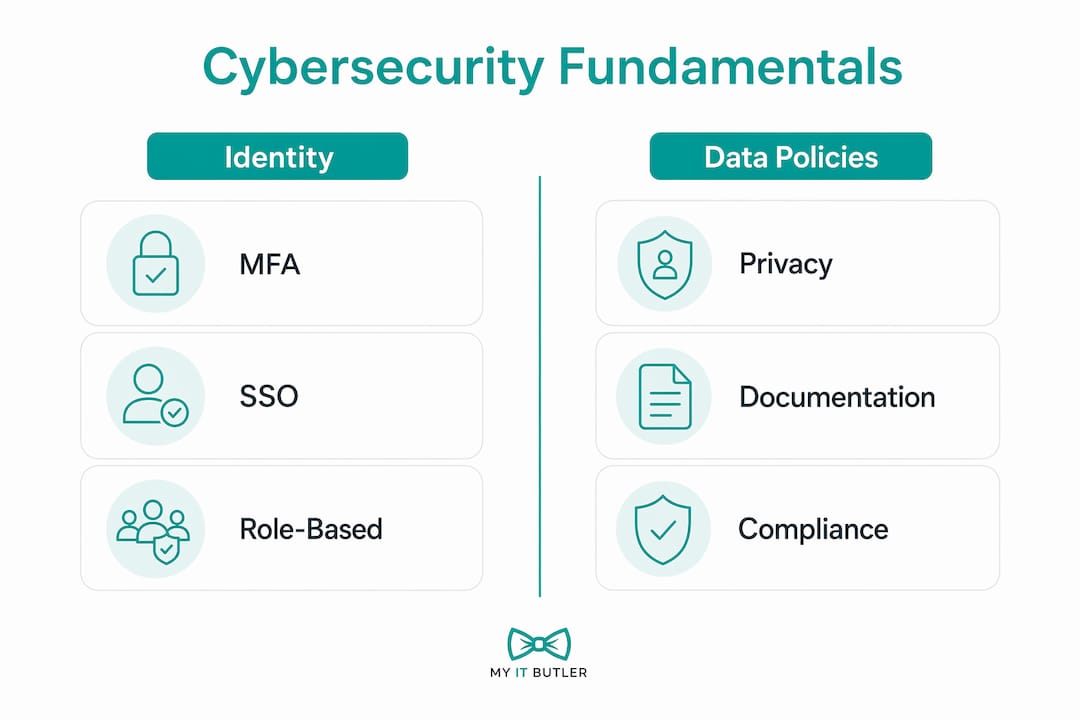
- Identity and access management: Multi-factor authentication (MFA) on every account, role-based access, and a password manager for the whole team.
- Data handling and privacy: Know what data you collect, where it lives, and who can touch it. Australia's Privacy Act 1988 applies to many startups earlier than founders expect.
- Employee training: Phishing simulations and a 30-minute security onboarding session for every new hire.
- Cloud security: Enforce least-privilege permissions, encrypt data at rest and in transit, and audit your SaaS tools quarterly.
- Endpoint protection: Full-disk encryption on every laptop, anti-malware or EDR software, and automatic screen lock.
- Business continuity: Automated daily backups stored in a separate account, with quarterly restoration tests.
- Secure development: Automated dependency scanning in your CI pipeline and a policy against adopting brand-new third-party packages without a settling period.
Pro Tip: If you are pre-revenue and resource-constrained, do identity and access management first. Stolen credentials are the leading initial attack vector for startups, and MFA costs almost nothing to turn on.
What are the seven cybersecurity fundamentals for startups?
1. Identity and access management
Every account your team uses, from your cloud console to your code repository, needs MFA. MFA combined with role-based access significantly decreases credential theft, which is the most common way attackers get in. Use a password manager like 1Password or Bitwarden (roughly $8 per user per month) so nobody reuses passwords across services. Remove access immediately when someone leaves, and review who has admin rights at least quarterly.

Single Sign-On (SSO) is worth adding once your budget allows. Disable one account and you instantly revoke access to every connected application, which makes offboarding clean and fast.
2. Data handling and privacy
Identify what personal or sensitive data your startup collects and document where it lives. Australia's Privacy Act 1988 and the Australian Privacy Principles (APPs) apply to businesses with an annual turnover above $3 million, but many startups handle health, financial, or government-related data that triggers obligations from day one regardless of size. Encrypt databases and storage buckets. Apply data retention policies so you are not holding information you no longer need. For practical steps on protecting customer data, the principle is simple: collect only what you use, protect what you keep, and delete what you do not need.
3. Employee education and training
People are the most exploited entry point. A 30-minute security onboarding session for new hires, combined with periodic phishing simulations, builds awareness without eating into product time. Train your team to recognise suspicious emails, verify unexpected requests through a second channel, and report anything odd without fear of embarrassment. Security awareness training platforms like KnowBe4 maintain current phishing templates and can run simulations automatically.
Good security culture compounds. Training a team of five on proper credential handling is far easier than forcing a culture shift at fifty people.
4. Cloud security basics
Cloud misconfigurations are the most common breach vector for cloud-native startups. The usual culprits: publicly exposed storage buckets, over-permissioned IAM roles, and unencrypted databases. Fix these first. Enforce least-privilege permissions across AWS, Google Cloud, or Azure. Enable audit logging (CloudTrail, Cloud Audit Logs) so you have a record of who did what. Block public access to storage by default.

Unmanaged SaaS sprawl is a hidden risk. The average company uses well over 100 SaaS tools, each representing a potential misconfiguration or forgotten admin account. Maintain an inventory and review admin access every quarter.
Pro Tip: Start with your cloud provider's native security tools, such as AWS Security Hub or Google Cloud Security Command Center, before buying third-party platforms. They are free, already connected to your infrastructure, and catch the most common misconfigurations.
5. Endpoint security essentials
Every laptop your team uses is a potential entry point. Enable full-disk encryption (FileVault on Mac, BitLocker on Windows) and enforce automatic screen lock after a short idle period. Require anti-malware or, better, an Endpoint Detection and Response (EDR) tool on all developer and operations machines. EDR goes beyond basic antivirus by detecting unusual behaviour in real time and allowing remote isolation of a compromised device.
Harden your server images too: remove unused packages, disable services you do not need, and set automated patching windows so vulnerabilities get closed without manual intervention.
6. Business continuity planning
Automated backups are worthless if you have never tested restoring from them. Run daily automated backups of production data, store them in a separate cloud account or region, and do a quarterly restoration test. Ransomware specifically targets backup systems, so keep at least one copy in an immutable or offline location that your production credentials cannot reach.
Document a basic disaster recovery plan. It does not need to be long. Two pages covering detection, containment, recovery steps, and who is responsible for each is enough for most early-stage teams.
7. Secure development practices
Hardcoded secrets in source code are a persistent vulnerability. API keys, database credentials, and encryption keys belong in a dedicated secrets manager, never in environment files committed to Git or shared in Slack. Use tools like GitGuardian or GitHub's built-in secret scanning to alert on any credential appearing in a code commit.
Dependency hygiene matters too. A practical policy: do not adopt npm packages or package versions published less than 14 days ago for routine production use. That window gives the security community time to surface malicious or buggy releases before they land in your codebase. Enable automated Software Composition Analysis (SCA) scanning in your CI pipeline for all repositories.
What cyber threats do Australian startups actually face?
Phishing and ransomware remain the most common cyberattacks startups face, causing data loss and operational downtime. But the threat picture in 2026 is broader than it was even two years ago. Generative AI has made phishing emails far harder to spot: they now replicate corporate tone accurately, and deepfake voice attacks are increasingly targeting finance teams. For a lean startup without a dedicated security team, that is a serious problem.
| Threat | How it works | Likely impact on a startup |
|---|---|---|
| Phishing | Fake emails or messages trick staff into handing over credentials or clicking malicious links | Account takeover, data theft, malware installation |
| Ransomware | Malicious software locks systems or data until a ransom is paid | Operational downtime, data loss, recovery costs |
| Data breach | Unauthorised access to customer or business data, often via weak credentials or misconfigured cloud storage | Regulatory fines, customer churn, reputational damage |
| Credential stuffing | Attackers use leaked username/password pairs from other breaches to access your accounts | Account takeover across multiple services |
| Supply chain attack | Malicious code injected into a third-party package your product depends on | Widespread compromise, hard to detect quickly |
| SaaS misconfiguration | Incorrectly configured permissions in cloud tools expose sensitive data | Data leakage, compliance breaches |
The consequences of a breach go well beyond the immediate incident. Fundraising rounds stall when investors discover a recent breach during due diligence. Enterprise customers walk away. Regulatory scrutiny follows if personal data was exposed under the Privacy Act or the Notifiable Data Breaches scheme. For a startup operating on limited runway, any of these outcomes can be existential.
Australian startups face the same global threat actors as larger enterprises, but with far fewer defences. Attackers know this and exploit it.
What should you do immediately after a cybersecurity breach?
Speed is everything. The longer a breach goes uncontained, the more data is exposed and the harder recovery becomes. A brief, tested one-page incident response playbook can reduce breach containment time from weeks to hours in startups. Write it before you need it.
Immediate containment steps:
- Isolate affected systems from the network. Disconnect compromised devices without powering them off if possible, to preserve forensic evidence.
- Revoke or rotate any credentials you suspect were exposed. Change passwords and invalidate active sessions for affected accounts.
- Preserve logs. Do not delete or modify anything before you understand what happened.
- Identify the scope. Which systems were touched? What data may have been accessed or exfiltrated?
Communication and legal obligations:
- Notify your internal team and assign a single incident coordinator. Avoid a situation where multiple people are making uncoordinated decisions.
- Under Australia's Notifiable Data Breaches (NDB) scheme, if the breach is likely to result in serious harm to individuals whose data was involved, you must notify the Office of the Australian Information Commissioner (OAIC) and affected individuals as soon as practicable.
- If you hold data under a contract with an enterprise customer, check whether that contract requires you to notify them within a specific timeframe. Many do.
- Engage a lawyer with cyber incident experience before making any public statements.
Recovery and post-incident review:
- Restore systems from clean, verified backups.
- Conduct a post-mortem to identify the root cause and close the gap that was exploited.
- Update your incident playbook based on what you learned.
Pro Tip: Keep your incident response playbook as a single printed page stored somewhere your team can find it even if your systems are down. A 40-page document nobody has read is useless under pressure.
Why cybersecurity is a business enabler, not just a cost
The founders who treat security as a line item to minimise are the ones who lose enterprise deals in procurement. SOC 2 compliance accelerates enterprise sales and investment rounds because it signals operational maturity to buyers and investors who increasingly evaluate security posture as part of due diligence. Venture capital firms now routinely ask whether MFA is enforced, how customer data is stored, and whether incident response procedures exist. A startup that can answer those questions confidently moves through due diligence faster.
The NCSC Quick Start Guide is direct on this point: assigning a dedicated security lead at board level, even in a small team, means security gets factored into every business decision rather than slipping to the bottom of the priority list. That person does not need to be a full-time security hire. At the seed stage, it is often a founder or senior engineer carrying the responsibility at 10–15% of their role.
Governance also means documented policies. Written access control policies, a data handling policy, and a vendor risk assessment process are the building blocks of SOC 2 compliance. They also reduce operational risk by making expectations clear to every team member. Early adoption of SOC 2 requires documented controls that simultaneously build customer confidence and reduce the likelihood of a breach caused by ambiguous internal practices.
| Security posture | Business outcome |
|---|---|
| MFA enforced, documented access policy | Passes investor due diligence faster |
| SOC 2 Type I in progress | Unblocks enterprise procurement conversations |
| Incident response plan tested | Can reduce breach containment time from weeks to hours |
| Quarterly SaaS access reviews | Prevents forgotten permissions creating hidden vulnerabilities |
| Written data handling policy | Demonstrates Privacy Act compliance readiness |
The risk of ignoring security from launch is not theoretical. Security debt compounds. Shared admin passwords that feel pragmatic for a team of three become a glaring vulnerability at thirty people, and retrofitting good practices at that stage costs far more in time and money than building them in from the start. For remote startup teams, where staff connect from home networks, coworking spaces, and across time zones, that debt accumulates even faster.
Pro Tip: Integrate security into your hiring process. Ask candidates how they handle sensitive data and what they do when they receive a suspicious email. It signals that security is part of your culture, not an afterthought.
Key takeaways
Australian startups that build cybersecurity fundamentals into their first 90 days reduce breach risk, satisfy investor due diligence faster, and create the compliance foundation needed to win enterprise customers.
| Point | Details |
|---|---|
| Start with identity | MFA and a password manager on every account cuts the most common attack vector immediately. |
| Know your data obligations | Australia's Privacy Act and the Notifiable Data Breaches scheme apply to many startups from day one. |
| Test your backups | Automated daily backups stored in a separate account, with quarterly restoration tests, are the minimum for business continuity. |
| Treat SOC 2 as a sales tool | SOC 2 compliance unblocks enterprise deals and satisfies investor due diligence at Series A and beyond. |
| Assign security ownership early | A named security lead, even part-time, keeps security on the agenda as the business grows. |
How Myitbutler can help your startup stay secure
Building these foundations takes time your team may not have. Myitbutler provides remote IT support backed by over 15 years of enterprise experience and certifications including CompTIA Security+, CCNA, and PRINCE2. The team works with startups, distributed teams, and international organisations across multiple time zones, handling everything from security configuration and vendor liaison to ongoing IT supervision, all on transparent fixed pricing with no lock-in contracts.
Whether you need a one-off security assessment or ongoing managed IT support, Myitbutler can help you get the right foundations in place without the overhead of a full-time hire. Book a free consultation to talk through your startup's specific situation, or explore the managed IT services guide to understand what ongoing support looks like in practice.
FAQ
What are the cybersecurity basics every startup needs?
The core areas are identity and access management (MFA, password manager, role-based access), data protection, employee training, cloud security, endpoint protection, business continuity planning, and secure development practices. Implementing these in your first 90 days cuts the most common attack vectors with minimal budget.
What cyber threats do startups face most often?
Phishing and ransomware are the most common attacks on startups, causing data loss and operational downtime. Credential stuffing, supply chain attacks via third-party packages, and cloud misconfigurations are also frequent entry points for early-stage companies.
What does SOC 2 compliance mean for a startup?
SOC 2 is a compliance framework that evaluates your security controls across areas like access management, data handling, and incident response. For B2B SaaS startups, it is effectively a market-access requirement: enterprise buyers ask for it during procurement, and not having it can stall or kill deals.
What should a startup do immediately after a breach?
Isolate affected systems, revoke compromised credentials, preserve logs, and assign a single incident coordinator. Under Australia's Notifiable Data Breaches scheme, you must notify the OAIC and affected individuals as soon as practicable if the breach is likely to cause serious harm.
How much should an early-stage startup spend on cybersecurity?
Pre-seed and seed-stage companies can cover the fundamentals, including a password manager, MFA, and basic endpoint protection, for a few thousand dollars per month in tooling. Many of the highest-impact controls, such as enabling MFA and turning on cloud audit logging, cost nothing beyond the time to configure them.