
TL;DR:
- Effective IT management is essential for remote startups, encompassing infrastructure, security, collaboration tools, and decision frameworks. Incorporating scalable, security-forward practices and deliberate AI integration enhances team productivity and reduces risks. Engaging specialized support early helps build a resilient, efficient, and compliant remote working environment.
Most startup founders assume that a shared Slack channel and a project management tool is all they need to run a distributed team. That assumption is costly. The role of IT in remote startup teams goes far beyond fixing broken laptops or resetting passwords. With 32.6 million Americans projected to work remotely in 2025, and similar growth patterns across Australia and the UK, the startups pulling ahead are the ones treating IT as a core business function, not an afterthought. This guide breaks down exactly how.
Table of Contents
- Key takeaways
- The role of IT in remote startup teams
- AI tools and developer productivity
- Decision frameworks and accountability
- Security and compliance for distributed teams
- Practical steps for founders to integrate IT
- My perspective on IT and remote startups
- How Myitbutler supports remote startup teams
- FAQ
Key takeaways
| Point | Details |
|---|---|
| IT is a strategic function | In remote startups, IT shapes how teams communicate, decide, and ship product every single day. |
| AI tools change the speed of work | Developers using AI assistants produce code 2 to 3 times faster, which makes AI adoption a competitive priority. |
| Decision frameworks need IT support | Digital documentation tools prevent the "I thought we agreed" arguments that derail remote co-founder relationships. |
| Security cannot be retrofitted | Distributed teams need security policies built in from day one, not bolted on after a breach. |
| Specialised IT partners accelerate growth | Founders who partner with experienced remote IT providers skip the costly trial-and-error phase entirely. |
The role of IT in remote startup teams
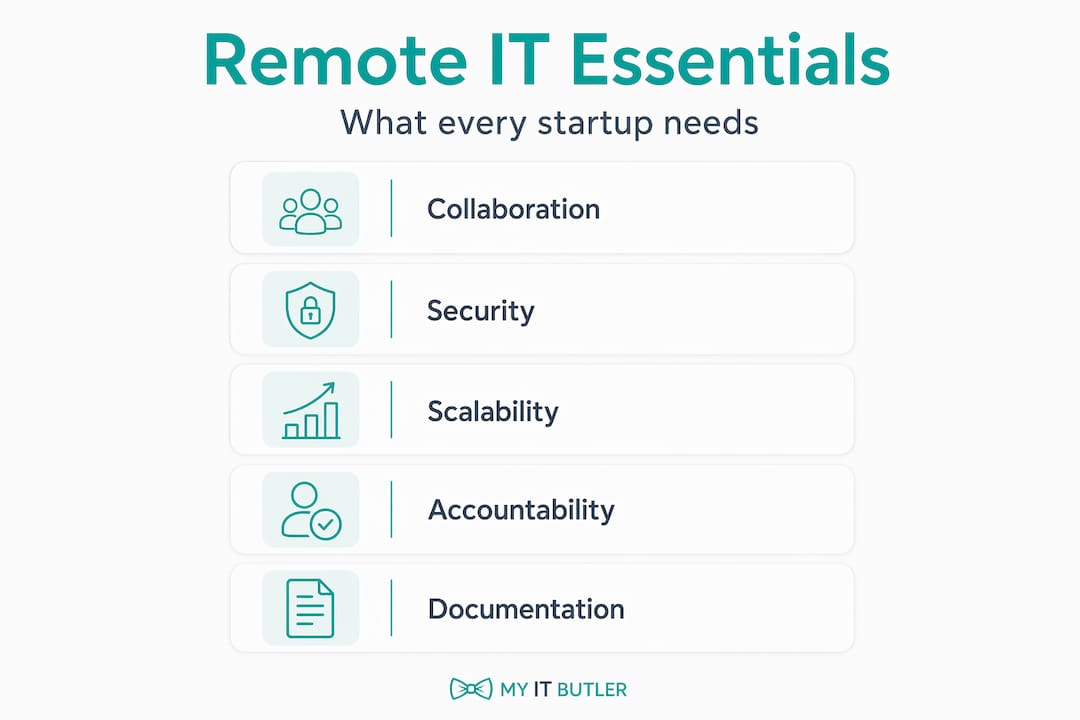
When a startup is fully distributed, IT is the connective tissue holding everything together. Without it, you do not have a remote team. You have a group of individuals working in isolation.
The foundational IT functions for a remote startup fall into three categories.
Infrastructure and connectivity covers everything a team member needs to do their job from anywhere. This includes:
- Cloud-based services such as Google Workspace or Microsoft 365 for files, email, and calendars
- VPN access to protect data travelling over public networks
- Remote device management so IT can push updates or wipe a lost laptop without being in the same room
- Reliable backup systems so a hardware failure does not become a business crisis
Collaboration platforms are where the daily work happens. Chat tools like Slack, video conferencing via Zoom or Google Meet, and project management platforms like Jira or Asana create the virtual office your team actually inhabits. Picking these tools thoughtfully matters. A startup that uses five overlapping platforms for communication will lose decisions in the noise. The goal is one clear place for each type of conversation.
Endpoint security is where most early-stage startups fall short. Every laptop, phone, or tablet connected to your systems is a potential entry point for an attacker. Managed endpoint protection, combined with multi-factor authentication on every account, is the minimum standard. You can read more about managing remote IT challenges before they become expensive problems.

Pro Tip: Build your IT systems to support twice your current team size. Migrating platforms mid-growth is disruptive and expensive. Make scalability a selection criterion from the start.
AI tools and developer productivity
The conversation about technology in startup teams changed significantly when AI coding assistants became mainstream. Developers using tools like GitHub Copilot or Cursor are not just working faster. They are working differently. AI-assisted developers produce code 2 to 3 times faster than those working without these tools, which means a four-person engineering team can realistically output what previously required seven or eight people.
That is a genuine competitive advantage for a capital-constrained startup. But there is a catch that most founders miss.
Adding an AI coding assistant to an existing workflow is not enough. AI integration requires redesigning the entire development workflow rather than simply bolting on new tools. Your code review process, your testing protocols, and your deployment checks all need to account for AI-generated output. Why? Because 45% of AI-generated code may introduce vulnerabilities if review processes are not adapted accordingly.
The other variable that determines whether AI adoption succeeds is leadership behaviour. Teams are 4 times more likely to experiment with AI tools when founders and team leads visibly use those tools themselves. If you want your team to adopt AI, you have to model it openly, not just mandate it in a policy document.
Pro Tip: Run a short internal session each fortnight where someone demos how they used an AI tool to solve a real problem that week. This creates a culture of learning and makes adoption feel collaborative rather than top-down.
Startups that invest in digital technologies consistently report 25% higher innovation rates and better employee retention. The IT infrastructure you build now determines how much of that advantage your team can actually access.
Decision frameworks and accountability
Here is where many remote startups quietly unravel. The technology challenges for remote teams are not always technical. Sometimes the problem is that nobody knows who is allowed to make a final call, and every decision turns into a committee meeting that spans three time zones.
Clear ownership domains prevent decision paralysis in distributed teams. The practical solution is assigning each domain, whether that is product, engineering, marketing, or finance, to a specific person who holds final authority within that area. IT enables this through the platforms and documentation structures your team uses daily.
The table below shows how different frameworks compare for remote startup decision-making:
| Framework | Best for | IT tools that support it | Risk |
|---|---|---|---|
| Domain authority | Co-founder teams with clear role splits | Notion, Confluence | Silos if domains overlap |
| Async proposal model | Distributed teams across multiple time zones | Jira, Linear, Loom | Slow in urgent situations |
| Decision log | All remote teams | Notion, Google Docs | Only works if consistently maintained |
| Structured sprint reviews | Engineering-led startups | Jira, GitHub | Less suited to non-technical decisions |
The decision log model deserves special attention because it is the most consistently underused. Decisions recorded within an hour of being made significantly reduce the "I thought we agreed" arguments that damage working relationships over time. Your IT setup should make logging decisions the path of least resistance, not an extra task.
Treating documentation as dynamic and living rather than a one-time record prevents context gaps from building up across your team. A new hire should be able to read your decision logs and understand not just what you decided, but why.
Security and compliance for distributed teams
Security is the area where the importance of IT in startups is most visible when something goes wrong. A distributed team with members in multiple countries, accessing sensitive systems from home networks, is a genuinely complex security environment to manage.
The baseline practices every remote startup should have in place include:
- Multi-factor authentication on every account, without exception
- A password manager rolled out across the entire team
- Encrypted file storage and transmission for all client and financial data
- Clear offboarding procedures so former team members lose access the moment they leave
- Regular security awareness updates, because phishing attacks are the most common entry point
Beyond the technical controls, the role of IT support in remote teams includes educating the team about these risks. A technically sound system can still be compromised by one person clicking a bad link. Your remote network security approach needs to account for human behaviour, not just software configurations.
For startups hiring globally, compliance adds another layer of complexity. When you bring on contractors or employees in multiple countries, you face employment law, tax obligations, and data sovereignty rules that vary significantly by jurisdiction. Many startups use Employer of Record services to manage this, but provider sprawl creates its own risks. GitLab learned this firsthand. GitLab consolidated 30 or more EOR providers into a single global partner to maintain compliance across more than 65 countries. The lesson is that treating EOR decisions as strategic early choices prevents significant complexity down the track.
Practical steps for founders to integrate IT
Knowing the theory is one thing. Building the actual system is another. Here is a straightforward sequence for startup founders who want to establish IT practices that scale:
-
Audit your current setup. Map every tool your team uses, every account with shared login credentials, and every device accessing your systems. Most founders are surprised by what they find.
-
Standardise your collaboration stack. Pick one platform per communication type and retire the rest. Consolidation reduces confusion and improves searchability of past decisions.
-
Implement access controls. Give every team member the minimum level of access they need to do their job. Do not share admin credentials. Use a central identity provider if you can.
-
Document your processes. Create a living handbook that covers how your team communicates, how decisions get made, and what the escalation path is for IT issues. Keep it updated.
-
Build a security baseline. Roll out multi-factor authentication, a password manager, and endpoint protection across every device before your team grows past five people.
-
Partner with a specialist. Many founders try to manage IT themselves until something breaks badly enough to demand attention. Working with a provider like Myitbutler from an early stage means you build the right foundations instead of fixing the wrong ones later.
-
Review quarterly. Your IT needs at ten people look nothing like your IT needs at fifty. Set a calendar reminder to review your stack and your security posture every three months.
The best practices for remote startups are not complicated in principle. What they require is consistency and the discipline to prioritise IT before it becomes urgent.
My perspective on IT and remote startups
I have worked with remote teams across a range of industries, and the pattern I see most often is this: founders treat IT as an infrastructure problem to be solved once and then ignored. That thinking creates real pain later.
In my experience, the teams that perform best are the ones where IT is treated as an ongoing discipline, not a setup task. The CTO or IT lead is not just keeping the lights on. They are shaping how the team thinks about information, ownership, and accountability. That is a strategic role, and it matters enormously.
The hidden cost that I rarely see discussed is the cost of poor async documentation. I have watched co-founder relationships deteriorate not because of a business disagreement, but because nobody could agree on what was actually decided six weeks ago. A fifteen-minute investment in writing down a decision properly would have avoided months of conflict.
I am also cautious about how founders approach AI adoption. The temptation is to move fast and layer in every new tool that looks promising. What I have seen work better is picking two or three tools deliberately, redesigning the workflow around them properly, and then measuring what actually changed. Speed without intention creates technical debt and security risk.
My honest advice: treat your IT setup the same way you treat your financial controls. You would not run your business without an accountant reviewing your books. Do not run your remote team without someone accountable for the health of your IT environment.
— Thomas
How Myitbutler supports remote startup teams
Running a distributed startup is demanding enough without IT problems slowing you down. Myitbutler provides specialised remote IT support built specifically for startups and distributed teams operating across time zones and borders. With more than 15 years of enterprise-grade experience, and credentials including CCNA and CompTIA Security+, the team delivers proactive management, vendor coordination, and on-demand troubleshooting with transparent fixed pricing and no lock-in contracts.
Whether you need to establish a secure baseline for a growing team, get a second opinion on your current IT setup, or hand off day-to-day IT management so you can focus on building your product, Myitbutler can help. You can book a consultation or access ongoing support through the client portal whenever it suits you.
FAQ
What is the role of IT in remote startup teams?
IT in remote startups covers infrastructure, security, collaboration tools, and process documentation. It is the foundation that allows distributed team members to work together as if they were in the same building.
Which collaboration tools work best for remote startups?
Slack or Microsoft Teams for chat, Zoom or Google Meet for video, and Notion or Jira for documentation and project tracking cover the core needs of most early-stage remote startups.
How should remote startups approach cybersecurity?
Start with multi-factor authentication, a password manager, and encrypted storage on day one. Every device accessing your systems needs endpoint protection, and access controls should be reviewed every time someone joins or leaves the team.
Does AI adoption actually improve remote team productivity?
Yes, when implemented properly. Developers using AI coding assistants produce code significantly faster, but the workflow around those tools needs to be redesigned to avoid introducing security vulnerabilities.
When should a startup bring in external IT support?
Before you need it urgently. Founders who engage a specialist like Myitbutler early build better foundations and avoid the expensive fixes that come from reactive IT management.