
TL;DR:
- Most startups underestimate the importance of early IT support, risking costly outages and knowledge loss. Proactive support enhances stability, security, and scalability by establishing documentation and monitoring from day one. Implementing structured IT practices early ensures smoother growth, reduces risks, and supports efficient scaling across time zones.
Most startup founders assume IT support is something you deal with once you have a proper team, a real office, or a product that's actually live. That assumption is one of the most expensive mistakes a new business can make. Understanding why startups need IT support early means recognising that the decisions you avoid in month one become the crises you manage in month twelve. This guide covers what early technical support actually buys you, from operational stability and risk reduction to documentation practices that protect institutional knowledge and scale with your team.
Table of Contents
- Key takeaways
- Why startups need IT support early
- Risk reduction through IT documentation
- Scaling IT support as you grow
- AI tools and your IT infrastructure
- Practical steps for founders to get started
- My perspective: the cost of waiting
- Start your startup off right with Myitbutler
- FAQ
Key takeaways
| Point | Details |
|---|---|
| Downtime costs more than you think | Even brief outages can stall a small team for hours, making proactive monitoring worth far more than break-fix fixes. |
| Documentation is risk management | Building runbooks and onboarding guides early reduces your "bus factor" and cuts new-hire onboarding from months to weeks. |
| Scalability requires early planning | Designing IT workflows for global time zones from the start prevents costly reactive hiring and customer churn later. |
| AI tools need IT input to work | Embedding AI into your CRM or support queue delivers gains only when your underlying IT infrastructure is set up correctly. |
| Remote support is a viable model | Remote managed IT services give startups enterprise-grade coverage without the cost of a full-time in-house hire. |
Why startups need IT support early
The managed IT services industry uses the term "proactive IT support" to describe what most founders only discover they needed after something breaks. Reactive IT, the break-fix model, is what happens when there is no plan. You wait for the laptop to die, the server to go down, or the email account to get compromised, then you scramble. Proactive support flips that sequence.
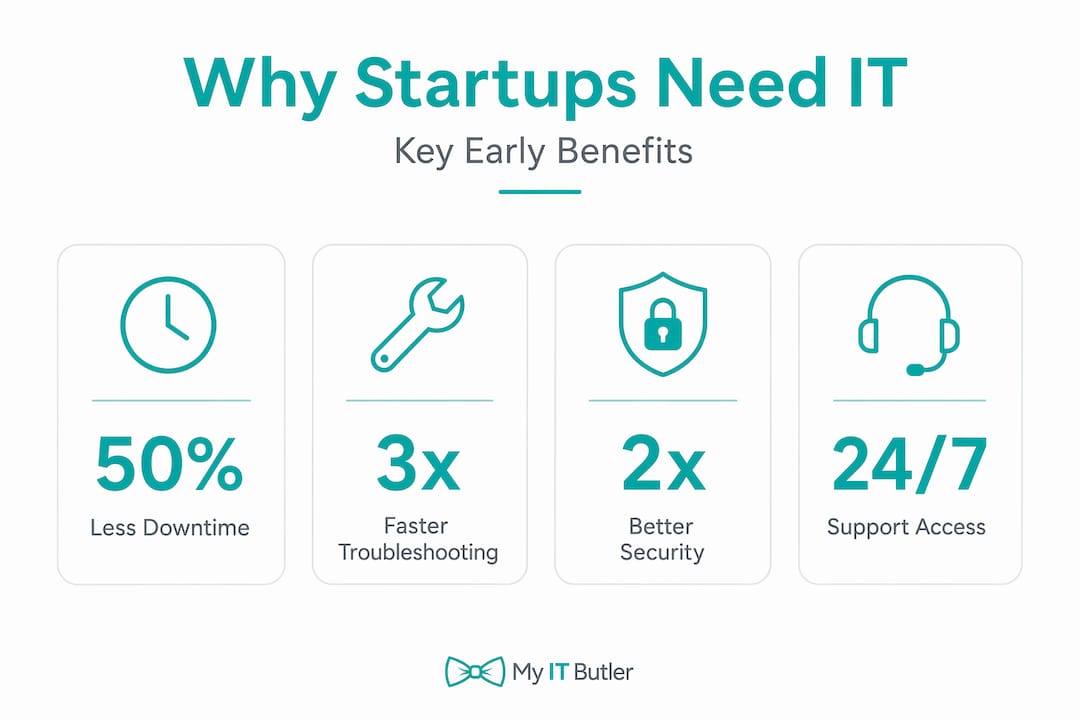
Reliable IT support reduces downtime through fast troubleshooting and regular maintenance, keeping systems stable and teams efficient. For a startup where two developers going offline for a day can halt an entire sprint, that stability is worth real money.
The importance of IT support for startups also extends to security. Small teams often store sensitive client data, financial records, and intellectual property on shared drives or personal devices with no formal controls. A single misconfigured cloud storage bucket has cost early-stage companies their client relationships and, in regulated industries, their operating licences.
Pro Tip: Set up basic monitoring and alerting from day one. Free tiers on tools like UptimeRobot or Datadog can flag infrastructure issues before your team even notices them.
Early tech support for new businesses is not about having a full IT department on payroll. It is about having someone who understands your systems, maintains them deliberately, and responds quickly when things go sideways. That distinction matters enormously to a five-person team trying to close its first enterprise deal.

Risk reduction through IT documentation
There is a concept in software teams called the "bus factor." It asks a brutal question: how many people would need to be hit by a bus before your product or business becomes unrecoverable? Many startups have a bus factor of one, meaning a single person carries critical knowledge about how systems are configured, why certain decisions were made, or how to recover from a failure.
Documentation is the fix. When knowledge lives in a runbook rather than one engineer's head, your bus factor increases immediately. The practical impact is significant. Structured documentation can reduce onboarding time from three months to two or three weeks, freeing senior staff from repetitive hand-holding and letting new hires contribute faster.
The types of documentation that matter most in early startup IT support include:
- Runbooks: Step-by-step procedures for common and uncommon operational tasks, like restarting a service or responding to a security alert.
- Architecture decision records (ADRs): Short documents that explain why a technical decision was made, not just what the decision was.
- Onboarding guides: Clear instructions for setting up a new team member's access, devices, and tools.
- Incident logs: Records of past outages or issues and how they were resolved.
The trap many founders fall into is believing they are moving too fast for documentation. That belief creates architectural drift, where systems evolve without anyone fully understanding the full picture. Chaos accumulates quietly. Then, when growth accelerates or a key person leaves, the chaos becomes visible and expensive.
Documentation should not sit in a separate "someday" folder. It must be integrated into development processes and linked to code changes as they happen. Why startups need IT documentation early comes down to this: the cost of writing it now is a fraction of the cost of reconstructing it later.
Pro Tip: Tie documentation updates to pull requests. If code changes without a doc update, the pull request does not merge. This one workflow rule keeps documentation alive rather than stale.
Scaling IT support as you grow
The decisions you make about IT structure in your first year follow you into your third. Founders who delay thinking about IT support models often find themselves with a patchwork of tools, no clear ownership, and support coverage that works during Sydney business hours but fails entirely for a client in London at 9 PM.
A real-world example makes this tangible. A remote IT support pod deploying 24/7 coverage reduced first-response time from 4.2 hours to 45 minutes, with customer satisfaction scores rising by 18 points and measurable reductions in churn-related revenue loss. That result did not come from hiring faster. It came from planning support coverage deliberately from the start.
Here is what scaling looks like with and without early IT planning:
| Scenario | Without early IT planning | With early IT planning |
|---|---|---|
| New hire onboarding | Ad-hoc, 6 to 12 weeks | Documented, 2 to 3 weeks |
| International expansion | Coverage gaps, customer complaints | Time zone coverage mapped in advance |
| Security incident | Reactive scramble, unclear ownership | Runbook-driven response, defined roles |
| Staff departure | Knowledge loss, project delays | Documented systems, continuity maintained |
Delaying IT support planning limits your ability to design workflows for global time zones, leading to staff burnout and customer churn that is avoidable. This is particularly relevant for Australian startups with clients or team members across Asia, Europe, or the Americas.
"Early IT support is not just a cost. It is a strategic investment that prevents expensive reactive firefighting and enables scaling."
The role of IT in remote startup teams is often underestimated until the team spans three continents and no one can agree on whose job it is to fix a broken VPN at 2 AM.
AI tools and your IT infrastructure
Artificial intelligence is genuinely useful for startups right now. Not in a hype-cycle way, but in practical, repeatable ways that save real hours. The catch is that AI tools embedded in your workflows only deliver their potential when the underlying IT setup is solid.
AI reduces manual work and enhances decision-making speed by automating CRM updates, flagging urgent support tickets, and summarising operational data. But those automations break when your CRM has duplicate records, your ticketing system lacks proper categorisation, or your data storage is inconsistent. IT support is what keeps the foundation clean enough for AI to do its job.
Practical examples of AI-assisted startup operations include:
- Automated ticket triage that reads incoming support requests and assigns urgency and category without human intervention.
- CRM enrichment that fills in missing company data from public sources when a new lead is created.
- Operational dashboards that summarise overnight activity across multiple markets, ready for the morning standup.
- Alert systems that use pattern recognition to flag anomalies in server performance before they cause outages.
None of these require a sophisticated data science team. They do require clean systems, reliable integrations, and someone who understands how the pieces connect. That is exactly what good IT support provides.
Pro Tip: Before adopting any AI tool, audit the data it will rely on. Garbage in means garbage out, and a messy CRM will produce AI recommendations that actively mislead your team.
Practical steps for founders to get started
Getting early tech support in place does not have to be complicated. The goal at the start is not perfection. It is structure. Here is a straightforward sequence for founders who are ready to take this seriously:
- Assess your current state. List every system your team uses: email, file storage, project management, customer tools, payment systems. Identify who manages each one and what happens if it breaks.
- Choose a support model. Decide between remote IT support, in-house hire, or a hybrid. Remote managed services are typically the most cost-effective starting point for teams under 20 people.
- Start a documentation habit. Create a shared folder today. Add your first runbook this week. It does not need to be polished. It needs to exist.
- Set up monitoring. At minimum, monitor your website uptime, email deliverability, and any cloud services your product depends on.
- Plan for security from the start. Enable multi-factor authentication on every account. Define who has admin access and why.
- Book a consultation. If you are unsure where to start, an expert review of your current setup costs far less than a reactive incident response after something goes wrong.
Pro Tip: When evaluating IT support providers, ask specifically about their documentation practices and onboarding processes. A provider who cannot explain their own documentation culture will not help you build yours.
My perspective: the cost of waiting
I have worked with enough early-stage businesses to say this clearly: the founders who treat IT support as optional are almost always the ones who call in a panic six months later. Not because they were careless people. Because they were busy, optimistic, and certain that problems would announce themselves before becoming critical.
What I have seen repeatedly is that IT problems do not announce themselves. They accumulate. A shared admin password here, an undocumented deployment process there, a single developer who is the only one who knows how the authentication service works. None of these feel urgent until someone leaves, a system fails, or an investor asks for a security audit and you realise you cannot produce one.
The founders I respect most made a different calculation early. They decided that spending a modest amount on IT support and documentation in months one through six was cheaper than the alternative. They were right. The businesses that scale well almost always have cleaner IT foundations than you would expect. That is not a coincidence.
My recommendation: do not wait until you feel big enough for IT support. You need it precisely because you are still small. The habits you build now are the infrastructure your future team inherits.
— Thomas
Start your startup off right with Myitbutler
If you have been putting off IT support because it felt like something for "later," this is your later. Myitbutler provides remote IT support for startups backed by over 15 years of enterprise experience and Australian-standard service delivery, accessible to teams anywhere in the world. Whether you need help auditing your current setup, establishing documentation practices, or designing support coverage across time zones, the team at Myitbutler has done it before.
No long-term contracts. Transparent fixed pricing. Support delivered via WhatsApp, email, or direct message, however your team prefers to work. If you are a founder who wants to get this right from the start, book a consultation and walk away with a clear picture of what your startup actually needs right now.
FAQ
Does my startup need IT support from day one?
Yes. The earlier you establish IT support, the cheaper it is to build good habits around security, documentation, and system monitoring. Waiting until problems arise means paying far more to fix preventable issues.
What is the bus factor and why does it matter for startups?
The bus factor measures how many people must leave before your business cannot function. Many startups have a bus factor of one, which structured IT documentation can directly reduce.
How does early IT support help with scaling internationally?
Planning IT support coverage early lets you design workflows for multiple time zones from the start. Proactive coverage design reduces customer dissatisfaction and staff burnout as your team grows globally.
Is remote IT support good enough for a growing startup?
Absolutely. Remote IT support gives startups access to enterprise-grade expertise without the overhead of a full-time hire. It scales with demand and typically includes proactive monitoring alongside on-demand troubleshooting.
Why do startups need IT documentation early?
Documentation captures institutional knowledge before it walks out the door with a departing team member. It reduces onboarding time significantly and gives your growing team a reliable source of truth for how your systems actually work.