
TL;DR:
- Startups should focus on buying purpose-driven technology at the right time and outsourcing the rest to experts.
- Implementing lean IT involves using modular, cloud-native infrastructure, automating tasks, and minimizing the tech stack to core functions.
Most startups waste money on IT before they even realise it. The fix is not buying less technology. It is buying the right technology, at the right time, and offloading everything else to people who already know what they are doing.
Lean IT operations means running your technology on the smallest, most purposeful set of tools and processes that keeps your business moving. For startups, that translates to a few concrete practices:
- Modular, cloud-native infrastructure so you pay only for what you use and can swap components without rebuilding everything
- Automation of repetitive tasks like onboarding, billing, and support triage, freeing founders for higher-value work
- A minimal, layered tech stack built around six functions: identity and security, communication, project management, CRM, analytics, and workflow automation
- Outsourcing IT management to a managed service provider (MSP) so your team focuses on the product, not the servers
- Lightweight observability to catch problems before customers do, without drowning in vanity metrics
Done well, lean IT keeps costs variable, lets you pivot quickly, and keeps you aligned with Australian compliance standards from day one. Myitbutler, backed by 15-plus years of enterprise IT experience and certifications including CCNA, CompTIA Security+, and PRINCE2, helps Australian startups build and manage exactly this kind of setup.
Table of Contents
- Practical examples of lean IT operations for startups
- Key takeaways
- Myitbutler: fixed-price IT support built for lean startups
- FAQ
Practical examples of lean IT operations for startups
1. Build on modular, cloud-native infrastructure
Lean architecture for startups prioritises modularity and cloud-native managed services over building your own servers. Serverless functions and pay-as-you-go compute mean your costs scale with actual usage, not with what you feared might happen at peak. When one component needs updating, you change it without touching the rest of the system.
The practical upside for a seed-stage team: you can set up IT infrastructure in days, not months, and pivot the architecture when your product direction changes.
2. Use Infrastructure as Code to automate deployments
Infrastructure as Code (IaC) treats your server environments as version-controlled code. Every environment, from development through to production, is provisioned the same way every time. One Series A SaaS startup that adopted IaC as part of a broader lean overhaul cut its AWS monthly spend from $13,000 to under $1,500 and reduced new customer onboarding from days to minutes.

IaC removes the fragility of manual configuration and gives small teams the consistency that enterprise IT departments pay large teams to maintain.
3. Automate onboarding before it becomes a bottleneck
One early-stage SaaS founder cut per-customer onboarding from two hours of their own time to a fifteen-minute welcome call by building a four-step self-service flow. Account provisioning, default settings, and credential delivery all happened automatically. The founder kept the relationship touchpoint and dropped the administrative load entirely.
That single change was what made scaling from three customers to fifty operationally survivable.
4. Triage support with a simple ticket system
Before a ticket system, every incoming message carries the same implicit urgency. A three-category triage model, urgent (production down), standard (questions and configuration), and feature requests reviewed weekly, gives founders permission to stop context-switching on every notification. Support becomes predictable and plannable rather than a constant interruption.
Pro Tip: Keep your support categories to three at most in the early stages. The goal is to make urgency explicit, not to build a sophisticated helpdesk before you have fifty customers.
5. Automate billing from day one
Recurring billing through a payment integration, one plan, one price, eliminates an entire class of manual work. Invoices generate automatically, payments collect automatically, and failures surface as urgent support tickets rather than silent revenue leaks. The monthly block of founder time spent chasing late payments simply disappears.
Deliberate simplicity here pays off. Building proration and enterprise billing terms before you have customers who need them is building for an imagined future.
6. Build a minimal, layered tech stack
Lean startup tech stacks add complexity only when there is a concrete, painful problem a tool would solve. The six layers worth covering early are identity and security (Google Workspace, 1Password), communication (Slack, Google Meet), project management (Linear or Notion), CRM (HubSpot free tier), analytics (PostHog or Mixpanel), and workflow automation (Zapier or Make). Every tool beyond these six layers needs to justify its subscription cost with a specific job it does that nothing else already covers.
For vendor selection guidance that fits lean principles, the question is always: what exact problem does this solve today?
7. Separate command from technical work during incidents
When something breaks, having one person coordinate and another investigate prevents the chaos of everyone trying to fix the same thing simultaneously. Clear incident roles and a shared record kept outside the system being repaired create the audit trail that Australian compliance standards require. Small teams can compress these roles, but the separation of responsibilities still matters.
8. Partner with a managed IT service provider
MSP partnerships reduce internal infrastructure resource needs significantly, shifting operational responsibility to specialists so your development team focuses on the product. One eco-friendly startup found that after adopting an MSP, its entire team "felt much lighter" once a delegation structure was in place.
For Australian startups, working with a provider who understands local compliance requirements and operates under Australian standards removes a layer of risk that in-house IT management often cannot cover adequately at the early stage.
9. Monitor outcomes, not machines
Lightweight observability means tracking the metrics that reflect customer impact: does the critical path complete? Are support ticket volumes trending up? Are key features being adopted? Tracking endless server logs without tying them to customer outcomes is a form of waste. Lean monitoring keeps the feedback loop tight and scaling decisions data-driven rather than gut-driven.
A simple customer health dashboard with three metrics per customer, login frequency, feature adoption, and support volume, is enough to catch churn risk before it becomes churn.
10. Automate workflows across your stack
A disconnected set of tools is expensive chaos. Workflow automation tools like Zapier and Make connect your stack so that a new signup triggers a CRM entry, an onboarding email sequence, and a team notification without anyone touching it manually. The automation layer is what turns a collection of subscriptions into an actual operating system for your business.
Key takeaways
Lean IT operations for startups means choosing purposeful tools, automating repetitive tasks, and outsourcing infrastructure management so founders can focus on growth.
| Point | Details |
|---|---|
| Modular infrastructure first | Cloud-native, pay-as-you-go architecture keeps costs variable and lets you pivot without rebuilding. |
| Automate the founder out of routine tasks | Self-service onboarding and automated billing recover the most founder time per engineering hour invested. |
| Keep the tech stack to six layers | Add a tool only when a concrete, painful problem justifies it. Subscription bloat is a form of IT waste. |
| MSP partnerships free your development team | MSP partnerships can reduce infrastructure resource needs by up to 70%, per published case studies. |
| Myitbutler for Australian startups | Myitbutler provides fixed-price, no-contract managed IT support aligned with Australian standards, backed by CCNA, CompTIA Security+, and PRINCE2 certifications. |
Myitbutler: fixed-price IT support built for lean startups
Running lean IT without an in-house IT team is entirely achievable. The gap most startups hit is not the tools. It is the expertise to configure, secure, and manage those tools correctly from the start.
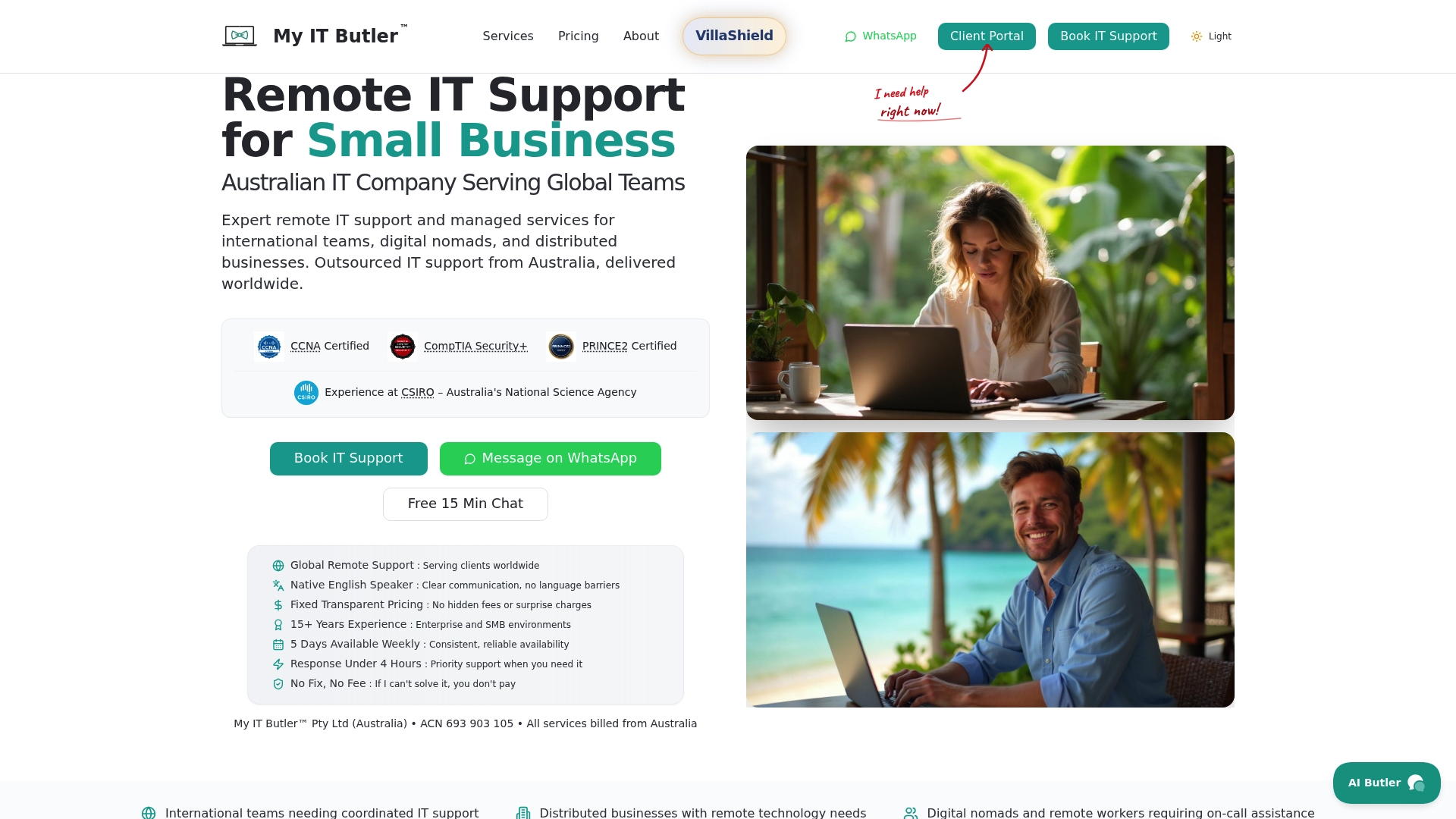
Myitbutler gives Australian startups and remote teams access to 15-plus years of enterprise IT experience at a fixed monthly price, with no long-term contracts. Thomas and the Myitbutler team hold CCNA, CompTIA Security+, and PRINCE2 certifications, and every engagement is built around Australian compliance standards. Support runs via WhatsApp, email, and direct messaging across time zones, so your team gets answers when they need them, not during Sydney business hours only.
Whether you need remote IT support for a distributed team or a managed IT partner to handle vendor liaison, security, and strategic planning while you focus on the product, Myitbutler fits the lean model precisely. No bloated retainer. No surprise invoices. Book a free consultation at myitbutler.com/book/freechat to talk through what your startup actually needs.
FAQ
What are the core examples of lean IT operations for startups?
The most common examples are modular cloud infrastructure, automated onboarding and billing, a minimal six-layer tech stack, managed IT service partnerships, and lightweight monitoring focused on customer outcomes rather than server metrics.
How does outsourcing to an MSP support lean IT?
MSP partnerships can reduce infrastructure resource needs by up to 70%, freeing your development team to focus on the product rather than managing servers and security configurations.
When should a startup automate its onboarding process?
Automate onboarding as soon as you have more than two or three paying customers. One founder reduced per-customer onboarding from two hours to a fifteen-minute welcome call by building a four-step self-service flow, which was the structural change that made scaling to fifty customers viable.
How does Myitbutler support lean IT for Australian startups?
Myitbutler provides fixed-price, no-contract remote IT support and managed services aligned with Australian standards, with certifications including CCNA, CompTIA Security+, and PRINCE2, making it a practical fit for startups that want expert IT management without the overhead of an in-house team.
What is the biggest pitfall in lean IT implementation?
Premature optimisation and tool bloat. Adding complexity before you have a concrete problem it solves wastes engineering time and subscription budget, and creates the kind of tangled infrastructure that slows a startup down rather than supporting it.