
TL;DR:
- Early-stage startups should focus on simple, managed cloud services for hosting, databases, and security controls to avoid costly rework.
- Implementing basic security measures like multi-factor authentication, secrets management, and automated backups from day one is essential.
Setting up IT infrastructure for an early-stage startup means choosing tools and systems that support your product today without locking you into expensive complexity tomorrow. The industry term for this discipline is IT infrastructure management, and for founders, it covers everything from cloud hosting and databases to security controls and deployment pipelines. Get it right early and your team ships faster, spends less, and avoids the painful rework that wrong tech stack choices in the first 6–18 months can cause. Get it wrong and you face re-platforming costs that can reach $500,000 before Series A.
What are the essential components of IT infrastructure for early-stage startups?
The foundational IT infrastructure for startups is simpler than most founders expect. At the pre-seed stage, with a team of fewer than ten people and under 10,000 users, you need four things: a place to host your app, a database, a way to send email, and basic security controls. That is it.

Managed cloud platforms like Vercel, Supabase, and Render handle hosting, databases, and deployment in one place. They get you to production in under a day, and the combined cost sits between $0 and $500 per month at the early stage. That figure matters because it means you can validate your product before spending serious money on infrastructure.
| Component | Recommended option | Typical monthly cost |
|---|---|---|
| App hosting | Vercel, Render | $0–$50 |
| Database | Supabase, PlanetScale | $0–$25 |
| Email delivery | Postmark, Resend | $0–$30 |
| Secret management | Doppler, Infisical | $0–$15 |
| Automated backups | Platform-native or Backblaze | $0–$20 |
Security belongs in this list from day one, not as an afterthought. Multi-factor authentication (MFA) on every account, a dedicated secrets manager instead of hardcoded API keys, and automated daily backups are non-negotiable. These security controls take less than a day to set up and prevent the kind of data breach that kills early-stage companies before they get traction.
Pro Tip: Never store API keys or database passwords in your code repository. Use a secrets manager like Doppler or Infisical from your very first commit. Fixing this habit later costs far more than setting it up correctly now.
One thing to avoid at this stage: Kubernetes, microservices, and multi-region deployments. These tools solve problems you do not have yet. Adopting them prematurely adds operational overhead without adding business value.
How to plan your IT infrastructure growth as your startup scales
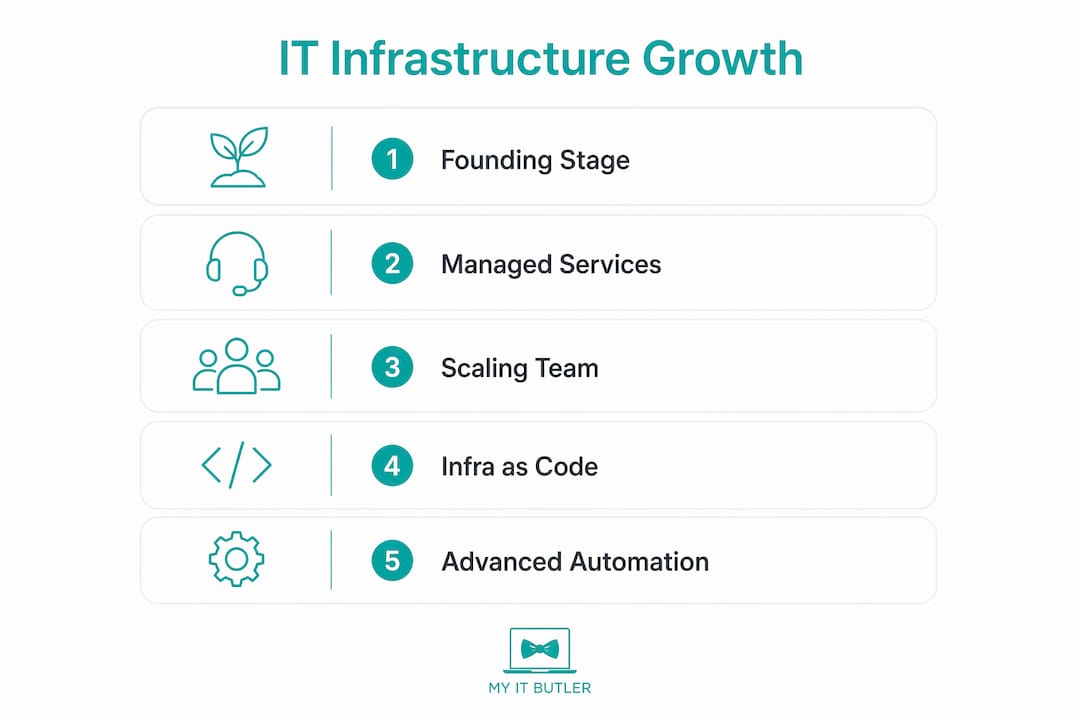
Early-stage startup tech setup follows a clear two-phase pattern. Phase 1 covers the period from founding to roughly ten engineers. Phase 2 begins when manual processes become the bottleneck.
Phase 1: managed services (0–10 engineers)
Managed Platform-as-a-Service (PaaS) tools handle the heavy lifting so your team focuses on the product. Vercel deploys your frontend automatically on every code push. Supabase gives you a PostgreSQL database with a built-in API. Render runs your backend without you managing a server. This stack costs $0–$500 per month and requires no dedicated infrastructure engineer.
Phase 2: Infrastructure as Code and CI/CD (10+ engineers)
Manual setups become bottlenecks beyond ten engineers. At that point, environment inconsistencies, slow deployments, and onboarding delays start costing you real money. The solution is Infrastructure as Code (IaC), which means writing your server configuration in files you can version-control, review, and repeat exactly. Tools like Terraform and Pulumi handle this. Paired with a CI/CD pipeline (Continuous Integration and Continuous Deployment, meaning code is tested and deployed automatically), your team ships faster with fewer errors.
The table below maps maturity stages to typical tech choices and monthly costs.
| Stage | Team size | Typical stack | Monthly cloud cost |
|---|---|---|---|
| Pre-seed | 1–5 engineers | Vercel, Supabase, Render | $0–$300 |
| Seed | 5–10 engineers | PaaS + basic CI/CD | $300–$800 |
| Early growth | 10–20 engineers | IaC, Terraform, GitHub Actions | $800–$1,400 |
| Scaling | 20+ engineers | AWS or GCP with container orchestration | $1,400+ |
The trigger for moving between stages is not a calendar date. It is a signal: deployments are slow, new engineers take weeks to get productive, or your cloud bill is growing faster than your user base. When you see those signs, it is time to invest in CI/CD pipeline upgrades and infrastructure automation.
Pro Tip: Treat your infrastructure configuration files the same way you treat your application code. Put them in version control, require code reviews, and document every change. This single habit prevents most of the environment drift problems that plague growing teams.
The transition from PaaS to AWS or Kubernetes should happen at a clearly defined cost or scale threshold, not because a competitor uses AWS or because it sounds more serious. Prestige is not a valid infrastructure requirement.
What are the critical security practices to implement from day one?
Security is the area where early-stage founders most often cut corners, and it is the area where the consequences are most severe. The good news is that the baseline controls are cheap and fast to implement.
The non-negotiable security foundations for any startup are:
- Multi-factor authentication (MFA): Enforce MFA on every account your team uses, including cloud consoles, code repositories, and email. MFA is the single most effective control against account takeover.
- Centralised secrets management: Store all API keys, database credentials, and tokens in a dedicated secrets manager. Never commit them to a code repository, even a private one.
- Automated backups with point-in-time recovery: Configure your database to back up automatically and verify that you can restore from those backups. A backup you have never tested is not a backup.
- Least-privilege access: Give each team member and each service only the permissions they actually need. Broad admin access is a liability.
- Dependency scanning: Use a tool like Dependabot or Snyk to flag known vulnerabilities in your third-party libraries automatically.
Security for early-stage startups is not about building a fortress. It is about removing the easy wins for attackers. MFA, secrets management, and automated backups together close the majority of common attack vectors before they become incidents.
Myitbutler holds certifications including CompTIA Security+ and CCNA, and applies Australian-standard security practices to remote IT support for startups globally. For founders who want expert oversight without hiring a full-time security engineer, remote IT support from a certified partner is a practical alternative.
Pro Tip: Run a free security audit on your cloud account using your provider's native tool, such as AWS Trusted Advisor or Google Cloud Security Command Centre. These tools surface misconfigured permissions and open storage buckets in minutes.
For a deeper look at affordable security tools suited to new businesses, the cybersecurity guide for new businesses covers practical options at every budget level.
What common IT infrastructure mistakes do early-stage startups make?
The most expensive infrastructure mistakes are not technical failures. They are decisions made too early, based on what looks impressive rather than what solves the actual problem.
The best DevOps decision is usually the boring one that lets you ship faster. Infrastructure should be a tool, not a trophy.
The most common pitfalls are:
- Adopting Kubernetes or microservices before product-market fit. Founders often choose complex, trendy technologies without validated demand. Kubernetes is an operations platform designed for teams managing hundreds of services. A five-person startup running one app does not need it.
- Skipping Infrastructure as Code. Manual server setup means every environment is slightly different. When something breaks in production but not in development, the cause is almost always environment drift. IaC eliminates this by making every environment identical by definition.
- Ignoring documentation. Without documented processes for deployment, secrets, and disaster recovery, your infrastructure knowledge lives only in the heads of the people who built it. When those people leave, new engineers waste weeks deciphering private systems instead of building features. This is called the "tribal knowledge" problem, and it is a growth killer.
- Treating infrastructure as a one-time purchase. Wrong tech stack choices in the first 6–18 months can cost up to $500,000 in wasted engineering if re-platforming is needed before Series A. Infrastructure requires ongoing review, not a set-and-forget mindset.
- Building custom tooling too early. Custom dashboards, bespoke deployment scripts, and home-grown monitoring tools all require maintenance. Use off-the-shelf tools until the off-the-shelf option genuinely cannot meet your needs.
The role of IT in remote startup teams adds another layer of complexity. Distributed teams need consistent access controls, shared documentation, and reliable communication tools from the start. These are infrastructure decisions, not HR ones.
Keeping your infrastructure boring and repeatable is not a sign of low ambition. It is a sign of engineering maturity. Simple, visible infrastructure that the next engineer can understand quickly is far more valuable than a sophisticated system only one person can operate.
Key takeaways
Building IT systems for startups works best when simplicity and security are treated as foundations, not features to add later.
| Point | Details |
|---|---|
| Start with managed PaaS | Use Vercel, Supabase, and Render to reach production quickly for $0–$500 per month. |
| Secure from day one | Enforce MFA, use a secrets manager, and configure automated backups before your first user arrives. |
| Phase your infrastructure growth | Move to IaC and CI/CD when your team reaches ten engineers, not before. |
| Avoid premature complexity | Skip Kubernetes and microservices until you have a clear, validated reason to adopt them. |
| Document everything | Written deployment and recovery processes prevent tribal knowledge loss and speed up onboarding. |
What I have learned from watching startups get infrastructure wrong
The pattern I see most often is founders who treat their tech stack as a signal of seriousness. They adopt Kubernetes because a well-funded competitor uses it, or they build a custom CI/CD pipeline because it feels more "production-grade." Then, six months later, they are paying two engineers to maintain infrastructure instead of building the product.
The startups that scale well do the opposite. They pick the most boring tool that solves the problem, document it thoroughly, and only upgrade when the pain of staying is greater than the cost of moving. That is not a lack of ambition. That is good engineering judgement.
Security is the one area where I push founders to invest early, even when money is tight. A data breach at the pre-seed stage does not just cost money. It costs the trust of your earliest users, and that is nearly impossible to recover. Setting up MFA and a secrets manager takes an afternoon. Rebuilding user trust after a breach takes years.
The other thing I would tell every founder: get external IT support earlier than you think you need it. Not because you cannot figure it out yourself, but because the time you spend debugging infrastructure is time you are not spending on customers. A trusted partner like Myitbutler, with certifications in CompTIA Security+, CCNA, and PRINCE2, gives you enterprise-grade oversight without the enterprise headcount. The IT strategy guide for startups is a good place to start thinking about this more formally.
Infrastructure is a strategic asset. Treat it like one from the first day, and it will support your growth instead of slowing it down.
— Thomas
How Myitbutler supports early-stage startups with IT
Founders who want expert IT oversight without hiring a full-time IT engineer have a practical option in Myitbutler. Operated by an Australian company with over 15 years of enterprise experience, Myitbutler delivers remote IT support for startups globally, covering everything from initial infrastructure planning and security setup to ongoing vendor management and strategic IT coordination.

Services are available on a fixed-price, no-contract basis, which suits the unpredictable budgets of early-stage teams. Myitbutler holds certifications in CCNA, CompTIA Security+, and PRINCE2, and applies Australian-standard practices to clients across multiple time zones. Founders can book a free consultation to discuss their specific infrastructure needs and get a clear picture of what expert support looks like at their stage.
FAQ
What does IT infrastructure mean for a startup?
IT infrastructure for a startup covers the cloud hosting, databases, security controls, and deployment tools your team uses to build and run your product. At the early stage, this is typically a small set of managed services rather than custom-built systems.
When should a startup move from PaaS to AWS or Kubernetes?
The move from managed PaaS platforms to AWS or Kubernetes should happen when your team reaches 10+ engineers or when your cloud costs clearly justify the switch. Adopting these tools before that point adds complexity without a matching business benefit.
How much does startup IT infrastructure cost per month?
Pre-seed infrastructure costs typically run $0–$500 per month using managed PaaS platforms. Costs rise to $300–$1,400 per month as teams grow and CI/CD and IaC tools are added.
What is the most important security step for a new startup?
Enforcing multi-factor authentication on all accounts is the single most effective security control for early-stage startups. Paired with a secrets manager and automated backups, these three controls close the majority of common attack vectors.
What is Infrastructure as Code and why does it matter?
Infrastructure as Code (IaC) means writing your server and environment configuration in files that can be version-controlled and repeated exactly. It eliminates environment drift, speeds up onboarding, and makes deployments consistent across every stage of your product.