
TL;DR:
- No-contract IT support offers startups flexible, on-demand technical help without long-term commitments. It reduces costs, improves response times, and enhances cybersecurity through continuous monitoring and expertise. This model scales easily and provides institutional knowledge, making it ideal for startups with fewer than 75 employees.
No-contract IT support is defined as on-demand technical assistance delivered without a fixed-term agreement, giving startups the freedom to scale, pause, or change their IT coverage at any time. The industry term for this model is "flexible managed services," and it sits between the traditional break/fix model and a full managed service provider (MSP) contract. For startup founders weighing up the benefits of no-contract IT support, the core advantage is clear: you get enterprise-grade expertise without locking your budget into a multi-year deal. Providers like Myitbutler deliver this model with transparent fixed pricing, CompTIA Security+ and CCNA-certified engineers, and no hidden fees.

1. What are the primary benefits of no-contract IT support for startups?
No-contract IT support removes the single biggest barrier most startups face when seeking professional tech help: the long-term financial commitment. A full-time IT hire costs upwards of $90,000 per year, while outsourced support runs $100–$200 per user per month. That gap represents 50–70% in cost savings, which is capital a startup can redirect into product development or hiring.
The advantages of flexible IT support go well beyond the price tag. Founders gain access to a team with skills across cybersecurity, cloud infrastructure, compliance readiness, and helpdesk support. A single in-house hire rarely covers all of those disciplines.
Key benefits include:
- Cost control: Pay only for what you use, with no redundancy costs or recruitment fees.
- Immediate capability: No-contract providers can be operational within hours, not weeks.
- Broad expertise: Access specialists in endpoint protection, SOC 2 compliance, and cloud management without hiring multiple staff.
- Reduced financial risk: Exit or adjust your arrangement without penalty clauses or notice periods.
- Focus on core business: Your team stops managing IT vendors and starts building your product.
Pro Tip: Ask any prospective IT provider to show you a sample invoice before you sign anything. Transparent billing is the clearest signal that a provider operates without hidden fees.
Startups under 50–75 employees benefit most from outsourcing IT support, because the cost of building an internal team at that size outweighs the value it delivers. That threshold is a practical benchmark, not a hard rule, but it gives founders a clear signal for when to bring IT in-house.
2. How no-contract IT support improves operational efficiency
Downtime is the silent killer of early-stage startups. Every hour a system is down costs revenue, customer trust, and team morale. Shared MSP teams average over 13 hours for a first response on support tickets. A dedicated no-contract provider cuts that figure dramatically by knowing your environment from day one.
The concept worth understanding here is the "context penalty." Every time a new support agent picks up your ticket, they spend 15–90 minutes learning your setup before they can solve anything. That time is billable and wasteful. A dedicated provider who knows your systems eliminates this overhead entirely.
No-contract support also handles the operational tasks that quietly consume founder time. New employee onboarding, device provisioning, and account setup complete in under 24 hours with a capable remote provider. For a startup hiring fast, that speed is not a luxury. It is a competitive requirement.
Pro Tip: When evaluating a no-contract IT provider, ask how they document your environment. A provider who maintains a living knowledge base of your systems will always outperform one who starts fresh each call.
Cloud infrastructure management, identity and access controls, and security monitoring all fall within the scope of a good flexible IT arrangement. Founders who hand these tasks to a trusted provider reclaim hours each week that go directly back into the business.
3. What cost-effective IT solutions do startups access through no-contract support?
Predictable billing is one of the most underrated advantages of flexible IT support. 62% of companies report unexpected charges in traditional MSP contracts, with costs inflating by 30–50% above the quoted price. No-contract models price per user per month, so your IT bill scales with your headcount and nothing else.
The break/fix model is the main alternative founders consider when avoiding contracts. It charges $150–$250 per hour and only activates when something breaks. That creates a perverse incentive: the provider profits from your downtime rather than preventing it. No-contract flexible support flips that dynamic by aligning the provider's interest with your uptime.
The table below compares what startups typically receive across different IT support models:
| Feature | No-contract flexible support | Break/fix model | Traditional MSP contract |
|---|---|---|---|
| Monthly cost structure | Per-user fixed pricing | Hourly on demand | Fixed contract fee |
| Proactive monitoring | Included | Not included | Included |
| Cybersecurity coverage | Included | Billed separately | Included |
| Exit flexibility | Cancel anytime | No commitment | Notice period required |
| Surprise fees | None | Common | Common (62% of clients) |
| Onboarding speed | Under 24 hours | Immediate | Days to weeks |
For startups pursuing IT compliance requirements such as SOC 2 or ISO 27001, no-contract support is particularly valuable. Compliance readiness requires ongoing monitoring and documentation, not a one-off fix. A flexible provider handles this continuously without locking you into a contract built around their revenue model.
4. When is no-contract IT support the right choice?
No-contract IT support is the best fit for startups in their first three years of operation, particularly those with fewer than 75 employees and no dedicated internal IT function. At this stage, the cost of a full-time hire is prohibitive, and the startup IT support benefits of outsourcing far outweigh the risks.
The decision becomes more nuanced as you grow. Use this checklist to assess your situation:
- Under 75 employees: No-contract outsourced support is almost always the better financial choice.
- Rapid hiring phase: Flexible support handles onboarding spikes without renegotiating a contract.
- Remote or distributed team: A provider like Myitbutler, operating across time zones, covers gaps that a local hire cannot.
- Compliance pressure: If you are approaching SOC 2 or handling sensitive customer data, outsourced expertise is faster to deploy than building internal capability.
- Budget uncertainty: No-contract models protect cash flow during funding gaps or pivot phases.
The break/fix model suits startups with very occasional IT needs and low risk tolerance for ongoing costs. The traditional MSP contract suits larger organisations with stable, predictable IT requirements and the negotiating power to push back on contract terms. For most startups, neither extreme fits.
Scalable IT support services that grow from 10 to 100 users without renegotiation are the defining feature of the no-contract model. That flexibility is what makes it the right default choice for founders who cannot predict their headcount six months out.
The one consideration worth naming honestly: no-contract arrangements require a provider who builds institutional knowledge proactively. Without that, you risk the context penalty every time you raise a ticket. Vet providers on their documentation practices, not just their price.
5. Cybersecurity: the hidden reason no-contract IT support matters
Cybersecurity is not optional for startups, regardless of size. 67% of startups that suffer a major security breach in their first three years fail within 12 months. That statistic reframes the cost of IT support entirely. The question is not whether you can afford professional IT coverage. It is whether you can afford to go without it.
No-contract IT support gives startups access to affordable cybersecurity tools and practices that would otherwise require a dedicated security hire. Endpoint protection, multi-factor authentication, patch management, and security awareness training all fall within the scope of a capable flexible provider. Myitbutler, for example, holds CompTIA Security+ certification, which means their engineers apply a recognised security standard to every client environment.
The no-contract model also removes the delay that comes with traditional procurement. A startup that identifies a security gap on a Monday can have a provider addressing it by Tuesday. A traditional MSP contract often requires a change request, approval, and scheduling. That lag is where breaches happen.
6. How to choose the right no-contract IT provider for your startup
The right provider is not the cheapest one. It is the one whose response time, documentation habits, and skill set match your specific environment. Start by asking three questions: How quickly do you respond to critical issues? How do you document our systems? What certifications do your engineers hold?
Certifications matter because they signal a minimum standard of knowledge. CCNA covers network infrastructure. CompTIA Security+ covers cybersecurity fundamentals. PRINCE2 covers project and change management. A provider holding all three, as Myitbutler does, brings structured thinking to IT decisions rather than reactive troubleshooting.
Communication channels are equally important for remote teams. A provider who operates via WhatsApp, email, and direct messaging removes the friction of logging tickets through a portal when something urgent breaks. For distributed startups across multiple time zones, that accessibility is the difference between a two-hour fix and an overnight outage.
Check the helpdesk support model before committing. Some providers offer shared helpdesk pools where any available engineer picks up your ticket. Others assign a dedicated contact who knows your environment. The dedicated model costs more but eliminates the context penalty and delivers faster resolution times.
Key takeaways
No-contract IT support is the most cost-effective and flexible IT model for startups under 75 employees, delivering enterprise-grade expertise without long-term financial commitments.
| Point | Details |
|---|---|
| Cost savings are significant | Outsourced IT costs $100–$200 per user per month versus $90,000+ for an in-house hire. |
| Predictable billing protects cash flow | No-contract models avoid the surprise fees that affect 62% of traditional MSP clients. |
| Cybersecurity is non-negotiable | 67% of startups hit by a major breach in year one to three fail within 12 months. |
| Context penalty drives hidden costs | Dedicated providers eliminate 15–90 minutes of wasted billable time per ticket. |
| Scalability requires no renegotiation | Flexible support grows from 10 to 100 users without contract amendments. |
The strategic value of no-contract IT: my honest view
After working with dozens of early-stage companies, I have seen the same mistake repeated: founders wait until something breaks before they think about IT support. By then, the cost is always higher than it would have been with a proactive arrangement in place.
The no-contract model is not just a budget decision. It is a strategic one. When you are not locked into a vendor relationship, you retain the power to demand better service. Providers know you can walk away, so they stay sharp. That accountability is worth more than any SLA written into a contract.
The hidden value I keep coming back to is institutional knowledge. The best no-contract providers build a detailed picture of your environment over time, even without a formal agreement binding them to you. That knowledge is what separates a 20-minute fix from a four-hour outage. When you are evaluating providers, ask to see how they document client environments. The answer tells you everything about how seriously they take the relationship.
My advice to any founder: do not treat IT support as a cost to minimise. Treat it as a capability to build. The right flexible provider gives you access to skills you could not afford to hire, at a price that scales with your growth, and with the freedom to change course when your needs shift. That combination is genuinely rare in any service category.
— Thomas
Myitbutler: flexible IT support built for startups
Startups that want expert IT coverage without a long-term contract have a clear option in Myitbutler. Operating with over 15 years of enterprise experience and engineers certified in CCNA, CompTIA Security+, and PRINCE2, Myitbutler delivers remote IT support with transparent per-user pricing and no lock-in agreements.
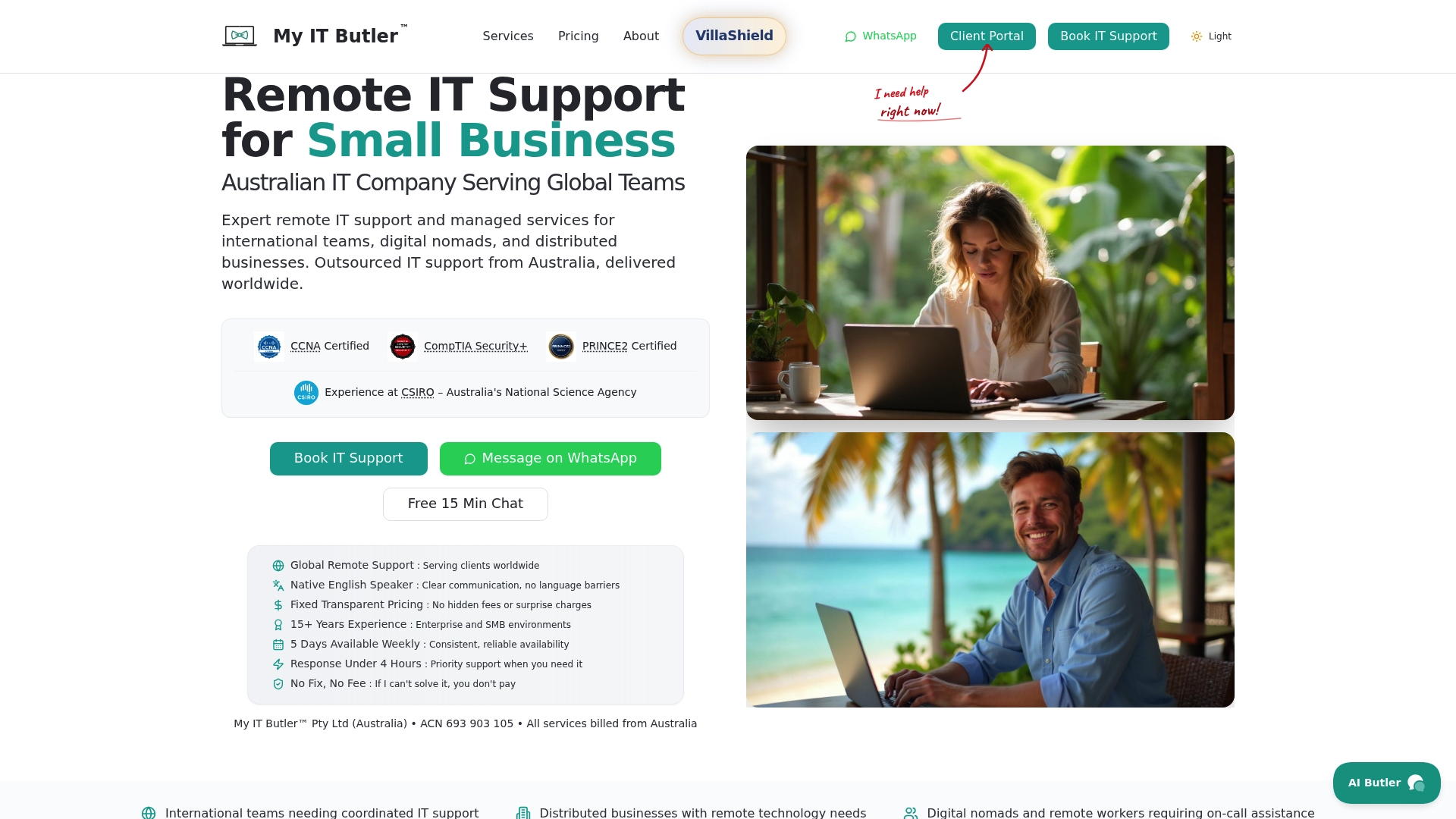
Services cover helpdesk support, cybersecurity, cloud management, vendor liaison, and compliance readiness, all accessible via WhatsApp, email, or direct message. For distributed teams and remote-first startups, that accessibility across time zones removes the gaps that local providers cannot cover. If you want to assess your current IT setup without any commitment, a free initial chat is available to help you map your needs and find the right level of support.
FAQ
What is no-contract IT support?
No-contract IT support is on-demand technical assistance with no fixed-term agreement, allowing startups to adjust or cancel coverage at any time. It is also called flexible managed services.
How much does no-contract IT support cost for a startup?
Outsourced IT support typically costs $100–$200 per user per month, compared to $90,000 or more annually for a full-time in-house IT hire.
Is no-contract IT support secure enough for startups handling sensitive data?
Yes, provided the provider holds recognised certifications such as CompTIA Security+ and covers endpoint protection, patch management, and access controls as part of their standard service.
When should a startup switch from no-contract support to an in-house IT team?
Most startups benefit from outsourced IT support until they reach 75 or more employees. Beyond that threshold, the volume and complexity of IT needs may justify a dedicated internal hire.
What is the context penalty in IT support?
The context penalty is the 15–90 minutes of extra billable time a support provider spends learning your systems before resolving each ticket. Dedicated no-contract providers eliminate this by building knowledge of your environment over time.