
The biggest common cross-border IT security challenges fall into five buckets: jurisdictional friction over where data legally sits, weak identity and access controls that let one stolen password become a global breach, software supply-chain compromise, data exfiltration during transit or storage, and slow, uncoordinated incident response when a breach spans multiple countries. If you fix one thing this week, map every place your data physically travels and put customer-controlled encryption on the highest-risk transfers, because that single move blunts jurisdictional, technical and supply-chain risk at once.
Do these things first, before reading further:
- Map every cross-border data flow, including backups and SaaS subprocessors
- Enforce multi-factor authentication and least-privilege access on every admin account
- Isolate high-risk transfers using privacy-enhancing technologies or customer-held encryption keys
- Vet your three or four most critical vendors for subprocessors and certifications
- Turn on centralised logging so you can reconstruct an incident across regions
- Write down who calls whom, and in what order, when something breaks
Pro Tip: Contracts and technical controls solve different problems. A Standard Contractual Clause reduces your legal exposure if a regulator comes asking. Encryption and access controls reduce whether an attacker, or a foreign government, can actually read your data in the first place. You need both, and most businesses only have the first.
Key Takeaways
Fixing common cross-border IT security challenges requires mapping data flows first, then layering identity controls, encryption and vendor due diligence on top.
| Point | Details |
|---|---|
| Map before you fix | Chart every cross-border data flow, including backups and subprocessors, before choosing any technical control. |
| Identity is the top risk | The Cloud Security Alliance ranks inadequate IAM as the leading cloud security threat for 2026. |
| Contracts alone are not enough | SCCs and BCRs reduce legal exposure but cannot stop a government compelling access in its own territory. |
| Supply chains move fast | CrowdStrike reports attackers exploiting new vulnerabilities within 24 to 48 hours of disclosure. |
| Get expert help early | Myitbutler offers remote, Australian-standard security assessments and managed IT liaison with fixed pricing and no lock-in contracts. |
Table of Contents
- Why cross-border IT security is different
- What are the most common cross-border IT security challenges?
- How do legal and regulatory rules increase cross-border risk?
- Which technical weaknesses do attackers actually exploit?
- Why is incident response harder across borders?
- How do contracts and vendor checks reduce cross-border risk?
- What is the right order for fixing cross-border IT security?
- What should a cross-border IT security check-up cover?
- How does this apply to real distributed teams?
- What decision-makers consistently get wrong
- How Myitbutler helps with cross-border IT security
- Sources
- FAQ
Why cross-border IT security is different
Moving data across a border does not just add paperwork. It changes the maths on how much control you actually have over your own information. A file sitting on a server in Frankfurt is subject to European law. The same file replicated to a backup in Singapore is now subject to Singaporean law too, plus whatever contract sits between you and the hosting provider in each country.
The OECD has tracked this problem closely and found nearly 100 data localisation measures in place across 40 countries by early 2023, with legal uncertainty and incompatible privacy regimes cited repeatedly as the core friction points. Every one of those measures can force a business to duplicate infrastructure, re-negotiate vendor contracts, or rebuild a data pipeline it thought was finished.
Three structural causes explain most of the pain:
- Data localisation laws that require certain data types to stay physically within a country's borders
- Multi-country vendor chains, where your cloud provider's subprocessor uses a subprocessor of its own, often in a fourth jurisdiction
- Fragmented visibility, where security teams can see logs from one region but not another, so an attacker moving between them goes unnoticed
Standards bodies like ISO 27001 and industry groups like the Cloud Security Alliance exist precisely because no single national law covers this mess end to end. They give you a common language for security controls that works whether your team sits in Sydney, Manila or Lisbon.
What are the most common cross-border IT security challenges?
Here is the working list most security teams triage against, roughly in the order they tend to bite.
Regulatory and jurisdictional friction. Different privacy laws (GDPR in Europe, the Privacy Act and Australian Privacy Principles in Australia, sector rules elsewhere) apply simultaneously to the same dataset. Symptom: a compliance team discovers, mid-audit, that a transfer they assumed was covered by one law is actually subject to three. Risk level: high for any business handling health, financial or identity data.
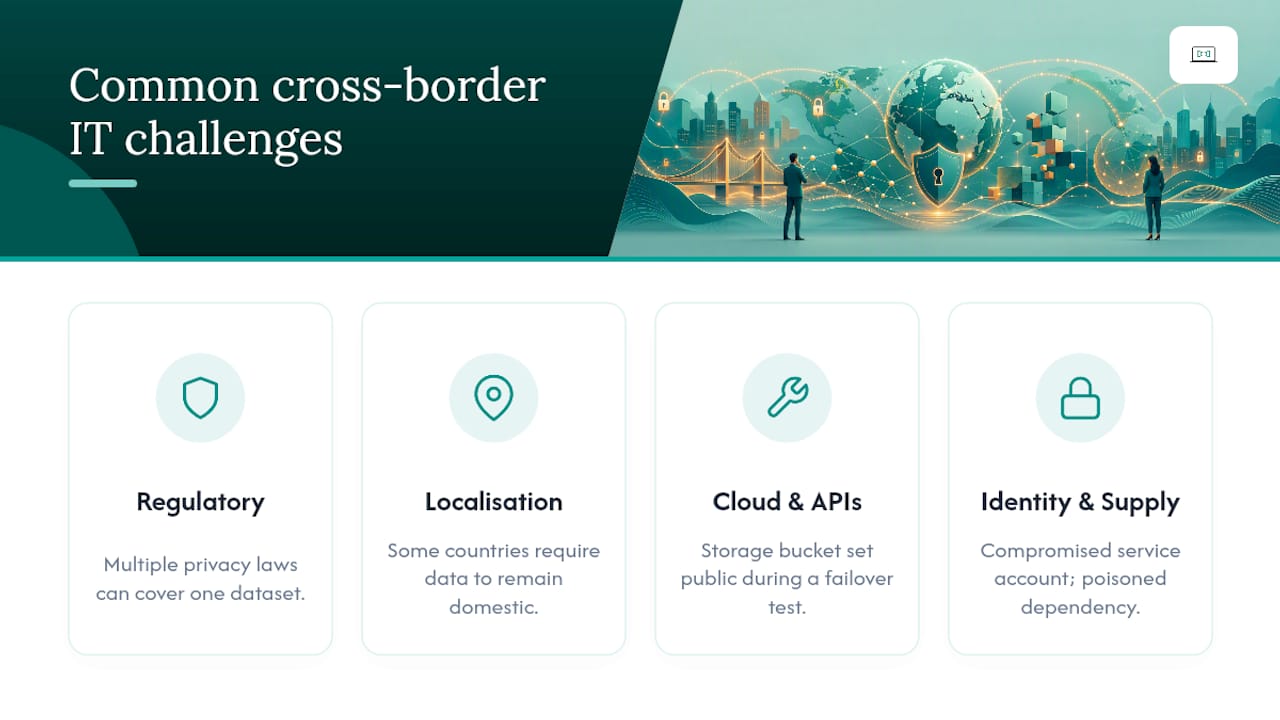
Data localisation and transfer limits. Some countries now require certain data categories to stay on domestic soil. Symptom: a cloud migration stalls because a government client insists their data cannot leave the country. Risk level: high and rising, given the OECD's localisation count.
Transit interception and metadata exposure. Even encrypted traffic leaks metadata, who talked to whom, when, and how much data moved. Symptom: an audit reveals that while message content was protected, the pattern of communications was visible to a network operator. Risk level: medium for most businesses, higher for anyone in regulated or politically sensitive sectors.
Cloud and SaaS misconfiguration. Multi-region cloud deployments multiply the number of storage buckets, IAM roles and network rules that can be set up wrong. Symptom: a storage bucket set to public by mistake during a regional failover test. Risk level: high, and the most common root cause behind cloud breaches generally.
Identity and non-human identity risks. The Cloud Security Alliance's 2026 top threats report puts inadequate identity and access management at the very top of its rankings, ahead of every other cloud risk category. Symptom: a service account with standing admin rights gets compromised and nobody notices for weeks because it is a machine identity, not a person, and nobody was watching it. Risk level: high.

Insecure APIs and interfaces. Cross-border systems talk to each other constantly through APIs, and each one is a potential door. Symptom: an integration built quickly for a partner in another country skips authentication checks "temporarily" and stays that way for a year. Risk level: medium to high.
Software supply chain and open-source compromise. CrowdStrike's 2026 Threat Hunting Report describes attackers exploiting newly disclosed vulnerabilities within 24 to 48 hours, and scaling attacks by poisoning open-source packages that thousands of companies pull automatically. Symptom: a routine dependency update quietly introduces malicious code into your build pipeline. Risk level: high and climbing.
Third-party and subprocessor risks. Your vendor's vendor is now your problem. Symptom: a breach notification arrives from a company you have never heard of, four layers deep in your supply chain. Risk level: high.
Remote workforce and endpoint gaps. CrowdStrike's Global Threat Report documents attackers moving fluidly across identity, cloud and edge devices, exploiting exactly the visibility gaps that distributed teams create. Symptom: a laptop used by a contractor overseas connects from an unmanaged home network with no endpoint protection. Risk level: high for any business without centralised device management.

Payment and transaction fraud. Cross-border e-commerce multiplies fraud vectors: currency conversion, chargebacks across legal systems, and payment processors with wildly different fraud tooling. Symptom: a spike in disputed transactions from a new market that your fraud rules were never tuned for. Risk level: medium to high depending on transaction volume.
Incident response and forensic limitations. When a breach spans jurisdictions, deciding who to notify and when becomes its own crisis inside the crisis. Risk level: high, covered in detail below.
Pro Tip: Rank these by sensitivity and regulatory exposure first, not by how technically interesting the fix is. A misconfigured marketing database is annoying. A misconfigured health records database is a regulatory event. Triage accordingly.
How do legal and regulatory rules increase cross-border risk?
Jurisdictional rules change what controls you legally must apply, and how fast you must act if something goes wrong, which is why they sit at the top of most cross-border risk assessments. Under GDPR Chapter V, transferring European personal data outside the European Economic Area generally requires an adequacy decision, Standard Contractual Clauses (SCCs), or Binding Corporate Rules (BCRs) for intra-group transfers. None of these mechanisms are "set and forget."
Since the Schrems II ruling, businesses relying on SCCs are expected to run a Transfer Impact Assessment (TIA) that honestly evaluates whether the destination country's surveillance laws could override the contract. Kiteworks makes the point bluntly: legal transfer mechanisms alone do not remove technical exposure, because a contract cannot stop a government agency that has a legal right to compel access in its own territory.
This is where localisation trends bite hardest. As more countries pass laws requiring certain data types to stay local, businesses running multi-country operations face a growing patchwork of rules that rarely line up neatly. The Global Data Alliance argues that blanket data isolation actually weakens collective cyber defence, because it fragments threat-sharing between allied organisations and governments. Interoperable safeguards, not walls, tend to hold up better under pressure.
- Confirm which transfer mechanism (adequacy, SCCs, BCRs) applies to each data flow, not just each vendor
- Run a TIA for any transfer touching a jurisdiction with broad surveillance powers
- Track localisation law changes in every country where you store or process data
- Never assume a signed SCC closes the loop without a technical control behind it
Pro Tip: If you take one legal hedge seriously, make it customer-controlled encryption with key residency in your own jurisdiction. If a foreign authority compels your cloud provider to hand over data, encrypted data they cannot decrypt is far less useful to them than plaintext.
Which technical weaknesses do attackers actually exploit?
The technical answer is unglamorous: attackers go after identity, misconfigured cloud settings, unsecured APIs, and software dependencies, because those four categories offer the fastest path from "outside the network" to "inside everything."
Identity and access management. A single-sign-on (SSO) credential compromise is now one of the fastest routes to lateral movement across an entire multinational environment, because SSO was built to make one login work everywhere. The CSA's 2026 findings put inadequate IAM at the top of cloud risk rankings for exactly this reason. Fix it with mandatory MFA on every account, least-privilege role design, and regular audits of non-human identities like service accounts and API keys, which are frequently forgotten and rarely rotated.
Cloud misconfiguration. Multi-cloud and multi-region deployments multiply the number of places a mistake can hide. A storage bucket, a firewall rule, an IAM policy, each one copied across regions is another chance to copy the mistake too. Fix it with automated configuration scanning and a single source of truth for security baselines across every region you operate in.
Insecure APIs. APIs built for internal use often skip the hardening applied to public-facing systems, and cross-border integrations tend to be built under time pressure. Fix it with API gateways that enforce authentication, rate limiting and logging by default, not as an afterthought bolted on later.
Software supply chain compromise. This is where 2026's threat landscape has shifted fastest. CrowdStrike's threat hunting data shows adversaries scaling attacks through poisoned open-source packages and compromised software registries, sometimes exploiting disclosed vulnerabilities within days of disclosure. A CNN report on an AI-enabled intrusion against Taiwanese infrastructure described autonomous AI agents mapping and compromising multiple systems in a short window, a preview of how fast these attacks can now move. Fix it with signed Software Bills of Materials (SBOMs), dependency scanning in your CI/CD pipeline, and contractual requirements that subprocessors disclose their own dependency chains.

Unmanaged edge devices. Remote and distributed teams generate a lot of endpoints nobody centrally manages, home routers, personal laptops, IoT devices in a shared office. CrowdStrike's global threat data flags exactly this kind of edge device as a growing blind spot exploited for cross-domain attacks.
On encryption specifics: use AES-256 for data at rest and TLS 1.3 for data in transit as your baseline, not your ceiling. TLS protects content but not metadata, so anyone watching network traffic can still see who is talking to whom and roughly how much data is moving, which matters if you are handling anything commercially or politically sensitive.
Pro Tip: Treat AI systems themselves as part of your attack surface, not just a tool you use. The Cloud Security Alliance's research identifies AI system compromise as a distinct threat category, recognizing that attacks on AI pipelines can cause damage even without credential theft.
Why is incident response harder across borders?
Cross-border incidents need pre-mapped accountability before they happen, because working out who is legally responsible for what during an active breach wastes hours you do not have. If your infrastructure spans the EU, the UK, the US and Australia, you could be juggling GDPR's 72-hour breach notification window, NIS2 obligations for critical infrastructure, DORA requirements for financial entities, and Australia's own notifiable data breach scheme, all with different clocks running from different trigger points.
Run this mini-playbook the moment you suspect a breach:
- Contain immediately using whatever access-revocation tools you have, even before you know the full scope.
- Preserve evidence by collecting immutable, timestamped logs from every affected region before anything gets overwritten.
- Make a TIA-informed disclosure decision, checking which regulatory clocks have started and what each jurisdiction actually requires you to disclose, and by when.
- Escalate to legal and the relevant regulators with a single coordinated message, not five different regional teams sending conflicting updates.
Build your notification map before an incident, not during one. Know which regulator gets called first, which internal stakeholders sign off on public statements, and where your evidence-preservation obligations differ by country.
Pro Tip: Pre-authorise an external forensics provider before you need one. Negotiating access agreements and non-disclosure terms during an active breach adds hours you cannot spare, and those hours often decide whether you meet a 72-hour notification deadline or miss it.
How do contracts and vendor checks reduce cross-border risk?
The contractual controls that actually reduce risk are specific: SCCs or BCRs where legally required, a proper processor Data Processing Agreement (DPA), a disclosed subprocessor list, right-to-audit clauses, defined security service levels, breach notification timeframes, and explicit data residency or key residency commitments. Vague "we take security seriously" language in a vendor contract is worth nothing in an actual dispute.
Before signing anything, run this due-diligence checklist on any vendor touching data that crosses a border:
- Ask for the full subprocessor list, not just the primary vendor's own claims
- Verify current ISO 27001 certification rather than taking a logo on a website at face value
- Request the vendor's own TIA or transfer risk documentation for the specific data flow you are using
- Ask what technical supplementary measures (encryption, key residency, pseudonymisation) apply on top of the legal mechanism
- Request recent penetration test summaries and SOC 2 or ASAE 3150 attestations, not just a policy document
Pro Tip: Self-attestation is not evidence. Build periodic live audits and a right-to-remediate clause into every vendor contract that touches sensitive cross-border data, so you can act if a vendor's actual security posture drifts from what they promised at signing. A structured vendor oversight approach makes this far easier to sustain than a one-off review at contract signing.
What is the right order for fixing cross-border IT security?
Get the priority order right and everything else gets easier: governance and mapping first, then access controls and encryption, then third-party controls and monitoring, then privacy-enhancing technologies (PETs) for your highest-risk flows. Skipping straight to advanced tooling before you have mapped your data flows is like installing a better lock on a door you have not found yet.
Step-by-step build order:
- Map every data flow across borders, including backups, analytics pipelines and vendor subprocessors, and keep the map current, not a one-time exercise.
- Classify data by sensitivity so you know which flows deserve the strictest controls and which can run on lighter-weight protections.
- Build a TIA template you can apply quickly to any new transfer, rather than starting from scratch each time.
- Settle your key management strategy, ideally customer-held keys or a Hardware Security Module (HSM), or a cloud Key Management Service (KMS) where you control access separately from the cloud provider.
- Deploy centralised Data Loss Prevention (DLP) and geo-fencing so sensitive data cannot leave an approved region without triggering a review.
- Move toward Zero Trust and strong IAM, meaning nothing is trusted by default regardless of network location, and every access request is verified.
- Integrate monitoring into a Security Information and Event Management (SIEM) platform that aggregates logs across every region you operate in.
- Apply PETs, such as pseudonymisation or differential privacy, for analytics workloads that need cross-border data without exposing raw personal information.
- Maintain SBOMs for every piece of software your business relies on, so a supply-chain compromise can be traced and contained fast.
When you are choosing tools for each of these categories, focus on a few practical criteria rather than feature lists:
- MFA and IAM providers: pick ones with strong non-human identity support, not just human user logins
- Key management: prioritise providers that let you hold your own keys independently of the storage provider
- Managed File Transfer (MFT) services: choose ones offering genuine end-to-end encryption, not just encryption in transit
- Vendor risk platforms: favour tools that automate subprocessor tracking rather than relying on annual spreadsheet reviews
Automate wherever you can. A transfer register or TIA library that only gets updated once a year is already out of date by the time anyone reads it. Good cloud storage governance and customer data protection practices both depend on that register staying current.
What should a cross-border IT security check-up cover?
Run this checklist in a single sitting, one to two hours, and you will surface most of your biggest exposures.
- Map high-risk transfers (owner: IT manager, timeline: 24 hours) — identify every data flow touching a jurisdiction with strict privacy law or broad surveillance powers.
- Confirm TIAs exist for EU-linked transfers (owner: Legal, timeline: 7 days) — check every SCC-based transfer has a current, honest risk assessment behind it.
- Verify key residency (owner: CISO or senior IT lead, timeline: 7 days) — confirm who actually holds the encryption keys for your most sensitive data.
- Audit MFA and Role-Based Access Control (RBAC) on admin accounts (owner: IT manager, timeline: 24 hours) — this is usually the fastest fix with the biggest payoff.
- Sample test three vendor subprocessors (owner: Procurement, timeline: 30 days) — request current certifications and subprocessor disclosures.
- Verify logging and SIEM collection across every region (owner: IT manager, timeline: 30 days) — confirm you can actually reconstruct an incident that spans two or more countries.
Once the checklist is done, book a proper technical review with a remote IT partner who has done this before. It is far cheaper to find gaps in a planned review than during an actual incident. This kind of structured audit pairs well with a broader IT risk review for growing businesses.
How does this apply to real distributed teams?
Distributed teams need centralised policy enforcement, managed identity, device posture checks and an automated transfer register to hold up under scrutiny, whether that scrutiny comes from a regulator, an insurer, or an actual attacker.
A remote sales team spread across four countries has a different risk profile to a cloud-native analytics pipeline processing customer data in three regions. The sales team's biggest exposure is usually unmanaged laptops and personal devices. The analytics pipeline's biggest exposure is usually subprocessor sprawl and inconsistent encryption standards between regions. Both need the same underlying discipline: policy-as-code so security rules apply uniformly regardless of where someone logs in from, automated TIAs so new data flows get assessed before they go live, and managed key rotation so nobody is relying on a key that has not changed in two years.
- Enforce MFA on every account, no exceptions for "trusted" senior staff
- Apply managed endpoint posture checks before granting network access
- Centralise backups with geo-fencing so backup copies do not quietly create new jurisdictional exposure
Pro Tip: The lowest-friction, highest-impact combination for most remote teams is enforced MFA, managed device posture, and centralised, geo-fenced backups. None of these require a security team of ten people, and together they close off the majority of attack paths that lead to a real breach. This is exactly the kind of foundation covered in a proper remote workforce cybersecurity setup, and it starts with reliable remote IT support coordinated across time zones.
What decision-makers consistently get wrong
Most businesses I talk to think cross-border security is a legal problem with a legal fix. Sign the SCC, tick the compliance box, move on. That mindset is what leaves the technical door wide open while the paperwork looks pristine.
The pattern repeats constantly: a business has a perfectly good Data Processing Agreement with a vendor, and no idea that vendor's subprocessor is three layers deep in a country with broad surveillance powers. Three fixes solve most of it. First, map data flows properly instead of trusting a vendor's own description of where data goes. Second, put MFA and least-privilege access everywhere, because identity compromise remains the fastest way into a cross-border environment. Third, stop treating encryption as a checkbox and start asking who actually holds the keys.
The non-obvious control worth taking seriously is combining customer-held encryption keys with privacy-enhancing technologies for analytics work. It means that even if a subprocessor gets compelled to hand over data, what they hand over is unreadable without a key they never had. Businesses that implement this properly usually do it in stages over six to eight weeks: mapping first, key management second, PETs for the highest-risk analytics flows last.
How Myitbutler helps with cross-border IT security
Most of the fixes in this guide, data flow mapping, MFA rollout, vendor subprocessor checks, key management decisions, take real hours from someone who knows what they are looking at. Myitbutler is built for exactly that gap: a remote IT partner working to Australian standards who can run a proper security assessment, manage vendor liaison, and coordinate the fix without you needing to hire an in-house security team.

Services relevant to everything covered above include cross-border security assessments, ongoing managed IT liaison so nothing drifts once it is fixed, vendor coordination and contract review support, and practical guidance on key management for businesses that are not ready to build that expertise internally. Everything runs remotely, with fixed pricing and no long-term contracts, so you know the cost before you commit. If your team spans two or more countries and you have not mapped your data flows yet, that is the logical starting point, and Myitbutler's managed IT services cover exactly that groundwork.
Book a free discovery chat to talk through where your biggest exposure sits, or go straight to a paid security consultation if you already know you need a formal assessment.
Sources
- Cross-border data flows | OECD
- AI emerges as an attack enabler and target in CSA 2026 top threats report
- CrowdStrike 2026 Threat Hunting Report: AI is now embedded across modern adversary operations | CrowdStrike
- Cross-Border Data Transfer Risks: 7 Key Threats | Kiteworks
Use ISO 27001 certification and a documented TIA as non-negotiable checkpoints whenever you evaluate a new vendor for cross-border work.
FAQ
What are the most common cross-border IT security challenges?
The most common are jurisdictional and regulatory friction, weak identity and access management, cloud misconfiguration, software supply-chain compromise, and slow incident response across multiple countries' legal systems.
What are the biggest challenges in border security for IT systems?
Beyond physical border controls, IT-specific border challenges centre on data localisation laws, inconsistent privacy regimes, and the difficulty of maintaining consistent security visibility when infrastructure spans multiple jurisdictions.
What are the five most common types of cyber security threats in cross-border operations?
Identity compromise, cloud misconfiguration, software supply-chain attacks, insecure APIs, and unmanaged remote endpoints consistently top the list for businesses operating across multiple countries.
What are the top information security challenges for multinational companies?
Multinational companies typically struggle most with reconciling different privacy laws for the same dataset, managing subprocessor risk across long vendor chains, and coordinating incident response when a breach spans regulatory jurisdictions with different notification timelines.
Can a contract alone protect cross-border data transfers?
No. Standard Contractual Clauses and similar agreements reduce legal exposure but cannot stop a government from compelling access within its own territory, which is why technical measures like customer-held encryption keys matter alongside any contract.
Who can help a small business assess its cross-border IT security?
A remote IT partner like Myitbutler can run a security assessment, review vendor contracts, and help set up encryption and access controls without the cost of an in-house security team.