
TL;DR:
- Effective international remote IT oversight is crucial for managing legal, security, and compliance risks across distributed teams. Implementing centralized governance, unified management platforms, and regular audits helps organizations maintain operational consistency and mitigate regulatory exposure. Building these frameworks early and investing in technology consolidation ensures scalable, secure, and compliant global IT operations.
The role of remote IT oversight internationally is one of the most underestimated challenges facing distributed organisations today. Most teams assume that a capable local IT person at each office is enough. It is not. When your people are spread across Singapore, London, Nairobi, and Sydney, you are not managing IT. You are managing multiple legal systems, data sovereignty rules, security exposure points, and compliance frameworks simultaneously. Get this wrong and you face regulatory fines, data breaches, and operational chaos. Get it right and your global team runs with the kind of consistency that actually builds trust.
Table of Contents
- Key takeaways
- The role of remote IT oversight internationally
- Building a governance framework for global IT
- Technology tools for distributed IT environments
- Legal, tax, and regulatory complexity in IT oversight
- Best practices for auditing IT oversight globally
- My honest take on international IT oversight
- How Myitbutler can support your international IT oversight
- Common questions
Key takeaways
| Point | Details |
|---|---|
| Centralised oversight matters | Fragmented local IT governance creates security gaps and compliance failures across international operations. |
| Governance needs cross-functional input | HR, legal, cybersecurity, and operations must all contribute to international IT policy. |
| Technology consolidation is non-negotiable | Unified IT management platforms give you visibility across time zones that siloed tools never can. |
| Legal and tax risks are real | Permanent establishment and data protection obligations vary by country and must be mapped to your IT policies. |
| Audit regularly and at scale triggers | Schedule oversight reviews at headcount milestones and when expanding into new jurisdictions. |
The role of remote IT oversight internationally
Remote IT oversight internationally means more than monitoring devices from afar. It covers how your organisation governs technology access, enforces security policies, manages compliance obligations, and maintains operational consistency across every country where your people work.
When IT governance stays local and informal, cracks appear fast. A team in Germany operates under GDPR with strict data handling rules. Your Manila team uses the same cloud platform but with different access permissions configured by a local IT contractor. Meanwhile, your Dubai office has no documented approval process for new software at all. Each of these gaps represents real risk.
Fragmented IT governance does not just create inefficiencies. It creates legal exposure, security vulnerabilities, and the kind of inconsistency that makes audits a nightmare and regulators very interested in your organisation.
Centralised governance models reduce these fragmented risks by establishing a global Information Security Management System (ISMS) that sets the policy baseline, while local teams execute within those boundaries. This is the key distinction between international IT management that works and one that merely exists.
The importance of IT oversight becomes clearest when something goes wrong. A breach traced to an unpatched system in a remote office. A tax authority questioning whether your IT contractor in Brazil constitutes a taxable presence. These are not hypothetical scenarios. They are the regular reality for organisations that treat remote IT as an afterthought.

Building a governance framework for global IT
The foundation of effective global remote IT supervision is not technology. It is structure. Without a clear governance model, even the best tools will be used inconsistently.
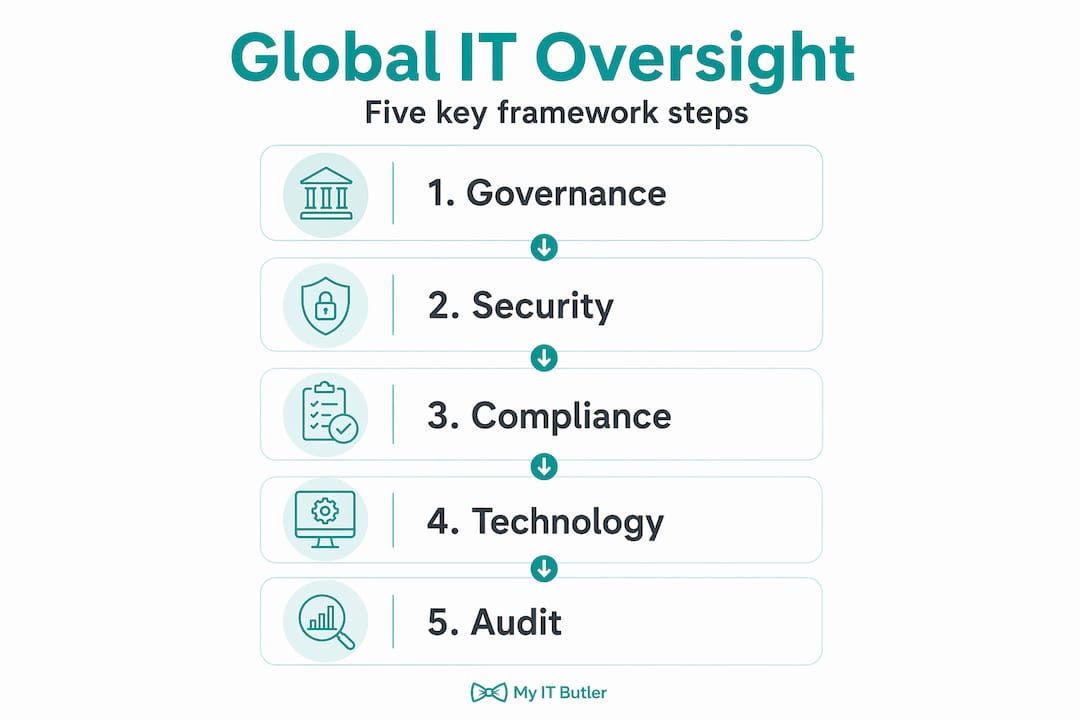
International remote work risk should be treated as a governance foundation, not a HR side project. That means building a cross-functional decision-making team that includes cybersecurity, legal, HR, finance, and business operations. Each function brings a different lens. Legal spots contract and liability risk. HR flags employment law obligations. Cybersecurity identifies access control weaknesses.
Here is a practical starting framework for international IT governance:
- Map your workforce by location and role risk. Identify which roles have access to sensitive data, financial systems, or client records. Document where each person is located and under which legal jurisdiction they operate.
- Define an approval workflow for IT access. Documented approval processes involving HR, legal, and cybersecurity are recommended by governance experts before any international remote IT access is granted.
- Create a centralised policy register. This includes acceptable use policies, data handling standards, software approval catalogues, and incident response procedures that apply globally with local addenda where required.
- Set location reporting obligations. Employees working internationally, even temporarily, must notify HR and IT so that compliance requirements and access permissions can be adjusted accordingly.
- Review at scale thresholds. Systematic governance typically becomes necessary around 50 employees and scales in complexity at around 200 employees across multiple markets.
Pro Tip: Do not wait until you hit these thresholds to start building governance. The cost of retrofitting a framework into a 150-person international team is significantly higher than building it at 30.
Structuring your remote system administration with these foundations in place means your oversight travels with your organisation as it grows.
Technology tools for distributed IT environments
Even the best governance framework falls apart without the technology to support it. One of the most common challenges of remote IT governance is tool sprawl. When each regional office selects its own monitoring software, ticketing system, and security platform, visibility disappears.
The answer is a unified, multi-tenant IT management platform. These platforms allow a central IT oversight team to manage remote desktops, apply patches, enforce security configurations, and monitor system health across every location from a single console. Consolidating remote management tools is consistently identified by practitioners as the key to operational visibility and faster response times in global environments.
Here is a comparison of management approaches:
| Approach | Visibility | Security consistency | Response time |
|---|---|---|---|
| Siloed local tools per region | Low | Inconsistent | Slow, depends on local staff |
| Centralised unified platform | High | Policy-enforced globally | Fast, centralised alerts |
| Hybrid with central policy layer | Medium-high | Consistent where configured | Moderate |
Beyond platform consolidation, modern international IT management must address insider threats. Identity-centric security approaches, including automated device-level monitoring and behavioural analytics, are now considered standard practice for organisations with distributed IT access. Behavioural analytics means monitoring patterns in how users access systems rather than just whether their credentials are valid.
This matters enormously in a remote context. A staff member in one country suddenly accessing financial records outside business hours in their time zone, or downloading unusually large data sets, is a risk signal that credential-only monitoring will miss entirely.
Pro Tip: When evaluating remote IT management tools, look specifically for platforms that include behavioural baselining. Credential-based access control alone is no longer sufficient for international operations.
Real-time analytics and automation also reduce the burden on your oversight team significantly. Automated patch deployment, compliance drift alerts, and anomaly notifications mean your team is responding to verified risks rather than manually reviewing logs across a dozen time zones.
Legal, tax, and regulatory complexity in IT oversight
This is the area where organisations most consistently underestimate their exposure. The challenges of remote IT governance go well beyond firewalls and software licences.
Permanent establishment (PE) risk is a critical concern. When an employee or IT contractor works from a foreign country long enough, tax authorities in that country may argue your organisation has a taxable presence there. 62% of multinational employers with international remote work policies have implemented specific guardrails to manage this risk. Your IT governance framework must include location tracking and time thresholds so you know when a remote worker's presence is approaching a PE trigger.
Data protection adds another layer. Key considerations include:
- Data sovereignty rules vary significantly. The EU's GDPR, Australia's Privacy Act, and Brazil's LGPD all impose different obligations on where data can be stored, processed, and accessed.
- Geo-fenced access controls restrict which users in which countries can access specific data sets, reducing the risk of inadvertent cross-border data transfers that breach local regulations.
- Cybersecurity protocols must align with the strictest applicable regulation across your international footprint, not the most convenient.
- Employment law obligations in many countries attach to where an employee works, not where your company is incorporated. Your IT policies around device management, monitoring, and acceptable use must be reviewed against local employment law before deployment.
Getting remote IT support set up internationally without understanding these obligations first is one of the most common and costly mistakes organisations make.
Best practices for auditing IT oversight globally
Building a governance framework is the start. Keeping it effective over time requires discipline.
Regular audit cadences, triggered by milestones such as headcount growth, new market entries, or funding rounds, consistently improve compliance outcomes and reduce risk exposure. The following schedule works well for most international organisations:
- Monthly: Automated compliance reporting across all monitored endpoints, flagging drift from baseline configurations and any anomalous access events.
- Quarterly: Cross-functional review involving IT, legal, and HR to assess any changes in team location, role changes, new tools adopted, and emerging regulatory changes in active jurisdictions.
- Annually: Full governance audit covering policy currency, tool stack evaluation, access permission review, and third-party vendor compliance assessment.
- Triggered reviews: Any expansion into a new country, a significant headcount increase, or a security incident should immediately prompt an out-of-cycle review.
| Audit type | Frequency | Scope |
|---|---|---|
| Automated compliance report | Monthly | All endpoints, access logs |
| Cross-functional review | Quarterly | Locations, roles, tools, regulations |
| Full governance audit | Annually | Policies, vendors, permissions |
| Triggered review | As needed | New jurisdiction or security event |
Cross-functional governance teams are particularly important here because each discipline will catch different things. Cybersecurity identifies configuration gaps. Legal spots new regulatory requirements. Finance highlights cost exposure from non-compliant tool usage. Together, they give you governance maturity that no single team can achieve alone.
My honest take on international IT oversight
I have worked with international distributed teams long enough to say this plainly: decentralised IT oversight almost always fails eventually. Not because the people managing it locally are incompetent, but because they are optimising for their context, not the organisation's global risk profile.
The teams that handle this well share one characteristic. They invest in a unified governance model early, before the complexity makes it painful. They do not treat IT oversight as a checkbox. They treat it as an operating principle.
The most common mistake I see is underestimating the tax and regulatory complexity. Organisations focus on cybersecurity, which is critical, and completely miss the permanent establishment or data sovereignty exposure sitting quietly in their team's working arrangements. By the time an auditor or regulator raises it, the remediation cost is substantial.
Technology consolidation is the other piece that pays back quickly. The organisations running five different monitoring tools across their regions are not saving money. They are paying for hidden operational delays, missed alerts, and the cost of an incident that a unified platform would have flagged weeks earlier.
My bottom line is this: the best practices for IT oversight are not complicated in theory. They are discipline and investment applied consistently. The organisations that build a solid remote network security foundation early are the ones that scale without painful governance crises.
— Thomas
How Myitbutler can support your international IT oversight
If this article has surfaced gaps in how your organisation currently manages distributed IT, you are not alone. Most international teams reach a point where informal arrangements stop being sufficient.

Myitbutler specialises in remote IT support for international organisations and distributed teams, backed by over 15 years of enterprise experience and certifications including CCNA, CompTIA Security+ and PRINCE2. From assessing your current governance gaps to designing a unified oversight framework and managing it on an ongoing basis, the team operates across time zones with no lock-in contracts. If you are ready to replace ad-hoc arrangements with genuinely structured IT oversight, book a consultation and let's work through what your organisation specifically needs.
Common questions
What does remote IT oversight internationally actually involve?
Remote IT oversight internationally covers the governance, security, compliance, and operational management of IT systems used by employees and contractors working across multiple countries. It includes policy enforcement, access controls, regulatory compliance, and technology monitoring from a centralised position.
Why do organisations struggle with international IT governance?
Most organisations start with informal local arrangements that do not scale. As team size and jurisdictions grow, fragmented tools and inconsistent policies create security gaps, compliance failures, and legal exposure that become difficult and expensive to remediate.
When should a company formalise its remote IT governance?
Systematic governance typically becomes necessary around 50 employees and grows considerably more complex at around 200 employees across multiple markets. The smarter approach is to build the framework earlier, before complexity forces it.
What is permanent establishment risk in international IT management?
Permanent establishment risk occurs when an employee or IT contractor working from a foreign country creates a taxable presence for your organisation in that jurisdiction. 62% of multinational employers now have policies specifically designed to manage this risk.
How often should international IT oversight frameworks be audited?
Automated compliance checks should run monthly, cross-functional reviews quarterly, and full governance audits annually. Any expansion into a new country or a significant security event should also trigger an immediate out-of-cycle review.