
TL;DR:
- Many organizations mistakenly believe that VPNs and strong passwords alone suffice for remote security, which is outdated. Implementing layered controls aligned with Zero Trust principles, such as segmentation, continuous verification, and session monitoring, is essential for effective protection. A lifecycle approach involving ongoing assessment, updates, and cross-functional governance ensures resilience in remote network security by 2026.
Many IT leaders assume a VPN and a strong password policy are sufficient to protect their distributed workforce. That assumption is outdated and increasingly costly. Modern remote work introduces layered risks that single-point controls simply cannot address, from unmanaged personal devices to third-party vendor sessions operating across multiple time zones and jurisdictions. This article covers the core principles of remote network security, the practical differences between legacy and modern access models, the controls that fill critical gaps, and the governance obligations that apply when your team spans borders. By the end, you will have a clear, actionable understanding of what genuine remote network security looks like in 2026.
Table of Contents
- Defining remote network security: key concepts and principles
- How remote access works: traditional vs modern approaches
- Beyond the tunnel: building resilience and defence-in-depth
- Managing privileged and third-party remote access
- Compliance, governance, and securing every component
- Our perspective: why remote network security must operate as an ongoing lifecycle
- Next steps: expert support for remote network security
- Frequently asked questions
Key Takeaways
| Point | Details |
|---|---|
| More than just VPNs | Effective remote network security requires layered controls beyond traditional VPNs and passwords. |
| Zero Trust matters | ZTNA approaches reduce risk by focusing on identity, device health, and application-level access. |
| Privileged and third-party risk | Special controls are needed for admin accounts, vendor access, and unmanaged devices. |
| Compliance is comprehensive | Remote security policies must include organisation-owned, BYOD, and third-party endpoints. |
Defining remote network security: key concepts and principles
Remote network security is not a single product or a toggle you switch on. Secure remote access is the set of policies, technologies, and controls that lets authorised users connect to an organisation's networks, systems, and applications from outside the normal office perimeter while reducing the risk of unauthorised access and data compromise. That definition matters because it immediately signals that people, devices, processes, and technology must all be considered together.
The core components of remote network security include:
- Authentication: Multi-factor authentication (MFA) requires users to verify their identity through two or more methods, such as a password combined with a time-based one-time code. This reduces the risk of stolen credentials granting immediate access.
- Encryption in transit: All data moving between a remote device and an organisational system should be encrypted, typically using TLS or a VPN protocol, so that intercepted traffic is unreadable.
- Logging and auditing: Recording who accessed what, when, and from where allows security teams to detect anomalies, investigate incidents, and satisfy compliance requirements.
- Policy and access controls: Rules that define what each user or device can do once connected, limiting exposure if an account is compromised.
The principle that ties these components together is Zero Trust. Remote access security is aligned to Zero Trust principles: do not implicitly trust location or network membership; instead verify identity and device posture, then enforce least-privilege access per session and per resource. In practical terms, this means that being inside the corporate VPN no longer grants automatic trust. Every access request is evaluated on its own merits.
"Zero Trust does not mean 'trust nothing.' It means 'verify everything.' The goal is reducing the blast radius of any single compromised account or device."
Strong remote IT support strategies are built on this layered philosophy. When each layer assumes the others may fail, the overall architecture becomes far more resilient.
How remote access works: traditional vs modern approaches
Understanding what remote network security is, let's explore the major approaches available for enabling and protecting remote access.
The two dominant models are traditional VPN and Zero Trust Network Access (ZTNA). They differ fundamentally in how much access they grant and how they enforce controls.
| Feature | Traditional VPN | ZTNA |
|---|---|---|
| Access scope | Broad network tunnel | Specific application or resource |
| Trust model | Trust after authentication | Continuous verification |
| Lateral movement risk | High if credentials compromised | Low due to resource isolation |
| Device posture checks | Often limited | Built into access decision |
| Complexity for end user | Moderate | Low to moderate |
| Scalability for global teams | Can be limited | Generally high |
ZTNA gives access to specific applications and resources, not broad network access, based on identity and device health with continuous verification. Compare that to a traditional VPN, where a successful login places the user on the internal network with visibility across many systems. The practical risk is significant. If an attacker obtains valid credentials, a VPN grants them wide lateral movement. ZTNA limits that damage to a single application.
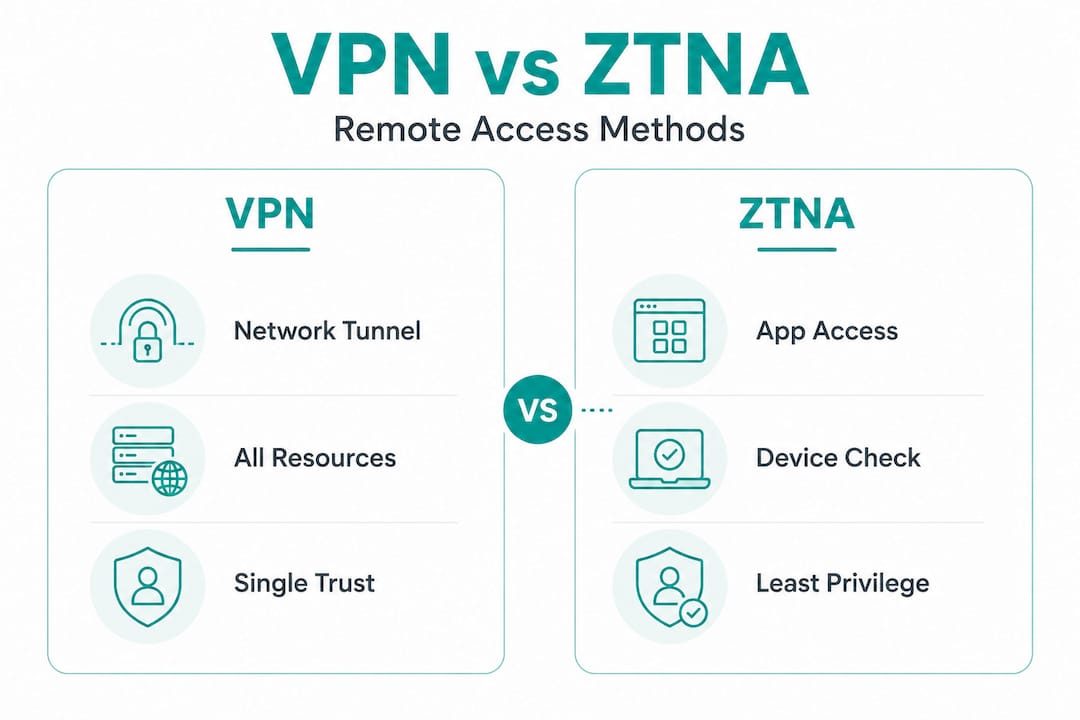
The core security nuance between the two approaches is access scope: VPN-style approaches create a broader tunnel into the network, while ZTNA grants application-specific access and thereby reduces lateral movement if endpoint trust is lost. For organisations managing remote teams across multiple countries, this distinction becomes even more consequential because breach response across time zones is slower.
A basic remote access authentication process using modern controls looks like this:
- The user initiates a connection from their device using a client application or browser.
- The identity provider verifies the user's credentials and MFA token.
- The device posture check confirms the endpoint meets minimum security requirements (updated OS, active antivirus, encrypted disk).
- The ZTNA gateway grants access only to the specific application or system the user requires.
- Session activity is logged continuously, with anomaly detection flagging unusual behaviour in real time.
Pro Tip: When evaluating ZTNA solutions, test the device posture check enforcement independently. Some products advertise posture checks but fail to enforce them consistently on unmanaged or personal devices, which is exactly where your highest risk sits.
Beyond the tunnel: building resilience and defence-in-depth
Now that the key models for remote access are clear, let's look at why a tunnel alone doesn't deliver true security and what's needed to fill those gaps.
Effective remote network security extends beyond the connection method to include segmentation, session monitoring, endpoint protections, and addressing operational seams such as log blind spots that occur after initial authentication. That last point is subtle but critical. Many organisations log the connection event but stop monitoring once the user is inside the system.

The 2025 Cisco Cybersecurity Readiness Index highlights ongoing industry focus on network resilience and controls like segmentation and microsegmentation as core readiness components for securing remote and distributed operations. This reflects a maturing understanding: perimeter defence alone is no longer viable when the perimeter is effectively everywhere.
Here is a comparison of resilience controls and their purpose:
| Control | What it does | Gap it fills |
|---|---|---|
| Network segmentation | Divides the network into isolated zones | Limits lateral movement after breach |
| Microsegmentation | Applies segmentation at the workload level | Contains compromised containers or apps |
| Session monitoring | Records and analyses activity during a session | Catches malicious behaviour post-authentication |
| Endpoint detection and response (EDR) | Monitors endpoint behaviour in real time | Catches threats that bypass perimeter controls |
| Privileged access management (PAM) | Controls and audits admin-level access | Reduces blast radius of credential theft |
Additional controls that distributed teams should implement include:
- Automated patch management across all endpoints, including those used by remote workers in different regions.
- DNS filtering to block malicious domains before a connection is established.
- Behavioural analytics that detect unusual access patterns, such as a user in Sydney suddenly accessing systems at 3am from a European IP address.
- Regular access reviews to remove accounts that are no longer needed, particularly for contractors and project-based staff.
Pro Tip: Treat log blind spots as your most dangerous unknown. After authentication, many remote sessions are effectively unmonitored. Implement session recording for privileged access and set alert thresholds for high-volume data transfers, even from trusted user accounts.
Managing privileged and third-party remote access
Defending the overall network is only part of the challenge. It's equally important to safeguard privileged access and third-party connections.
Third-party and privileged remote access use cases, such as administrators and contractors, must be accounted for in remote network security design, with controls that reduce blast radius through least privilege and segmentation. This is where many organisations carry hidden risk. A contractor who has not worked with you for six months may still have active credentials. An outsourced vendor may be accessing your systems from an unmanaged device with no endpoint protection in place.
The controls that address privileged and third-party access specifically include:
- Just-in-time access: Admin rights are granted only for the duration of a specific task, then automatically revoked. This removes standing privileges that can be exploited.
- Vendor-specific credentials: Rather than sharing internal admin accounts, create purpose-built credentials for each vendor with access only to their relevant systems.
- Device compliance requirements: Before any session begins, the connecting device must meet defined security baselines. This applies to vendors just as it does to employees.
- Session recording and audit trails: All privileged and third-party sessions should be recorded. This satisfies compliance obligations and creates accountability.
- Time-limited access windows: Vendors should only have access during agreed working hours, reducing the risk of off-hours abuse.
Learning how to secure mobile data for global teams is also relevant here, particularly for contractors and digital nomads who operate from mobile devices across multiple networks.
"Privileged access is not just a technical problem. It is a relationship and accountability problem. The controls must mirror the accountability structure of the organisation."
Pro Tip: Conduct a quarterly vendor access audit. Pull a list of every third-party account with active credentials, match it against current contracts, and immediately deactivate any account that cannot be tied to an active, current engagement. This single action closes a disproportionately large number of exposure points.
Compliance, governance, and securing every component
Beyond technical controls, meeting legal and regulatory requirements is vital for any organisation operating globally with a distributed workforce.
Remote network security for compliance is treated as a full-system responsibility, including securing both organisation-issued and BYOD (bring your own device) endpoints, not just the connection layer. Regulators and auditors do not accept "the device was personal" as a defence if that device was used to access organisational data.
Major frameworks that IT leaders managing global teams should be familiar with include:
- NIST SP 800-46r2: The US National Institute of Standards and Technology's telework and remote access guide, widely used as a reference standard internationally.
- ISO/IEC 27001: The international information security management standard that includes requirements for remote access controls and endpoint security.
- GDPR and regional data protection laws: When remote employees access personal data, the jurisdictional requirements of the data subjects apply, not just where the employee is located.
- SOC 2 Type II: For service organisations, this framework requires evidence of ongoing monitoring and access controls, including for remote access sessions.
- Industry-specific regulations: Healthcare (HIPAA), finance (PCI DSS), and government sectors carry additional obligations that directly affect remote access architecture.
A practical governance checklist for IT leaders managing distributed or global teams:
- Document all remote access methods and their security controls.
- Maintain an up-to-date inventory of every endpoint that connects to organisational systems, including personal devices.
- Define and enforce a minimum device security baseline for BYOD devices.
- Conduct annual policy reviews aligned to framework updates.
- Train staff on acceptable use, phishing recognition, and incident reporting.
- Establish a remote access incident response procedure, tested at least annually.
- Ensure eSIM in remote work compliance is considered for internationally mobile staff who use data connectivity across different carriers.
If you are building or reviewing your programme, an IT support consultation with specialists who understand both technical controls and international compliance obligations can save significant time and reduce the risk of costly gaps.
Our perspective: why remote network security must operate as an ongoing lifecycle
The most dangerous assumption we encounter when working with international teams is that remote network security is a project with a finish line. Organisations invest in a ZTNA platform, configure MFA, document a policy, and then treat it as complete. Six months later, a contractor account left active after a project ended becomes the entry point for a breach. The technical architecture was sound. The lifecycle management was not.
Experienced practitioners understand that the seams between systems are where most incidents originate. The gap between what your ZTNA solution covers and what a legacy application still handles via VPN. The difference between what your logging captures and what actually happens in a privileged session after authentication. These are not exotic attack vectors. They are ordinary operational gaps that accumulate when no one is assigned to actively review them.
What we have seen consistently is that organisations with excellent technical controls but poor cross-functional governance suffer incidents that those with simpler but actively managed environments avoid. Security is ultimately a practice, not an installation. The teams that maintain strong posture are those that schedule regular access reviews, treat vendor credential management as a live process, and revisit their architecture whenever business operations change, such as when a new market is entered or a significant contractor relationship begins.
The other lesson that rarely appears in vendor documentation is the importance of policy literacy across business units. When HR does not understand why offboarding must include an IT step, and when project managers do not understand why vendor access must be formally requested, the controls that your security team has carefully designed are undermined at the operational level. Investing in short, practical training for non-technical leaders pays dividends that no additional security product can match.
Remote network security in 2026 demands a lifecycle mindset: assess, implement, monitor, review, and adapt. That cycle never ends. The organisations that accept this reality are the ones that stay resilient.
Next steps: expert support for remote network security
Navigating the complexity of remote network security, from selecting the right access model to satisfying global compliance obligations, requires more than a checklist. Organisations that get this right typically have access to specialist guidance aligned with current frameworks and practical operational experience.

At My IT Butler, we work with international organisations and distributed teams to design, implement, and manage remote network security that actually holds up under real-world conditions. Our team holds CCNA, CompTIA Security+, and PRINCE2 certifications, and we bring over 15 years of enterprise experience to every engagement. Whether you need ongoing remote IT support for your global team or want to book a security consult to review your current architecture, we offer transparent fixed pricing and no lock-in contracts. Reach out via WhatsApp, email, or direct message. We are available across time zones because your security challenges do not wait for business hours.
Frequently asked questions
What are the main components of remote network security?
Remote network security includes access controls, strong authentication, encryption, session monitoring, and endpoint protection for all devices, including personal and BYOD equipment, not just company-issued hardware.
How does Zero Trust Network Access improve remote security?
ZTNA grants access only to specific applications rather than the entire network, which means a compromised account causes far less damage because the attacker cannot move freely across other systems.
Why isn't VPN and MFA enough for remote teams?
Effective remote security requires segmentation and session monitoring beyond the connection method, because without them an attacker with valid credentials can still move laterally across the network undetected.
How can organisations secure remote access for third-party vendors?
Least-privilege access, segmentation, session recording, and just-in-time credential provisioning collectively reduce the risk that a vendor account becomes an uncontrolled entry point into your environment.
What standards or frameworks guide remote network security policies?
Full-system governance for remote access is guided by frameworks including NIST SP 800-46r2 and ISO/IEC 27001, both of which require securing all endpoint types, not just the connection layer, across your organisation.