
TL;DR:
- Strategic planning guides startups to focus resources, set clear priorities, and align teams for growth. It also reduces wasted effort, improves investor confidence, and helps integrate IT early in the process. Regular reviews and a one-page framework like OGSM keep plans practical and actionable.
Strategic planning is the process a startup uses to set clear priorities, focus resources, and guide daily decisions toward sustainable growth. Without it, fragmented focus and reactive decisions become the default, and that is a leading cause of startup failure. The industry term for this discipline is "strategic management," and it covers everything from setting a one-year vision down to the 90-day actions your team executes each week. For startup founders asking why startup IT needs strategic planning, the short answer is this: without a plan, your technology spending, your team's time, and your investor pitch all pull in different directions.
Why is strategic planning indispensable for startups?
Strategic planning is not about writing a long document that sits in a drawer. It is the process of deciding what your startup will do, and just as critically, what it will not do.

Most early-stage founders chase every promising idea. That behaviour fragments resources across too many initiatives, and no single one gets enough attention to succeed. Strategic planning ensures that 100% of team effort aligns with high-impact initiatives rather than non-essential tasks. That alignment is the difference between a team that moves fast and one that stays busy but goes nowhere.
The core benefits of planning at the startup stage include:
- Filtering opportunities. A clear plan gives you a filter. When a new idea arrives, you can ask: does this serve our current objective? If not, it waits.
- Aligning your team. Every hire, every sprint, and every budget decision connects back to the same goals. Culture drift and conflicting priorities shrink.
- Reducing wasted effort. Planning accelerates decision-making by clarifying priorities, so your team spends less time in meetings debating direction.
- Building investor confidence. Investors fund founders who can articulate a clear path, not just a vision.
Pro Tip: Write your strategic plan before you hire your second employee. The act of writing it forces you to make decisions you would otherwise defer until they become crises.
Strategic planning is widely misunderstood as something that slows startups down. The opposite is true. It actually accelerates startups by concentrating effort where it counts most.
How does strategic planning bridge vision and execution?
Vision alone is insufficient. Strategy must be explicit and integrated into daily operations to be effective. The gap between "we want to be the leading platform in our category" and "here is what each team member does on Monday morning" is where most startups fall apart.
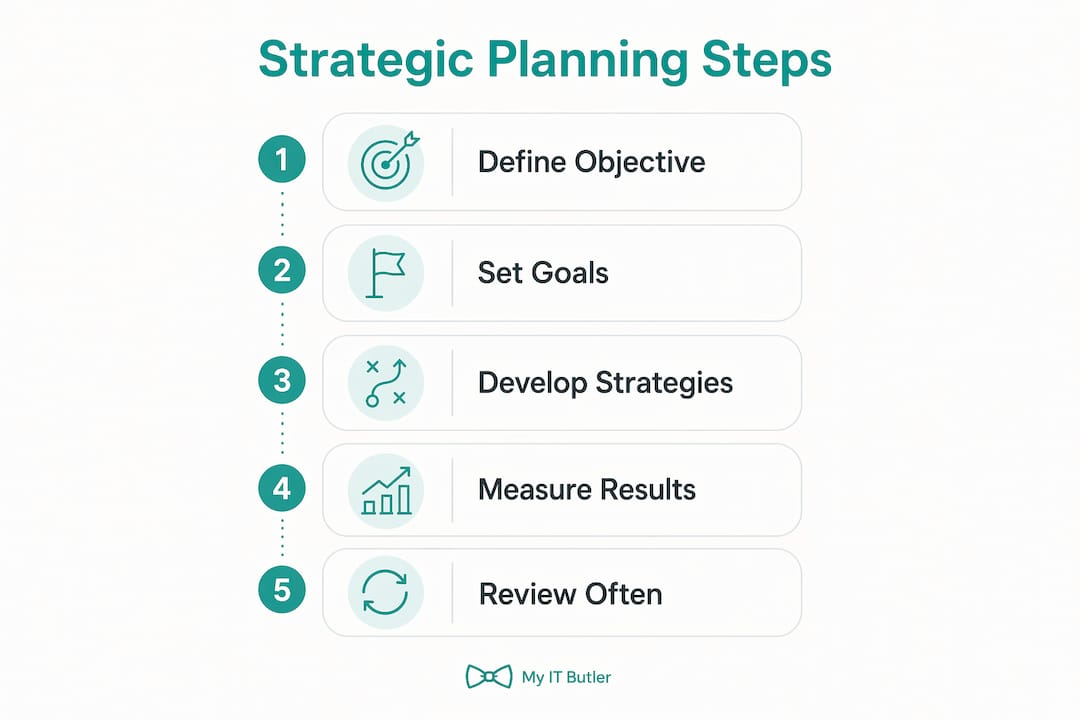
The OGSM framework (Objectives, Goals, Strategies, Measures) closes that gap. It condenses startup strategy to a single page, enabling quick updates and team alignment. That single-page constraint forces ruthless prioritisation. You cannot hide vague ambitions in a one-page document.
| OGSM component | What it defines | Startup example |
|---|---|---|
| Objective | The single overarching ambition | Become the go-to payroll tool for Australian SMEs |
| Goals | 3–5 measurable outcomes | Reach 500 paying customers by december |
| Strategies | How you will achieve each goal | Partner with two accounting firms per quarter |
| Measures | KPIs that confirm progress | Monthly recurring revenue, churn rate, net promoter score |
Effective startups focus on a 90-day or 12-month horizon with 3–5 quantitative goals per plan. A 90-day horizon keeps the plan close enough to reality that your team can act on it without second-guessing whether the market has shifted.
The plan must also be a living document. Strategy must be updated frequently and kept to a limited number of initiatives to remain aligned with fast-changing startup realities. A plan reviewed once a year is not a plan. It is a historical record.
Pro Tip: Set a recurring calendar block every 90 days for a two-hour strategy review. Treat it with the same seriousness as a board meeting. Founders who skip this step are the ones who pivot unnecessarily six months later.
For startups with distributed or remote teams, IT alignment is part of this execution layer. The role of IT in remote startup teams directly affects whether your strategic plan translates into coordinated daily action or fragmented individual effort.
What are the real benefits of strategic planning for startups?
The benefits of strategic planning show up in four concrete areas: operations, finances, investor relations, and team culture.
Operational efficiency. A clear roadmap identifies structural gaps early and avoids unnecessary pivots. When your team knows the plan, they make faster decisions without escalating every question to the founder. That frees you to work on the business rather than in it.
Financial discipline. Planning forces you to assign budget to priorities rather than react to whoever asks loudest. Founders who understand their startup IT costs within the context of a plan avoid the common trap of overspending on tools that do not serve the current strategy.
Investor readiness. Structured planning improves investor confidence by providing consistent narratives and clear roadmaps. Investors do not just fund ideas. They fund founders who demonstrate they can execute. A one-page OGSM plan shown in a pitch meeting signals discipline that a slide deck alone cannot.
Team alignment. Startups that pause quarterly to reflect and recalibrate move faster and save capital compared to those in constant motion. That quarterly pause reduces culture drift, because every team member reconnects with the same goals and measures.
The IT dimension of these benefits is often underestimated. When your IT infrastructure aligns with your strategic goals, IT readiness attracts investors and reduces the risk of technical debt derailing your roadmap.
How should startups implement strategic planning in practice?
Implementation is where most planning efforts fail. Without clear accountability and frequent review, plans become useless documents. The following steps give your planning process structure without bureaucracy.
-
Build the plan with your team. Strategy created in isolation by the founder rarely gets adopted. Involve your two or three key people in the first planning session. They will surface blind spots and commit to outcomes they helped define.
-
Limit initiatives to 2–3 per cycle. Limiting strategic initiatives to 2–3 per strategy improves focus and accountability. Every initiative beyond that competes for the same limited time and budget.
-
Map your strategic paths explicitly. Evaluate 2–3 distinct strategic paths with explicit cost and revenue trade-offs before committing. Choosing evidence-based paths over instinct leads to better decisions. Write down what you are choosing not to do, and why.
-
Assign an owner to every goal. Each goal in your plan needs one person responsible for it. Not a team. One person. That person tracks the KPI, reports at the quarterly review, and escalates blockers early.
-
Set a 90-day review cycle. Review the plan every 90 days. Update goals that are no longer relevant. Retire initiatives that have stalled. Add new ones only if they replace something, not in addition to everything else.
-
Integrate IT into the plan from day one. IT is not a support function you bolt on later. Getting IT support early prevents costly pivots when your infrastructure cannot support the growth your plan demands.
The best startup strategies map multiple strategic paths and evaluate trade-offs objectively. That means sitting down with your team, writing out two or three realistic directions, and choosing the one with the strongest evidence, not the one that feels most exciting.
Key takeaways
Strategic planning is the single most effective way for a startup to align resources, accelerate decisions, and build the investor confidence needed for sustainable growth.
| Point | Details |
|---|---|
| Plan before you scale | Create your strategic plan before hiring or raising capital to set a clear direction. |
| Use the OGSM framework | Condense strategy to one page with one objective, 3–5 goals, strategies, and KPIs. |
| Limit active initiatives | Restrict each planning cycle to 2–3 initiatives to maintain focus and accountability. |
| Review every 90 days | Quarterly reviews keep the plan relevant and prevent unnecessary pivots. |
| Integrate IT from the start | Aligning IT with your strategic plan prevents technical debt and supports investor readiness. |
What I have learned from watching startups skip the plan
Thomas here. After years of working with early-stage teams across multiple time zones, the pattern I see most often is not a bad idea. It is a good idea executed without a plan.
The founders who struggle are not the ones who lack ambition. They are the ones who treat planning as something they will do "once things settle down." Things never settle down. The chaos you are managing at ten customers is a smaller version of the chaos you will manage at a thousand, unless you build the structure now.
What I have found is that the startups who grow fastest are not the ones who move fastest. They are the ones who stop every 90 days, look at what the numbers are actually saying, and make deliberate choices about what to do next. That discipline feels slow in the moment. It saves months of wasted effort over a year.
Treat your strategic plan as a working tool, not a formal document. Write it on one page. Update it when the market tells you something new. And make sure your IT infrastructure is part of that plan from the beginning, not an afterthought you scramble to fix during your next funding round.
— Thomas
How Myitbutler supports startup strategic planning
Startups that align their IT infrastructure with their strategic plan from the outset avoid the costly scramble that derails growth at the worst possible moment.

Myitbutler provides remote IT support and managed services built specifically for distributed startups, remote teams, and international founders. With over 15 years of enterprise experience and certifications including CCNA, CompTIA Security+, and PRINCE2, Myitbutler brings Australian-standard IT discipline to your strategic planning process, wherever your team operates. Fixed pricing, no long-term contracts, and direct access via WhatsApp or email mean you get expert IT coordination without the overhead of an in-house team. Book a free consultation to align your IT setup with your next 90-day plan.
FAQ
What is strategic planning for startups?
Strategic planning for startups is the process of defining a clear objective, setting 3–5 measurable goals, and connecting them to daily actions through a framework like OGSM. It replaces reactive decision-making with a structured, evidence-based roadmap.
Why does startup IT need to be part of the strategic plan?
IT infrastructure directly affects whether your team can execute the plan. Misaligned IT creates bottlenecks, security risks, and technical debt that slow growth and reduce investor confidence.
How often should a startup review its strategic plan?
A 90-day review cycle is the most effective cadence for startups. It keeps the plan close enough to current reality to act on, while giving enough time to see whether initiatives are producing results.
What is the OGSM framework?
OGSM stands for Objectives, Goals, Strategies, and Measures. It condenses an entire startup strategy onto one page, forcing founders to make explicit trade-offs and connect ambition directly to measurable daily execution.
How does strategic planning improve investor readiness?
A clear strategic plan gives investors a consistent narrative and demonstrates that the founding team can make disciplined decisions. Structured planning identifies structural gaps early, which reduces the perceived risk of investing in an early-stage venture.