
TL;DR:
- Startup IT costs encompass hardware, software, infrastructure, and support expenses necessary before generating steady revenue. Budgets vary from under $20,000 for solo founders to over $500,000 for seed-funded teams, with early decisions greatly influencing total expenditure. Prioritizing essential costs, avoiding subscription sprawl, and integrating early support help manage expenses and extend operational runway.
Startup IT costs are all the hardware, software, infrastructure, and service expenses a new business must cover to operate before generating consistent revenue. Understanding your startup IT expenses overview from day one separates founders who run out of money at month eight from those who reach product-market fit with runway to spare. First-year costs for software startups range from $10,000 to $80,000 for bootstrapped solo founders and climb to $500,000 or more for seed-funded teams once payroll and marketing enter the picture. The gap between those two numbers is almost entirely explained by decisions made in the first 90 days of budgeting.
What are the main categories of startup IT costs?
Startup IT costs fall into six distinct categories, and missing even one of them will blow your budget before the end of the first quarter.

Payroll and contractor costs represent the largest single line item for most startups. A developer on a $100,000 base salary actually costs you $125,000 to $140,000 once you factor in fully loaded employee costs covering payroll taxes, superannuation, benefits, and onboarding. That 25% to 40% premium catches founders off guard every time.
Infrastructure and software subscriptions are the second major category. Tools like AWS or Google Cloud for hosting, HubSpot or Pipedrive for CRM, Slack for team communication, and Cloudflare for security all carry monthly fees. Monthly SaaS tool costs for lean teams run $2,000 to $5,000, covering infrastructure, CRM, analytics, and security. Seed-stage companies can spend $5,000 to $10,000 monthly on SaaS tools before developer tooling is even counted.
Workspace and hardware costs vary dramatically depending on your operating model. Remote and hybrid startup models in 2026 reduce traditional office leases, with coworking spaces running $1,839 to $4,201 per month depending on location. Home-based operations can reduce this to near zero, which is a genuine competitive advantage for early-stage founders.
Legal and compliance costs are chronically underfunded. Incorporation through a service like Stripe Atlas or a local solicitor costs $500 to $1,500, but comprehensive legal documents add another $1,000 to $3,000 in the first year alone. Privacy policies, terms of service, contractor agreements, and IP assignments are not optional extras.
Marketing technology rounds out the picture. Early-stage startups allocate 10% to 20% of projected revenues to marketing, with paid acquisition budgets ranging from $5,000 to $20,000 per month for seed-stage companies. Tools like Google Ads, Meta Ads Manager, Mailchimp, and SEMrush all carry costs that compound quickly.
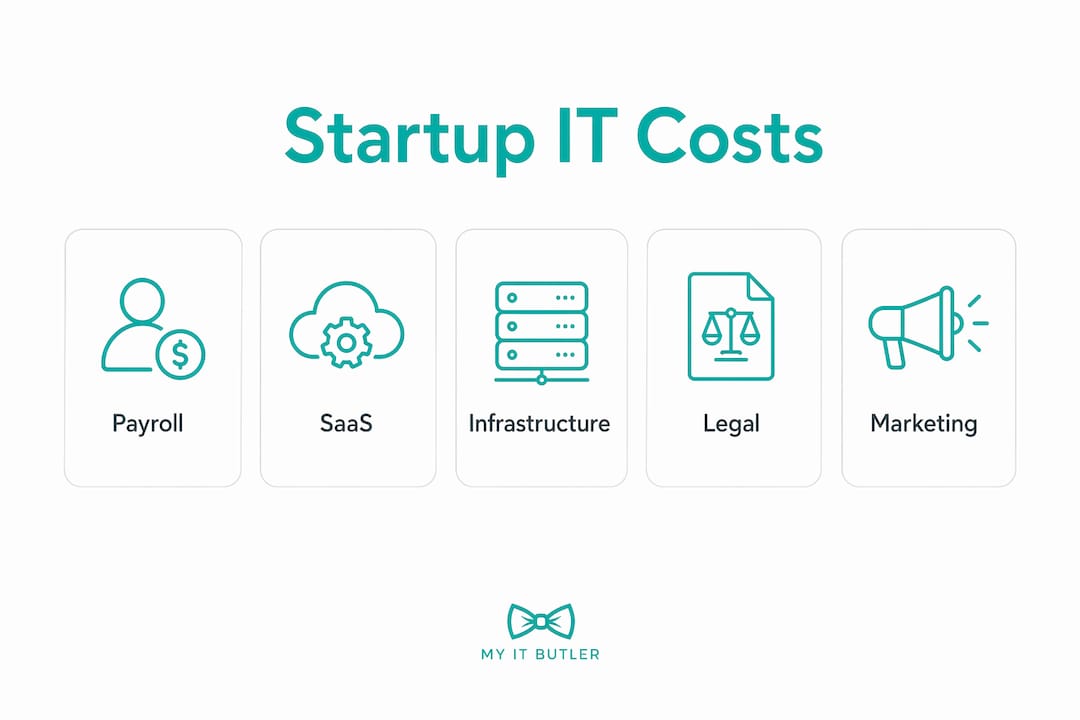
Miscellaneous costs include accounting software like Xero or QuickBooks, payment processing fees through Stripe or Square (typically 1.7% to 2.9% per transaction), cyber insurance, and domain registration at roughly $15 per year.
| Cost category | Typical monthly range |
|---|---|
| SaaS tools and infrastructure | $2,000 to $10,000 |
| Payroll (per hire, fully loaded) | $8,000 to $15,000+ |
| Workspace (coworking or office) | $0 to $4,200 |
| Legal and compliance | $200 to $500 (ongoing) |
| Marketing technology | $500 to $20,000 |
Pro Tip: Build your cost catalogue in a simple Google Sheets spreadsheet before you sign up for anything. List every tool, its monthly cost, and whether it is one-time or recurring. This single habit prevents subscription sprawl from eating your runway.
How do startup IT costs vary by funding stage?
The cost of IT services looks completely different depending on whether you are a solo founder bootstrapping from savings or a team of twelve running on seed capital.
A bootstrapped solo founder building an MVP in 2026 can genuinely launch for under $2,000 by using free tiers on Vercel or Railway for hosting, a $15 domain, and AI coding assistants like GitHub Copilot. This approach defers costly infrastructure and legal spending until revenue validates the idea. It is not glamorous, but it works.
A bootstrapped small team of two to five people changes the maths significantly. Monthly burn for pre-revenue startups typically runs $500 to $15,000 depending on headcount and tool choices. The moment you add a second person, you need proper access management, shared communication tools, and at minimum a basic security policy.
Seed-funded startups face a different reality entirely. Seed-stage burn rates for teams of 10 to 15 people run $64,500 to $143,000 per month. At that scale, the IT budget for startups includes enterprise-grade security, dedicated DevOps tooling, compliance frameworks, and often a fractional CTO or outsourced IT management.
| Startup type | First-year IT spend estimate | Key cost driver |
|---|---|---|
| Bootstrapped solo founder | $10,000 to $80,000 | Tools and freelancers |
| Bootstrapped small team | $30,000 to $120,000 | Payroll and SaaS |
| Seed-funded team (10 to 15) | $150,000 to $500,000+ | Payroll and marketing |
SaaS startups face a particular challenge as they grow. Cloud infrastructure costs escalate non-linearly beyond 100 users, consuming 5% to 15% of revenue. This requires early optimisation decisions around database architecture and API design that many non-technical founders do not anticipate.
Pro Tip: Use free tiers on AWS, Google Cloud, and tools like Notion, Figma, and Linear for as long as they serve your needs. Scale your spend only when paying customers demand it, not when you think you might need it.
What hidden startup IT costs do founders overlook?
The most dangerous costs in any startup budget are the ones that feel optional until they are not.
Subscription sprawl is the silent budget killer. A team of five can easily accumulate 30 to 40 active SaaS subscriptions across project management, design, communication, analytics, and security tools. Many founders overspend on infrastructure and tools prematurely, and starting with free subscriptions before scaling with paying customers dramatically improves runway.
Legal and compliance creep is the second major trap. Most founders budget for incorporation and forget that legal costs are ongoing. Privacy policy updates triggered by new regulations, contractor agreement revisions, and IP protection filings all carry fees. Underestimating legal expenses creates compounding risk, so treat these as a recurring line item rather than a one-time cost.
Premature infrastructure complexity is a trap for technical founders specifically. Building microservices architecture, Kubernetes clusters, and multi-region redundancy before you have 100 users wastes both money and time. The right infrastructure for an MVP is the simplest thing that works.
Hiring too early is the most expensive mistake of all. A common funding trap is hiring before revenue coverage is established, which dramatically increases payroll burn. Wait until recurring revenue fully covers salaries plus a runway buffer before expanding the team.
"Accurate financial planning distinguishes one-time startup expenses from monthly recurring costs and includes tax planning to allocate 25% to 30% of revenue for tax liabilities from the outset." — How to Calculate Startup Costs
Pro Tip: Do a subscription audit every 90 days. Cancel anything that has not been actively used in the past 30 days. Tools like Cledara or Spendesk make this visible at a glance for small teams.
How to create an IT budget for your startup
A practical IT budget for startups takes less than two hours to build and saves you from the most common financial surprises.
- List every known tool and service. Include hosting, domain, email, communication, CRM, security, accounting, and any APIs your product depends on. Be exhaustive.
- Separate one-time from recurring costs. A successful IT budget always distinguishes setup expenses from monthly obligations. One-time costs include hardware purchases, initial legal fees, and logo design. Recurring costs include every SaaS subscription, cloud hosting, and ongoing IT support.
- Add a 20% contingency buffer. Unexpected costs are not exceptional. They are normal. Budget for them explicitly rather than hoping they will not appear.
- Calculate your monthly burn rate. Add all recurring costs plus your own living expenses if you are not yet drawing a salary. This number tells you how much runway your current savings or funding provides.
- Plan your scaling triggers. Decide in advance at what revenue milestone you will upgrade from a free tier to a paid plan, or from a freelancer to a full-time hire. This prevents reactive, emotion-driven spending.
- Budget for IT support from month one. Outsourced IT support for startups typically costs far less than a single hour of downtime during a product launch. For guidance on building this into your plan, the IT budget for small business framework from Myitbutler is a practical starting point.
Early-stage SaaS startups should maintain a working capital buffer of 9 to 12 months of burn, because recurring revenue typically lags 6 to 18 months behind launch. Technology spend as a percentage of revenue declines from 15% to 25% at lean stages down to 8% to 14% at scale.
Pro Tip: Separate your IT budget into three columns: committed (signed contracts), probable (likely but not confirmed), and possible (nice to have). Review this monthly and move items between columns as your situation changes.
What IT costs can Australian startups expect?
Understanding startup technology costs in the Australian context requires accounting for both local pricing and the global nature of most modern startup tools.
Australian startups pay for most SaaS tools in US dollars, which means exchange rate fluctuations directly affect your monthly burn rate. A $5,000 USD monthly SaaS bill becomes approximately $7,500 to $8,000 AUD depending on the exchange rate. This is a real cost that many founders ignore until it shows up on their bank statement.
Remote IT support is one of the most cost-effective investments an Australian startup can make. The benefits are concrete:
- No full-time IT hire required. A junior IT employee in Australia costs $60,000 to $80,000 AUD per year fully loaded. A managed IT support plan from a provider like Myitbutler costs a fraction of that with broader expertise.
- Faster problem resolution. Downtime during a product launch or investor demo is not just inconvenient. It has a direct dollar cost. Professional IT support reduces mean time to resolution significantly.
- Compliance and security coverage. Australian Privacy Act obligations, data sovereignty requirements, and cyber security frameworks like the Essential Eight all require ongoing attention. A qualified IT partner handles this as part of their service.
- Scalability without headcount. As your team grows from two to twenty, your IT support scales with you without the overhead of hiring and training.
For founders evaluating their options, the IT support options for startups guide covers the main models available in 2026, from break-fix arrangements to fully managed services.
Good IT support also directly supports your fundraising story. Investors look for operational maturity, and a startup with documented IT policies, security controls, and a managed support arrangement signals that the founders understand how to build a real business. The connection between IT and startup fundraising is more direct than most founders realise.
Key takeaways
Startup IT costs are manageable when you separate one-time setup expenses from recurring obligations, apply a 20% contingency buffer, and scale your technology spend in line with paying customers rather than ambition.
| Point | Details |
|---|---|
| Know your cost categories | Budget across six areas: payroll, SaaS tools, workspace, legal, marketing tech, and miscellaneous. |
| Stage determines spend | Bootstrapped solo founders can launch for under $2,000; seed-funded teams burn $64,500 to $143,000 monthly. |
| Hidden costs are predictable | Legal creep, subscription sprawl, and premature hiring are the three most common budget killers. |
| Build in a 20% buffer | Every startup budget needs a contingency line. Unexpected costs are normal, not exceptional. |
| IT support pays for itself | Outsourced IT support costs less than a single hour of downtime and covers compliance obligations. |
Why I think most founders get their IT budget wrong from the start
The founders I see struggle most with IT costs are not the ones who spend too much. They are the ones who spend in the wrong order.
The pattern repeats itself constantly. A founder signs up for an enterprise CRM before they have ten customers. They build a multi-region cloud architecture before they have validated a single feature. They hire a full-time developer before they have confirmed that anyone will pay for the product. Every one of those decisions felt logical at the time and turned out to be expensive.
The uncomfortable truth about understanding startup technology costs is that most of the money wasted in the first year goes to tools and people that were added to signal seriousness rather than to solve a real problem. Free tiers on Notion, Linear, Vercel, and GitHub will carry most solo founders to their first $10,000 in revenue without breaking a sweat.
What I have found genuinely valuable, and what most articles on this topic skip, is the discipline of separating your IT budget into committed versus probable versus possible spending. Committed costs are non-negotiable. Probable costs are likely but not yet signed. Possible costs are aspirational. Reviewing this split monthly forces honest conversations about what is actually necessary right now.
The other thing I would push back on is the idea that IT support is a cost to defer. Getting early IT support in place before you need it is one of the highest-return investments a startup can make. A security incident, a compliance failure, or a week of downtime during your growth phase costs far more than a year of managed IT support. The founders who treat IT as a strategic function from day one are the ones who have cleaner cap tables, better investor conversations, and fewer operational fires to fight.
— Thomas
How Myitbutler helps startups control IT costs
Myitbutler provides remote IT support for startups and small businesses with Australian-standard expertise delivered globally. Whether you are a solo founder in Melbourne or a distributed team across three time zones, Myitbutler's fixed-price plans give you enterprise-grade IT management without the enterprise-grade price tag. There are no long-term contracts, which means your IT spend scales with your business rather than locking you into commitments you cannot afford.
Myitbutler's team holds CCNA, CompTIA Security+, and PRINCE2 certifications, covering everything from on-demand troubleshooting to vendor liaison and compliance planning. If you want to understand exactly how IT support fits into your startup budget, book a consultation and get a clear picture of what you actually need versus what you can defer.
FAQ
What is included in startup IT costs?
Startup IT costs cover hardware, software subscriptions, cloud hosting, IT support, legal and compliance tools, marketing technology, and payment processing fees. Both one-time setup expenses and ongoing monthly costs are included.
How much should a startup budget for IT in the first year?
Bootstrapped solo founders typically spend $10,000 to $80,000 in their first year, while seed-funded teams can exceed $500,000 once payroll and marketing are included. The right number depends on your funding stage, team size, and business model.
What is the biggest hidden IT cost for startups?
Fully loaded employee costs are the most commonly underestimated expense. A $100,000 base salary costs $125,000 to $140,000 once payroll taxes, superannuation, and onboarding are factored in.
When should a startup invest in IT support?
From day one, or as soon as you have customer data or a live product. Early IT support reduces downtime, covers compliance obligations, and costs significantly less than recovering from a security incident or data breach.
How do I calculate my startup's IT burn rate?
List all recurring IT costs including SaaS subscriptions, hosting, support contracts, and payroll. Add a 20% contingency buffer, then divide by 12 for your monthly burn rate. Compare this against your available capital to determine your runway.