
TL;DR:
- Proper IT infrastructure is essential in startup fundraising because investors form judgments based on document sharing and security practices. A well-organized virtual data room, strong security features, and consistent investor updates build credibility and speed up deal closing. Maintaining good data hygiene and leveraging CRM tools transforms investor engagement into a streamlined, confidence-inspiring process.
Most founders treat fundraising as a pitch problem. Refine the deck, sharpen the story, target the right VCs. But the role of IT in startup fundraising is just as decisive as the narrative itself. Investors form judgements before a single meeting takes place. They assess how quickly you share documents, whether your data room is organised, and how confidently you handle their security questions. Get the IT side wrong and the deal slows down, or dies. Get it right and you close weeks faster, build genuine credibility, and set up every future round on a stronger foundation.
Table of Contents
- Key takeaways
- The role of IT in startup fundraising
- IT-enabled investor engagement systems
- Data hygiene and IT governance
- Practical IT workflows for document sharing
- My perspective on IT and fundraising
- How Myitbutler supports startup fundraising
- FAQ
Key takeaways
| Point | Details |
|---|---|
| Virtual data rooms accelerate deals | A well-structured VDR can compress due diligence by two to four weeks compared to ad hoc file sharing. |
| Consistent investor updates matter | Founders who send monthly updates raise follow-on rounds about 2.3 times faster than those with sporadic communication. |
| Data hygiene is foundational | Clean, duplicate-free records prevent miscommunication and broken workflows throughout the fundraising process. |
| Security controls build investor trust | Features like 256-bit encryption, two-factor authentication, and audit trails are expected by institutional investors. |
| IT is a system, not a folder | Treating your data room and CRM as living systems with version control and permissions prevents costly rework. |
The role of IT in startup fundraising
When investors receive a request to review your company, the first thing they interact with is not your product. It is your documentation infrastructure. The way you share, organise, and protect information signals how you run your business.
Virtual data rooms: your due diligence engine
A virtual data room (VDR) is a secure, cloud-based environment where founders store and share sensitive documents with investors during due diligence. Think of it as a digital deal room that replaces the old practice of emailing PDFs back and forth or dropping files into a generic shared drive.
A seed-stage data room typically spans 40 to 70 documents across seven core categories, but the smartest founders trim that to 15 to 25 lean, well-labelled documents. This is not about hiding information. It is about respecting investor time and removing friction from the review process.
The seven categories typically covered are:
- Company overview: executive summary, pitch deck, cap table
- Financials: historical statements, projections, and unit economics
- Legal: incorporation docs, IP assignments, and existing agreements
- Team: bios, org chart, and key employment contracts
- Product: roadmap, technical architecture summary, and demo access
- Market: customer research, competitive positioning, and growth data
- Operations: key vendor contracts and any regulatory approvals
The reason lean rooms matter is measurable. Organised data rooms help close deals up to 35% faster compared to disorganised document handling, with seed round timelines compressing by two to four weeks when a clean room is ready from day one.
Pro Tip: Structure your data room index to follow the typical path an investor takes during due diligence. Company overview first, financials second, legal third. This matches their mental model and reduces back-and-forth questions.
| Feature | Generic cloud storage | Purpose-built VDR |
|---|---|---|
| Granular access controls | No | Yes |
| Dynamic watermarking | No | Yes |
| Viewer analytics | No | Yes |
| Audit trail | No | Yes |
| Two-factor authentication | Optional | Standard |
| Revoke-after-download | No | Yes |
Dedicated VDR software provides 256-bit encryption, role-based permissions, and SOC 2 or ISO 27001 certifications. These are not nice-to-haves. Institutional investors treat them as minimum requirements, and missing them raises immediate red flags about how seriously you take data governance.
IT-enabled investor engagement systems
Getting investors into a data room is one thing. Keeping them engaged throughout a six-month fundraise is another challenge entirely. This is where CRM tools and automated communication workflows become your most underused asset.

A CRM built for investor relations does three things that manual tracking cannot. It logs every interaction automatically, schedules follow-ups without you needing to remember, and surfaces which investors have gone quiet so you can re-engage before momentum dies. Integrated investor relations platforms create a single source of truth for all interactions, preventing the common pitfall of duplicate outreach or missed follow-ups that plague founders managing everything in a spreadsheet.
Here is a practical sequence for building IT-enabled investor engagement:
- Set up a CRM before your first outreach. Tools purpose-built for fundraising let you tag investors by stage, interest level, and last contact date.
- Create a monthly update template and schedule it. Founders who send consistent monthly updates raise follow-on rounds 2.3 times faster because regular communication builds trust and keeps your company top of mind.
- Structure each update with four components: a metrics dashboard showing key numbers, highlights and lowlights from the past month, a specific ask, and your current cash position. This format provides execution evidence that reinforces your credibility.
- Use engagement analytics to prioritise follow-ups. If your CRM shows that three investors opened your last two updates but have not replied, that is your short list for this week's calls.
- Automate reminders, not relationships. Let automation handle scheduling and logging. Keep the actual communication personal and specific.
Pro Tip: Never send a fundraising update and go quiet for six weeks. The investor update cadence creates a reinforcement loop. When you eventually ask for a meeting, you are not a cold contact. You are a founder they have been quietly tracking for months.
Data hygiene and IT governance
Here is the insight most founders miss: the biggest failure in fundraising technology adoption is not a lack of fancy dashboards. It is poor data hygiene. Duplicate investor records, outdated contact details, broken segmentation. These cascade into missed follow-ups, conflicting information, and the kind of operational sloppiness that sophisticated investors notice immediately.
Data governance is IT infrastructure, not just housekeeping. Treat it that way from the start.
The practices that matter most during a fundraising process are:
- Deduplicate your investor database monthly. Merge duplicate records before they lead to double outreach or conflicting notes.
- Version control every document in your data room. When financials are updated, archive the old version and label the new one clearly. Investors who return to a room should always find the current document.
- Implement role-based access. Not every team member needs to see every document shared with investors. Limit access to what each person actually needs.
- Run a compliance check before launch. Confirm that your file sharing practices align with relevant privacy obligations, particularly if you have international investors. The Australian Privacy Act and equivalent international frameworks apply to how you handle personal investor data.
- Audit your communication logs quarterly. A clean record of who said what and when is invaluable if a deal later becomes complicated.
Pro Tip: Before you start any funding round, spend two hours cleaning your investor database. Remove duplicates, update contact details, and tag every record by relationship stage. Two hours of data hygiene saves weeks of confusion during the round itself.
Practical IT workflows for document sharing
Knowing you need a VDR is one thing. Knowing how to run it through a live fundraising process is what separates founders who close quickly from those who spend months recreating documents and chasing access requests.
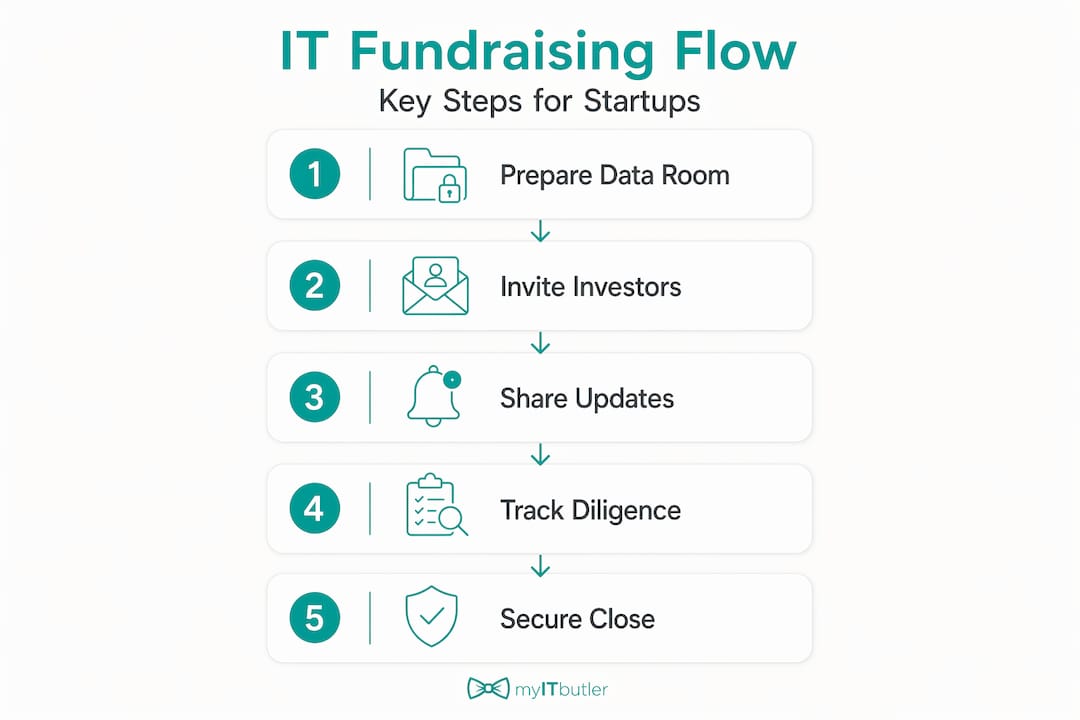
The inbound fundraising playbook recommends preparing your document infrastructure approximately six weeks before you begin sharing. That gives you time to build, test, and refine the room before an investor is actually sitting inside it.
Here is a practical timeline:
- Weeks one and two: Build the data room index following a standard due diligence path. Upload your core 15 to 25 documents. Test all links and access controls internally.
- Week three: Set up NDA gating so investors must accept a non-disclosure agreement before entering the room. Configure per-investor unique links so you can track exactly who has accessed what.
- Week four: Enable dynamic watermarking. Every PDF viewed or downloaded will carry the investor's name and timestamp, which discourages unauthorised sharing.
- Weeks five and six: Do a final security and content review. Confirm that the revoke-after-download and audit trail features are active. Share access with two trusted advisers and get their feedback on structure and clarity.
- During the round: Use viewer analytics to see which investors spent the most time on which sections. An investor who spent 20 minutes on your financials and five minutes on the team page is telling you where to focus your next conversation.
- Post-close: Archive the round's data room with full audit logs. This becomes your starting point for the next round, not a folder you rebuild from scratch.
| Workflow stage | IT action | Outcome |
|---|---|---|
| Pre-launch | Build staged data room with NDA gating | Controls who enters and when |
| Active round | Track per-investor engagement analytics | Prioritises follow-up conversations |
| Document sharing | Dynamic watermarking on all files | Reduces unauthorised redistribution |
| Post-access | Revoke access after close or rejection | Maintains confidentiality of sensitive docs |
| Next round | Carry forward version-controlled room | Saves weeks of setup time |
Experienced founders treat their data room as a living permission system, not a one-time folder upload. The difference in efficiency over multiple rounds is substantial. For practical guidance on NDA-gated document workflows, the PeerFounder due diligence framework outlines a structured approach worth reviewing.
My perspective on IT and fundraising
Over the years I have watched talented founders walk into investor meetings completely unprepared on the IT side. They had great products and believable stories. But when the investor asked for the data room link, they sent a Google Drive folder with no permissions, no version labels, and a financial model that had not been updated since the previous quarter.
The uncomfortable truth is that investors judge operational maturity through how you manage information. An unstructured data room tells them that your internal systems are probably just as chaotic. It is not a conscious verdict. It is a gut feeling that accumulates across every small friction point.
What I have found actually works is treating IT infrastructure as a fundraising preparation task, not an afterthought. Get the data room, CRM, and communication cadence sorted before you send a single investor email. The founders who do this close faster, receive fewer diligence questions, and walk into second meetings with momentum rather than cleanup to do.
The other lesson I keep coming back to is this: the technology is not the hard part. Any founder can set up a VDR in a day. The discipline is the hard part. Maintaining data hygiene, updating the room consistently, and sticking to the monthly update schedule when things get busy. That is where most founders fall short, and it costs them weeks they cannot afford to lose.
— Thomas
How Myitbutler supports startup fundraising
Preparing for a funding round puts enormous pressure on your IT setup. Founders dealing with investor document requests, security audits, and remote team coordination all at once often find their technology infrastructure is not ready for the scrutiny.
Myitbutler provides remote IT support for startups that covers exactly these scenarios. From setting up secure document sharing environments to advising on data governance and access controls, the team brings over 15 years of enterprise-grade IT experience to early-stage companies that need institutional-quality systems without the cost of an in-house IT department. If you are heading into a funding round and want an expert review of your IT setup, book a consultation to get started.
FAQ
What does a startup virtual data room need to include?
A seed-stage data room should cover company overview, financials, legal documents, team information, product details, market research, and operations. Trim the total to 15 to 25 well-labelled documents for the fastest due diligence process.
How does IT infrastructure affect investor confidence?
Investors assess operational maturity by how securely and efficiently you handle documentation. Features like audit trails, role-based access, and the ability to revoke document access quickly signal that you run a well-governed business.
What security features should a startup data room have?
At minimum, your data room should include 256-bit encryption, two-factor authentication, dynamic watermarking, and a full audit trail. SOC 2 or ISO 27001 certification from your VDR provider adds further credibility with institutional investors.
How often should founders send investor updates?
Monthly updates using a consistent format covering key metrics, highlights, specific asks, and cash position produce the best results. Founders who maintain this cadence raise follow-on rounds roughly 2.3 times faster than those who communicate sporadically.
Can a CRM really improve fundraising outcomes?
Yes. A CRM built for investor relations prevents duplicate outreach, surfaces investors who have gone quiet, and creates a measurable engagement pipeline. The practical impact is fewer missed follow-ups and faster deal progression across a multi-month round.