
TL;DR:
- Small businesses with a written IT strategy grow 30% faster by aligning technology with their goals. Without proactive planning, they face higher costs, increased cybersecurity risks, and slower growth. Even a simple, clear plan helps optimize resources, improve security, and adapt quickly to changing business needs.
Most small business owners assume IT strategy is something large corporations worry about. Wrong. The data tells a different story: businesses with written plans grow 30% faster than those without one, and why small businesses need an IT strategy has never been more pressing. Your technology decisions today will either accelerate your growth or silently drain your budget, one reactive repair at a time. This article explains what an IT strategy actually is, the practical advantages it delivers, the risks you face without one, and how to build something that works for your size and budget.
Table of Contents
- Key takeaways
- Why small businesses need an IT strategy
- Real benefits of having an IT strategy
- What happens without an IT strategy
- How to build a practical IT strategy
- Measuring whether your IT strategy is working
- My take on why this matters more than most owners realise
- How Myitbutler supports your IT strategy
- FAQ
Key takeaways
| Point | Details |
|---|---|
| IT strategy drives growth | Documented strategies help small businesses grow faster and allocate resources wisely. |
| Cybersecurity is non-negotiable | Nearly half of all SMBs faced a cyberattack last year, making security planning critical. |
| Reactive IT costs more | Break-fix models consistently cost more over time than proactive, planned IT management. |
| Measurement matters | Assign KPIs to your IT goals or you will never know if your investments are working. |
| Remote IT partners fill the gap | Trusted managed IT support removes the need for expensive full-time in-house staff. |
Why small businesses need an IT strategy
Think of an IT strategy as a written plan that connects your technology decisions to your actual business goals. Not a list of software you use. Not your IT support phone number. A genuine plan that answers: what do we need technology to do for us over the next one to three years, and how will we get there?
A proper IT strategy covers several areas that most small businesses handle reactively, if at all:
- Technology planning: What tools, systems, and infrastructure do you need to operate and grow?
- Cybersecurity: How will you protect your data, your customers, and your reputation?
- Budget allocation: Where should technology spending go to deliver the most value?
- Operations: How do your systems support day-to-day workflows, remote teams, and communication?
- Vendor management: Who are your technology providers and how are those relationships managed?
The key distinction is this: IT support fixes things when they break. An IT strategy decides what should be built, protected, and invested in before anything breaks. IT strategy is a leadership mandate that requires assigning real dollar value to technology initiatives, not simply calling the technician when the printer stops working.
For small businesses specifically, this matters because every dollar and every hour counts. Without a plan, technology spending happens in response to crises rather than in service of goals.

Real benefits of having an IT strategy
The advantages are practical, measurable, and directly tied to how your business performs day to day.
-
Improved productivity. When your systems are planned and maintained proactively, staff spend less time dealing with slow computers, broken software, and confusing workarounds. Planned IT infrastructure means your team can focus on actual work.
-
Stronger cybersecurity. Nearly 48% of SMBs experienced a cyberattack in the past year, primarily through phishing and stolen credentials. A documented IT strategy includes a security plan, not a scramble after something goes wrong. Practical customer data protection starts at the strategy level.
-
Better budget control. Unplanned IT spending is unpredictable and expensive. A strategy sets budgets for hardware refresh cycles, software licences, and security tools in advance. No more emergency purchases at the worst possible time.
-
Digital transformation that actually works. 70% of digital transformations fail due to lack of clear ambition and human resistance to change. A written strategy forces you to be honest about your capabilities and plan the change properly.
-
Support for remote work and global teams. If your business operates across locations or time zones, your technology has to hold it together. A strategy that accounts for remote network security and collaboration tools keeps distributed teams running without chaos.
-
Competitive advantage. Businesses with clear technology plans adapt faster to market changes. A strong IT strategy aligns departments, aids leadership through change, and positions you to adopt useful technology ahead of slower competitors.
Pro Tip: You do not need a 50-page document. Even a two-page written IT plan covering your goals, current systems, security approach, and budget priorities will put you ahead of most small businesses.
What happens without an IT strategy
The consequences of ignoring IT planning rarely arrive all at once. They accumulate quietly, until one incident makes the cost impossible to ignore.
- Constant reactive repairs. Most small businesses lack full-time IT staff, meaning every problem is handled on a break-fix basis. That model costs significantly more over time than managed, proactive support.
- Data breaches with real consequences. Phishing and stolen credentials are the top entry points for SMB breaches, and ransomware demands now average over $120,000. For most small businesses, that is not a recoverable figure.
- Technology that falls behind. Without a plan, businesses keep running outdated systems because there is no budget or process for upgrading. Competitors who planned ahead move faster.
- Wasted investment. Buying software because it sounds useful, or because a salesperson called at the right moment, is how technology budgets disappear with nothing to show for it.
- Employee frustration. Poor, unreliable, or confusing technology is one of the most commonly cited sources of workplace frustration. Staff productivity suffers, and good people leave.
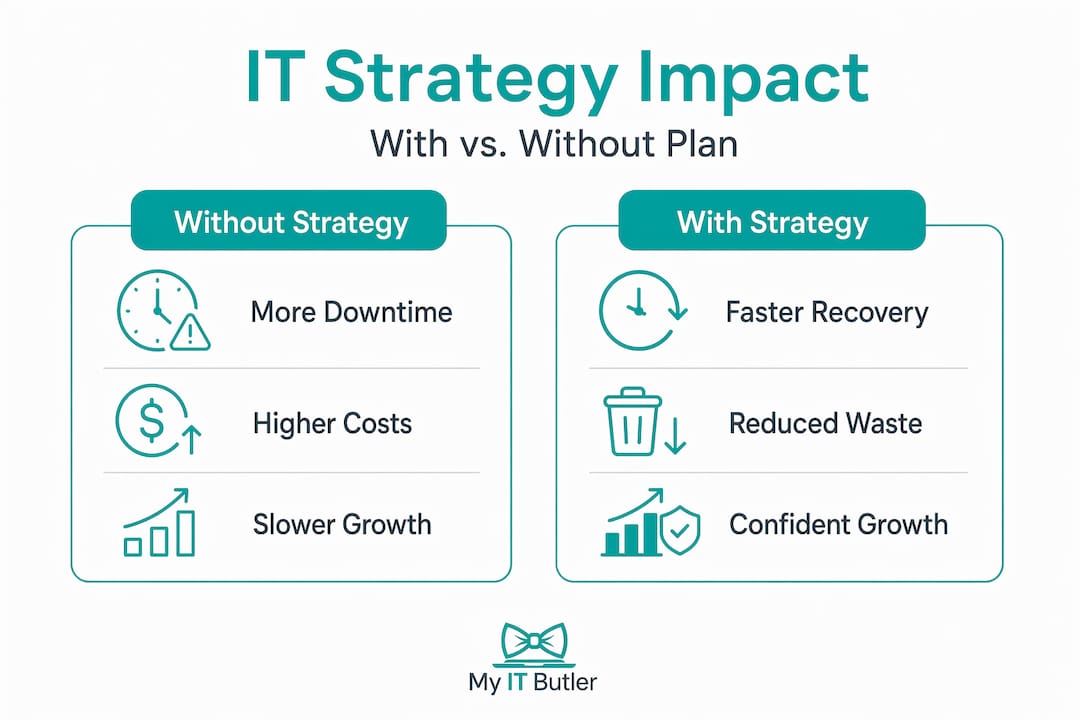
The pattern is predictable. Small businesses without a strategy spend more, recover slower, and grow less confidently than those with even a basic written plan.
How to build a practical IT strategy
You do not need a technology background to build an IT strategy. You need honesty about where you are, clarity about where you are going, and the discipline to write it down.
-
Assess your current environment. List every system, tool, and piece of hardware your business relies on. Identify what is working, what is unreliable, and what is missing. Be honest.
-
Align with business goals. Your IT strategy exists to serve your business, not the other way around. If you plan to grow your team, open a new location, or expand internationally, your technology plan needs to reflect those goals directly.
-
Involve your team. The people using your systems daily know where the pain points are. Their input shapes a strategy that solves real problems rather than assumed ones.
-
Set measurable objectives. Vague goals produce vague results. Define what success looks like: system uptime targets, response time for IT issues, a reduction in security incidents, or a specific cost-per-user target for technology.
-
Plan for cybersecurity explicitly. This is not optional. Include a security review, staff training on phishing awareness, and a data backup plan as non-negotiable elements. Explore IT support options for your size to match your security needs with your budget.
-
Budget realistically. Technology investment follows a predictable cycle. Hardware needs replacing every three to five years. Software licences renew annually. Security tools require ongoing management. Build these into your annual budget, not your emergency fund.
-
Review and adjust regularly. A strategy written once and filed away is not a strategy. Commit to a quarterly check-in and a full annual review. Assigning ownership and KPIs to each element of your plan is the single biggest factor in whether it gets executed.
Pro Tip: If you are not sure where to start, book a single consultation with a trusted IT partner. One conversation with the right expert will surface priorities you had not considered and save you months of trial and error.
Here is a quick comparison of how businesses operate with and without a formal IT strategy:
| Area | Without an IT strategy | With an IT strategy |
|---|---|---|
| Cybersecurity | Reactive, after incidents occur | Proactive, with regular reviews and controls |
| IT budget | Unpredictable, crisis-driven | Planned, with clear annual allocations |
| System downtime | Frequent, unplanned disruptions | Minimised through monitoring and maintenance |
| Technology adoption | Ad hoc, based on sales pressure | Deliberate, aligned to business objectives |
| Growth readiness | Limited by technology bottlenecks | Supported by scalable, planned infrastructure |
Measuring whether your IT strategy is working
Building a strategy is step one. Knowing whether it is delivering value is what separates businesses that grow from those that stagnate.
A few practical ways to track impact:
- Uptime and reliability metrics. How often do systems go down? How quickly are issues resolved? These numbers should improve year on year.
- Security incident tracking. Log every phishing attempt, unauthorised access attempt, and security event. A reduction over time confirms your controls are working.
- Cost per user. Track your total technology spend divided by staff count. This gives you a baseline to measure efficiency gains.
- Employee experience. Ask your team. Regular, short feedback surveys about technology frustration give you early warning on problems before they become expensive.
- Strategic goal progress. Every objective you set in your IT strategy should have a measurable outcome. Review them quarterly without exception.
The temptation is to chase every new technology trend. Resist it. Your strategy should evolve based on what your business actually needs, not what sounds impressive at a conference. Partnering with an experienced IT provider for an annual strategy audit keeps you honest and current without the distraction.
My take on why this matters more than most owners realise
I have worked with dozens of small businesses over the years, and the pattern is always the same. The ones struggling to grow are almost always the ones treating technology as an afterthought. They are brilliant at their core product or service, but their IT is a patchwork of decisions made under pressure, and it is quietly costing them every single day.
What surprises most owners when I walk them through their first proper IT review is not the cost. It is the risk. They had no idea their backup system had not run in six months. They did not know their former employee's account was still active. They had three different cloud subscriptions doing roughly the same thing because nobody ever stopped to compare them.
The good news is that catching up does not require a massive budget or a technical hire. It requires a written plan, clear priorities, and a trusted partner who can execute and advise. I have seen small businesses with five employees operate with more IT discipline than companies ten times their size, simply because they chose to be deliberate about it.
My honest view: if you are running a business and you do not have a documented IT strategy, you are not saving money. You are just deferring the cost until it arrives at the worst possible moment.
— Thomas
How Myitbutler supports your IT strategy
If the idea of building an IT strategy feels overwhelming, you do not need to figure it all out alone. Myitbutler provides remote IT support for small businesses across Australia and globally, with over 15 years of enterprise experience behind every engagement. The approach is proactive: regular monitoring, security management, vendor coordination, and strategic planning, all delivered remotely with fixed transparent pricing and no lock-in contracts.

Whether you need help assessing your current environment, building a security plan, or just want an expert second opinion on your technology setup, Myitbutler works as your dedicated IT partner without the cost of a full-time hire. You can book a consultation and get clear, practical guidance tailored to your business size, goals, and budget. No jargon, no upsells. Just honest IT advice from a team that has seen what works.
FAQ
What is an IT strategy for a small business?
An IT strategy is a written plan that connects your technology decisions to your business goals. It covers planning, cybersecurity, budgeting, and operations so your technology investment drives growth rather than creating problems.
How does IT strategy help small businesses grow?
Businesses with documented strategies grow 30% faster than those without one, because clear plans reduce waste, improve reliability, and allow faster adaptation to change.
What are the biggest risks of not having an IT strategy?
Without an IT strategy, small businesses face unplanned downtime, budget blowouts, data breaches, and an inability to compete with businesses that have invested in proactive technology planning.
Do I need a large budget to build an IT strategy?
No. A practical IT strategy can be built with modest resources. The priority is clarity about your goals and current systems, not expensive software or consultants. Even a short written plan delivers measurable benefits.
How often should a small business review its IT strategy?
A quarterly check-in combined with a full annual review is the standard recommendation. Technology and business needs change, so your strategy should be a living document rather than something written once and forgotten.