
TL;DR:
- IT visibility offers remote teams clear awareness of assets, workflows, and activities necessary to prevent disruptions.
- Implementing structured visibility reduces security risks, minimizes downtime, and fosters trust by replacing oversight with outcome tracking.
IT visibility is defined as the clear, consistent awareness of technology assets, workflows, and team activities that allows distributed businesses to operate without micromanagement or lost productivity. For remote teams, this awareness is not optional. Without it, leaders cannot detect problems early, support their people fairly, or maintain the security posture that modern distributed work demands. Understanding why IT visibility matters remotely is the starting point for every business leader managing teams across time zones, home offices, or international locations.
Organisations using modern IT asset visibility programs reduced average data breach costs by 9% to USD $4.4 million in 2025. That figure tells you something concrete: visibility is not just a management philosophy. It is a measurable financial control. Myitbutler, operating to Australian standards with CCNA, CompTIA Security+, and PRINCE2 certifications, builds this kind of structured visibility into every remote IT engagement it delivers globally.
Why IT visibility matters remotely for operational risk
Poor IT service visibility is the single biggest driver of extended downtime in distributed teams. When your IT environment lacks end-to-end service mapping, problems hide until they become crises. Enterprises without service mapping report increased downtime costs and inefficient troubleshooting that burns hours your team cannot recover.

The pattern is predictable. A server degrades quietly. No alert fires. A remote worker in Singapore notices their application is slow. They raise a ticket. Your IT team, working from a different time zone, starts diagnosing from scratch. By the time the root cause surfaces, the outage has compounded across three dependent systems. This is reactive firefighting, and it costs far more than the fix itself.
Multi-cloud environments make this worse. Visibility loss in complex cloud setups creates hidden operational and security vulnerabilities that standard monitoring tools miss entirely. The more distributed your infrastructure, the more you need automated incident detection and mapped service dependencies, not more staff watching dashboards manually.
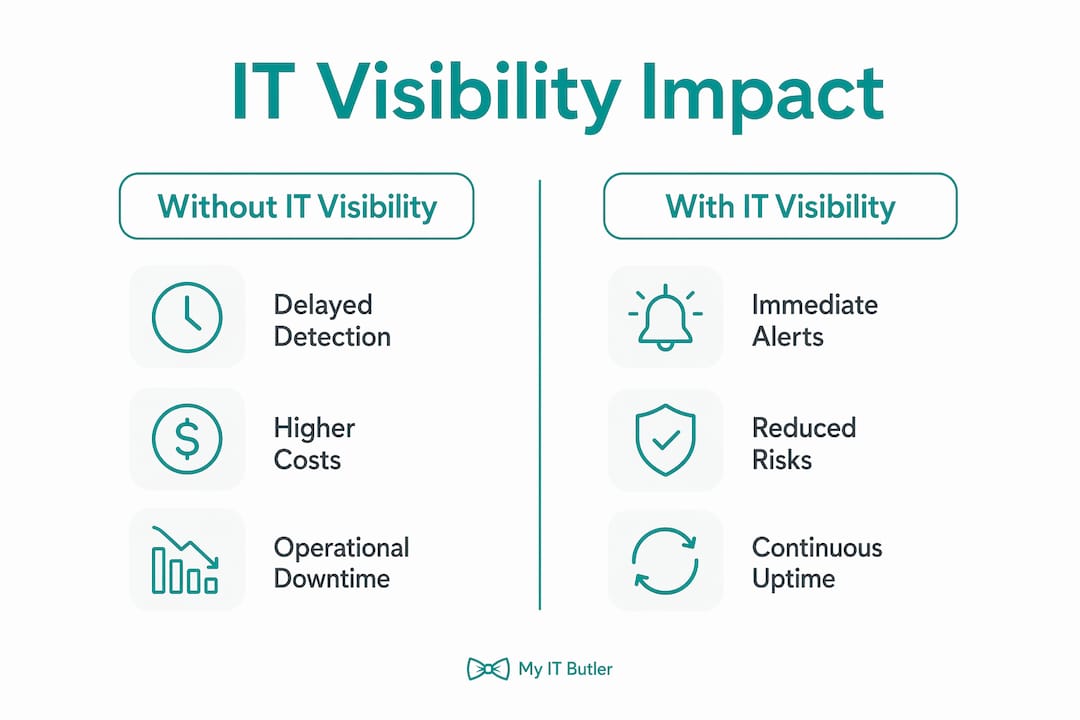
| Scenario | Without IT visibility | With IT visibility |
|---|---|---|
| Incident detection | Manual, delayed, reactive | Automated, early, proactive |
| Downtime duration | Extended, compounding | Contained, faster resolution |
| Troubleshooting cost | High, repeated effort | Lower, targeted response |
| Security exposure | Hidden vulnerabilities | Mapped and monitored |
| Team confidence | Low, blame-prone | High, process-driven |
Pro Tip: Map your critical services end-to-end before an incident occurs. A simple dependency diagram showing which systems rely on which others costs nothing to create and saves hours when something breaks.
How does remote visibility affect team careers and collaboration?
Proximity bias is the tendency for managers to favour employees they see in person, and it remains a documented career barrier for remote workers in 2026. Remote workers face career stalling when visibility systems do not replace the informal signals that physical presence once provided. This is not a soft HR concern. It directly affects who gets promoted, who gets sponsored for high-profile projects, and who builds the cross-functional relationships that drive career growth.
Early-career remote workers carry the heaviest burden here. Remote work slows early career growth without deliberate visibility focus, because the apprenticeship model, the informal mentoring, the hallway conversations, simply do not happen by default. Managers who do not actively build visibility systems for their teams are not being neutral. They are allowing proximity bias to decide outcomes.
The fix is not surveillance. Increasing status updates alone will not solve visibility problems rooted in poor manager relationships. What works is building advocacy through peer and skip-level engagement, making work outputs visible through shared dashboards, and creating deliberate touchpoints that surface contribution without requiring constant reporting.
Practical strategies for building remote team visibility include:
- Share weekly output summaries in a shared channel, focused on completed work rather than hours logged.
- Use project management tools to make task progress visible to the whole team, not just direct managers.
- Schedule regular skip-level check-ins so senior leaders see remote team contributions directly.
- Assign cross-functional projects that create natural visibility across departments.
- Recognise contributions publicly in team meetings and written communications.
Pro Tip: Frame visibility as an engineering problem, not a surveillance problem. Build the systems that surface work automatically, so your team spends time doing the work, not reporting on it.
How does transparency build trust in distributed teams?
Visibility and surveillance are not the same thing, and conflating them is the most common mistake remote leaders make. Surveillance tracks presence. Observability tracks outcomes. The distinction matters because tracking activity hours creates a 'looking busy' culture that damages morale and produces no useful management signal. Sustainable visibility maps task flow and output, not time online.
The engineering approach to this problem is embedding checkpoints directly into workflows. In software teams, this looks like CI/CD pipeline status boards that show build health without requiring a status meeting. In operations teams, it looks like shared dashboards that update automatically as tasks move through stages. The principle is the same: make the work visible, not the worker.
Visibility is the price of trust in remote teams. When commitments are explicit and workflows are tracked, managers stop guessing and teams stop being blamed for delays that were never their fault. Psychological safety rises when expectations are clear and progress is shared openly.
Visible workflows create psychological safety by replacing ambiguity with clear expectations. When a remote worker knows their progress is visible and their manager can see the blockers they are facing, the dynamic shifts from suspicion to support. This is how distributed teams build the kind of trust that holds across time zones and cultures.
Myitbutler applies this philosophy directly. Their remote IT oversight approach treats visibility as a structural feature of the IT environment, not an afterthought. Status-as-code, automated alerts, and proactive service monitoring replace the need for constant check-ins between clients and their IT support team.
What IT practices actually improve remote visibility?
The most effective IT visibility practices share one characteristic: they surface useful signals without creating noise or invading privacy. Results-oriented management depends on seeing what matters, not everything. Embedding checkpoints and automation into workflows turns invisible friction into manageable signals that teams can act on immediately.
For Australian small businesses managing remote teams, the following practices deliver the clearest return:
- Deploy centralised IT asset management to track device health, software versions, and licence status across all remote endpoints.
- Use automated alerting for service degradation rather than relying on users to report problems.
- Implement shared IT dashboards that show system status in real time, accessible to both IT teams and business leaders.
- Adopt IT tools for remote employees that integrate with existing workflows rather than requiring separate logins and manual updates.
- Set clear IT response time standards and make performance against those standards visible to the whole team.
The choice between entry-level field apps and enterprise platforms matters less than the discipline of using whatever you choose consistently. A simple shared status board used every day beats a sophisticated monitoring platform that nobody checks.
Pro Tip: Start with one visibility gap, not all of them. Pick the system your team complains about most, make its status visible, and build from there. Incremental visibility beats a big-bang rollout that nobody adopts.
Myitbutler offers managed IT services that include proactive monitoring, vendor liaison, and IT planning tailored to the specific needs of distributed teams. For businesses that do not have in-house IT capacity, this kind of structured support turns visibility from a goal into a daily operational reality.
Key takeaways
IT visibility is the foundation of effective remote team management, reducing security costs, preventing downtime, and replacing proximity bias with fair, output-based recognition.
| Point | Details |
|---|---|
| Visibility reduces breach costs | Organisations with IT asset visibility programs cut data breach costs to USD $4.4 million on average. |
| Poor visibility extends downtime | Without end-to-end service mapping, incidents compound and troubleshooting costs multiply. |
| Proximity bias needs active countering | Remote workers face career stalling without deliberate visibility systems that replace in-office signals. |
| Observability beats surveillance | Tracking task flow and outputs builds trust; tracking hours online damages morale and produces no useful data. |
| Automation makes visibility sustainable | Embedding checkpoints into workflows surfaces problems early without requiring constant manual reporting. |
IT visibility is a leadership problem, not a technology problem
After working with distributed teams across multiple industries, the pattern I keep seeing is this: leaders treat IT visibility as a tool selection problem when it is actually a relationship and systems design problem. They buy a monitoring platform, tick the box, and wonder why their remote teams still feel disconnected and their managers still complain about not knowing what is happening.
The technology is the easy part. The hard part is deciding what you actually want to see and why. Vanity metrics like hours online tell you nothing useful. What you need to see is whether work is moving, where it is blocked, and whether your people have what they need to do their jobs. That requires intentional design, not just software.
The leaders I have seen get this right share one habit: they treat visibility as a two-way street. They make their own priorities and decisions visible to their teams, not just the other way around. That reciprocity is what turns a monitoring system into a trust-building tool. It is also what separates a healthy remote culture from one where people feel watched rather than supported.
My honest view is that remote leaders who invest in structured IT visibility early, before the first major incident or the first unfair promotion decision, build teams that outperform those who wait. The cost of getting it right is low. The cost of getting it wrong compounds quietly until it becomes a crisis.
— Thomas
How Myitbutler supports remote IT visibility for Australian businesses
Myitbutler delivers remote IT support built around the kind of proactive visibility that distributed teams actually need. With over 15 years of enterprise experience and certifications including CCNA and CompTIA Security+, the team provides monitoring, incident management, and IT planning that keeps your systems visible and your team supported, wherever they are working.

For small businesses managing remote teams across Australia or internationally, Myitbutler offers fixed-price managed services with no long-term contracts. You get proactive alerts, vendor coordination, and a dedicated IT partner who understands the complexity of distributed operations. Book a free consultation to find out how structured IT visibility can reduce your downtime, protect your data, and give your remote team the support they deserve.
FAQ
What is IT visibility in remote work?
IT visibility is the clear awareness of technology assets, system health, and workflow status across a distributed team. It allows managers to detect problems early and support remote workers without micromanagement.
How does IT visibility reduce security risks?
Organisations with IT asset visibility programs reduced average data breach costs to USD $4.4 million in 2025, according to IBM research. Mapped service dependencies and automated alerts catch threats before they escalate.
What is proximity bias and how does visibility fix it?
Proximity bias is the tendency for managers to favour employees they see in person, which disadvantages remote workers. Deliberate visibility systems, such as shared output dashboards and skip-level check-ins, replace physical presence signals with fair, output-based recognition.
Is monitoring remote workers the same as IT visibility?
Monitoring presence and tracking hours is not the same as IT visibility. Sustainable visibility focuses on task flow and outputs, not time online, and builds trust rather than a culture of appearing busy.
How can a small business start improving IT visibility?
Start by mapping your most critical systems and setting up automated alerts for service degradation. Myitbutler provides managed IT services that include proactive monitoring and IT planning tailored to small business needs.