
TL;DR:
- Long-term IT contracts can lock startups into rigid agreements, reducing flexibility and increasing costs. These clauses threaten growth, cash flow, and investor confidence, especially when market conditions change rapidly.
Long-term IT contracts are one of the most common ways startups destroy their own flexibility before they ever get the chance to grow. The core problem, known in legal circles as vendor lock-in, is straightforward: a startup signs a multi-year agreement with an IT provider, and the moment the market shifts or the product pivots, that contract becomes a financial anchor. Fixed costs increase burn rate by over 10–20% when market conditions change. That kind of cost pressure can end a startup before the next funding round even begins.
Why IT contracts hurt startups: flexibility and cash flow
Rigid multi-year IT agreements are the single biggest contract threat to early-stage startups. A startup's greatest asset is its ability to change direction quickly. A three-year infrastructure contract removes that ability entirely.

Long-term obligations become liabilities overnight when rapid market changes hit. A startup locked into a fixed cloud or software agreement cannot downscale costs during a slow quarter, cannot switch to a better-fit technology, and cannot reallocate budget to product development when it matters most.
Cash flow is the other casualty. Fixed monthly fees eat into runway regardless of revenue performance. A startup generating $20,000 per month in revenue but paying $8,000 in locked-in IT costs has far less room to manoeuvre than one paying month-to-month for the same services.
Pro Tip: Before signing any IT agreement longer than 12 months, map out three realistic pivot scenarios for your business. If the contract prevents you from executing any of them, negotiate shorter terms or walk away.
The impact on startup IT costs compounds over time. Here is what long-term contracts typically restrict:
- Technology changes: You cannot swap vendors or platforms without paying exit fees.
- Headcount scaling: Per-seat pricing locked into a fixed user count punishes both growth and downsizing.
- Budget reallocation: Fixed IT spend cannot be redirected to sales, hiring, or product when priorities shift.
- Negotiating power: Locked-in founders lose all leverage with their vendor until renewal time.
Agility is a survival requirement for early-stage startups. Enterprise contract terms designed for large organisations with stable revenue and predictable headcount actively harm startups operating in volatile conditions.
Common contract pitfalls that jeopardise startup growth
Most startup founders sign contracts without a lawyer present. That is understandable given cost pressures, but it is also where the worst damage happens. The clauses that cause the most harm are rarely obvious on first reading.
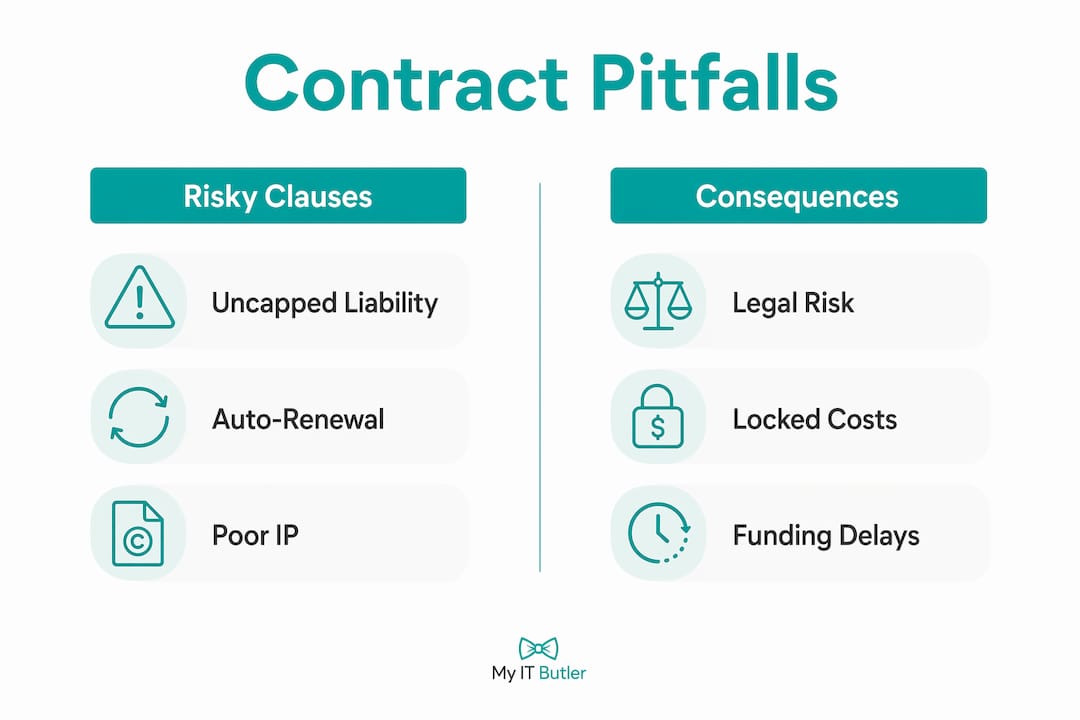
Uncapped indemnity, unlimited work obligations, and broad refund rights often become financial liabilities disproportionate to revenue. These clauses consume leadership attention and cash flow at exactly the moment a startup needs both focused elsewhere.
The five most damaging contract structures founders encounter are:
- Uncapped liability clauses: These expose a startup to unlimited financial risk if a dispute arises. A single claim can exceed total annual revenue.
- Auto-renewal with short cancellation windows: A 30-day cancellation notice buried in a 60-page agreement means missing the window locks you in for another full term.
- Broad refund or unlimited service obligations: Vague service scope language can obligate a startup to deliver work far beyond what was originally priced.
- IP ownership confusion: Early-stage contracts often borrow enterprise templates that inadvertently grant customers rights to product improvements or data, limiting valuation and AI model training capabilities.
- One-sided indemnity clauses: These require the startup to cover a customer's legal costs in almost any dispute, regardless of fault.
"Commercial contracts form the operational system for revenue. Ignoring critical clauses like termination rights and IP ownership risks building on borrowed land. Every clause you do not read is a risk you have accepted without knowing it."
The investor impact of these clauses is significant. Common contract clauses such as uncapped liability and auto-renewals can slow or jeopardise funding rounds in 1 in 5 startups. Investors read contracts as a signal of how well a founder understands their own business risk.
Poor IP clauses are particularly damaging for tech startups. If your customer agreements grant usage rights over your core product data, your valuation takes a direct hit. Acquirers and investors both scrutinise data rights during due diligence, and a single poorly worded clause can reduce what you can claim as proprietary.
Why do investors scrutinise startup contracts so closely?
Investors treat a startup's contract estate as a proxy for operational maturity. A disorganised set of contracts with inconsistent terms signals that the founding team does not have control of its own business.
Disorganised contracts or inconsistent versions can trigger audit delays and complicate fundraising efforts. A Series A due diligence process that uncovers five different versions of the same customer agreement is a red flag, not a minor administrative issue.
Investor diligence focuses heavily on three specific contract areas:
| Contract area | Why investors care |
|---|---|
| Customer data rights | Determines what the startup actually owns and can monetise |
| Termination flexibility | Shows whether the startup can exit bad relationships quickly |
| Ownership of improvements | Affects whether product enhancements belong to the startup or the customer |
| Payment and renewal terms | Signals churn risk and gross margin predictability |
Investor diligence focuses heavily on customer data, ownership of improvements, and termination flexibility as key risks. These are not legal technicalities. They are direct inputs into how an investor models your future revenue.
Unfavourable payment terms also affect how investors read gross margins. A contract that allows customers to delay payment by 90 days, or that includes automatic price reductions on renewal, directly reduces the revenue quality an investor sees in your financials.
Pro Tip: Before your next funding round, conduct a contract audit. Pull every active customer and vendor agreement, check for auto-renewals in the next 6 months, and flag any clause that limits your IP or data rights. Fix what you can before investors find it.
Founders who treat IT vendor selection as a purely technical decision often miss the contract risk entirely. The vendor you choose and the terms you accept are financial decisions with direct consequences for your cap table.
How can founders avoid startup contract pitfalls?
The good news is that most contract risks are avoidable with a small amount of preparation. Founders do not need to become lawyers. They need to become literate enough to spot the clauses that matter.
Standardising legal processes can shorten sales cycles and improve pipeline growth. A startup that handles routine contracts internally moves faster and spends less on external counsel.
Startups often face delays of up to 9 days on routine contract reviews by external law firms charging over €350 per hour. That delay costs momentum and revenue opportunities at the exact stage when speed matters most.
Here is a practical framework for reducing contract risk:
- Build a contract playbook: Document your standard positions on liability caps, IP ownership, payment terms, and termination rights. Use this as your starting point for every negotiation.
- Negotiate modular agreements: Push for shorter initial terms with renewal options rather than committing to multi-year deals upfront. A 12-month agreement with two renewal options gives you far more control than a 36-month lock-in.
- Use order forms to override master terms: Contracts are modular; founders can push back on specific clauses or override master terms by negotiating order forms. This is a standard commercial practice that many founders do not know is available to them.
- Reserve external counsel for high-stakes deals: Many founders pay external counsel excessively for routine documents like NDAs. Use lawyers for complex deals, not standard agreements you can manage internally.
- Set calendar reminders for every renewal date: Auto-renewal clauses are only dangerous when you miss the cancellation window. A simple calendar system eliminates that risk entirely.
The comparison below shows how contract approach affects startup outcomes:
| Approach | Risk level | Flexibility | Cost impact |
|---|---|---|---|
| Multi-year enterprise agreements | High | Low | Fixed costs increase burn rate |
| Month-to-month or short-term agreements | Low | High | Costs align with actual usage |
| Modular agreements with order forms | Medium | Medium-high | Negotiated terms reduce exposure |
Maintaining an organised contract repository and consistent versioning prevents costly diligence delays. This is a hallmark of operational maturity that investors notice immediately.
No-contract IT support is now a viable option for many startups. Choosing IT partners who operate without long-term lock-in removes one of the most common sources of contract risk entirely.
Key takeaways
Long-term IT contracts hurt startups by locking in fixed costs, limiting flexibility, and introducing hidden liabilities that damage both cash flow and investor confidence.
| Point | Details |
|---|---|
| Fixed costs increase burn rate | Multi-year IT agreements raise costs by 10–20% when market conditions shift. |
| Hidden clauses create funding risk | Uncapped liability and auto-renewals can slow or block funding rounds in 1 in 5 startups. |
| IP clauses affect valuation | Enterprise contract templates can inadvertently grant customers rights over your product data. |
| Investors read contracts as risk signals | Disorganised or inconsistent contract versions trigger audit delays and reduce investor confidence. |
| Short-term agreements preserve agility | Month-to-month or modular contracts keep costs aligned with actual usage and business needs. |
Contracts are infrastructure, not paperwork
I have worked with enough early-stage founders to know that contracts get treated as an afterthought. The product is the priority. The customer is the priority. The contract is just the thing you sign before you get to work.
That mindset is exactly why so many startups end up trapped. A contract is not paperwork. It is the operating system for your commercial relationships. Every clause you accept without reading is a decision you made without knowing you made it.
The founders I have seen navigate this well share one trait: they treat legal literacy as a competitive advantage, not a cost centre. They know their standard positions on liability, IP, and termination before they sit down to negotiate. They use external counsel selectively, not reflexively. And they build systems, like contract playbooks and renewal calendars, that keep them in control without requiring a lawyer on speed dial.
The practical reality for most startups is that flexible IT arrangements are available if you know to ask for them. Choosing IT partners who operate without long-term lock-in, like Myitbutler, removes one of the most common contract risks before it ever becomes a problem. That is not just a cost decision. It is a strategic one.
— Thomas
Myitbutler: flexible IT support with no lock-in
Startup founders dealing with contract risks do not need another vendor demanding a multi-year commitment. Myitbutler provides remote IT support for startups with transparent fixed pricing and no long-term contracts, backed by over 15 years of enterprise experience and Australian standards including CCNA and CompTIA Security+ certifications.
Whether you need on-demand troubleshooting, ongoing IT supervision, or vendor liaison support, Myitbutler works around your business needs rather than locking you into terms that no longer fit. For distributed teams, international operations, and founders who need reliable IT without the contractual baggage, book a free consultation to explore how flexible IT support actually works in practice.
FAQ
Why do IT contracts hurt startups more than large businesses?
Startups operate in volatile conditions where the ability to pivot quickly is critical to survival. Large businesses have stable revenue and headcount that absorb fixed contract costs; startups do not.
What contract clauses should founders watch out for most?
Uncapped liability, auto-renewal with short cancellation windows, and broad IP ownership clauses cause the most damage. These can limit valuation, block funding rounds, and expose founders to unlimited financial risk.
How do poor contracts affect startup funding rounds?
Investors treat contract estates as operational risk signals. Disorganised contracts, inconsistent versions, or unfavourable IP clauses can trigger audit delays and reduce valuation during due diligence.
Can startups negotiate IT vendor contracts?
Contracts are modular, and founders can push back on specific clauses or use order forms to override master terms. Shorter initial terms with renewal options are a standard and achievable negotiating position.
What is the best way to manage contract renewals?
Set calendar reminders for every auto-renewal date at least 60 days before the cancellation window closes. A simple tracking system eliminates the most common and costly contract mistake founders make.