
TL;DR:
- Startups should prioritize structured evaluation and clear contract terms over demos and pitch quality. They must assess vendors with objective scoring, limit shortlists to avoid analysis paralysis, and ensure proper documentation and ownership from the start. Ongoing management and focus on long-term fit safeguard against costly dependency and technical debt.
Startup IT vendor selection is the structured process of evaluating, scoring, and contracting technology partners based on defined business requirements and measurable fit criteria. Most founders treat it as a procurement task. The best founders treat it as a hiring decision for a long-term partner. Done poorly, the process produces technical debt, wasted budget, and months of lost progress. Done well, it gives your startup a technology foundation that grows with you. Myitbutler, operating to Australian enterprise standards, works with startups globally to make this process faster and far less painful.
What are the essential steps in the startup IT vendor selection process?
The single biggest mistake in IT vendor selection is starting with demos before agreeing on requirements. Stakeholder alignment on requirements must come first. Without it, every demo becomes a political debate rather than an evidence-based comparison. Write a formal requirements document, get every decision-maker to sign off, and only then open the door to vendors.

The full process, done properly, takes around 6 weeks. That is not a long time. It is the minimum needed to avoid the alternative: months of drift, conflicting opinions, and a decision made on gut feel.
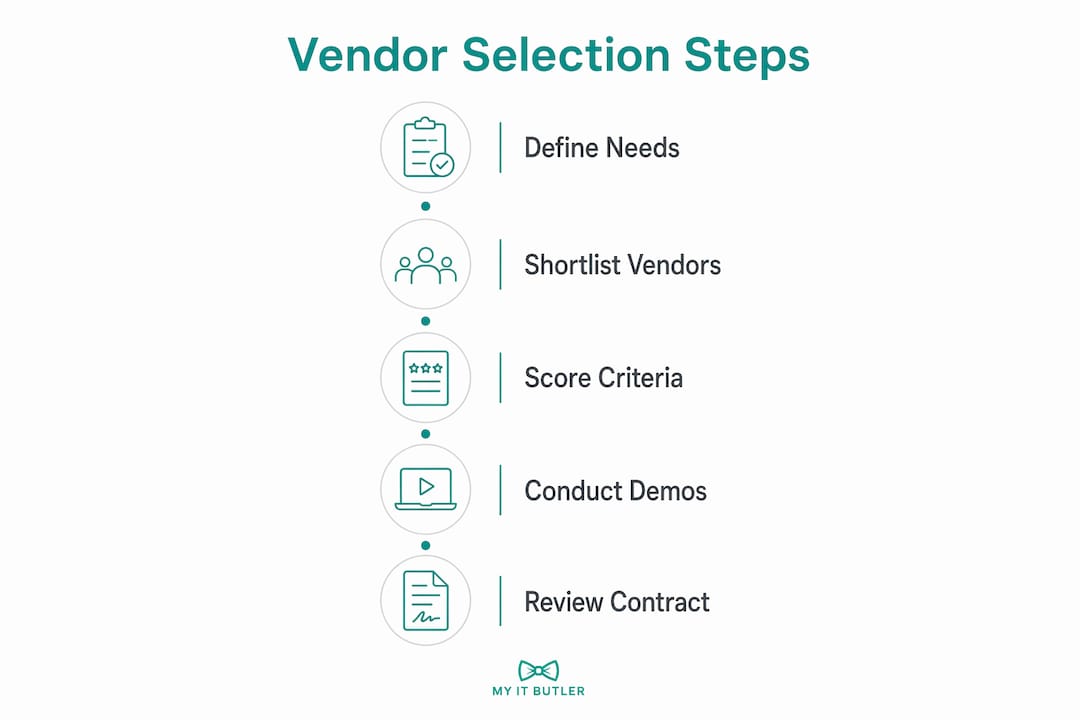
Here are the core steps every startup founder should follow:
- Write a requirements document. List your must-have features, integration needs, security requirements, and budget boundaries. Every stakeholder signs it before any vendor is contacted.
- Build a shortlist of 3–5 vendors. Evaluating more than 5 vendors leads to analysis paralysis and demo fatigue. Narrow the field early using desk research and peer referrals.
- Run scenario-based demos. Give each vendor the same real-world scenarios drawn from your actual workflows. Score each demo against your requirements document, not against each other.
- Conduct a proof of concept (PoC). PoC testing is most effective when your own team runs it on real data without vendor guidance. Vendor-assisted PoCs mask friction and usability problems.
- Check references properly. Ask referees about problems, not just successes. A reference who only praises the vendor tells you very little.
- Score and decide. Use a consistent scoring rubric across all vendors. Document the scores and the reasoning. This protects your decision from second-guessing later.
Pro Tip: Ask each vendor to walk through a scenario where a project went wrong and how they recovered. The quality of that answer tells you more than any polished pitch.
How to evaluate and score vendors effectively
A scoring matrix turns a subjective conversation into a defensible decision. Formal scoring and scenario-based demos give all stakeholders a common language and reduce the influence of whoever shouts loudest in the room.
The most practical scoring system uses a 0–3 scale with clear definitions for each score:
| Score | Meaning |
|---|---|
| 0 | Does not meet the requirement at all |
| 1 | Partially meets the requirement with significant gaps |
| 2 | Meets the requirement with minor gaps |
| 3 | Fully meets or exceeds the requirement |
Score vendors across six categories: technical fit, process maturity, team stability, transparency, contract and intellectual property terms, and reference quality. Each category carries weight in the final score.
The contract and IP category is the one most founders underestimate. Vendors scoring below 1.5 out of 3 in contract, pricing, and intellectual property terms should be disqualified outright, regardless of how well they score on technology. A vendor who owns your code, locks your data, or hides pricing structures is a liability, not a partner.
Pricing is another trap. Only 30–40% of total cost typically appears in the initial vendor quote. The rest arrives later through scope creep, change requests, and add-on charges. That means a quote that looks affordable on day one can triple by month six. Always ask vendors to itemise what is not included in their quote.
Pro Tip: Build a simple spreadsheet with your six scoring categories as columns and your 3–5 vendors as rows. Fill it in during or immediately after each demo while the detail is fresh. Waiting until all demos are done blurs the distinctions.
What practical strategies reduce long-term vendor risk?
Choosing the right vendor is only half the work. Protecting your startup once the contract is signed is the other half. These strategies reduce the risk of being trapped by a vendor who underdelivers or becomes difficult to exit.
- Separate discovery from the main contract. Splitting discovery and main contracts lets you walk away cheaply after the initial evaluation phase if the fit proves poor. A discovery contract typically covers a few weeks of scoping work at low cost. It gives you real evidence before committing to a full engagement.
- Demand documentation and code access from day one. Any vendor who withholds architecture notes, environment credentials, or repository access is creating a black box. Vendors who maintain black-box control make it expensive and painful to switch providers later.
- Require knowledge transfer as a contract deliverable. Your internal team should understand what the vendor is building and why. If the vendor leaves, you should not lose the knowledge with them.
- Match the contract type to your scope. Fixed-price contracts suit narrow, stable projects. Time-and-materials contracts suit exploration and evolving startup needs. Hybrid models, which combine a fixed discovery phase with a flexible delivery phase, often work best for early-stage startups.
- Plan for scale, not just today. A vendor who is right for your current 10-person team may not be right at 100 people. Ask vendors directly how their service model changes as your business grows.
Understanding IT risks small businesses overlook is also worth your time before signing any vendor contract. Many of the most costly problems are avoidable with basic due diligence.
What do real startup founders learn from vendor selection?
The founders who navigate IT vendor selection well share one consistent habit: they prioritise fit before price. Paying too much is less risky than paying a vendor who is the wrong fit. A misaligned vendor produces technical debt, missed deadlines, and rework that costs far more than the original saving.
Fit breaks down into four dimensions: product fit (does the technology actually solve your problem?), delivery fit (can they work at your pace and in your time zone?), ownership fit (do they treat your project as their own?), and communication fit (do they report progress clearly and flag problems early?). Price is the fifth consideration, not the first.
"The most expensive vendor mistake a startup can make is choosing based on the best pitch rather than the best process. A vendor who presents beautifully but delivers opaquely will cost you months and credibility. Ask to see how they handle a project that went sideways. That answer is worth more than any slide deck."
Reference checks are where this lesson becomes concrete. 80% of vendor reference calls return positive feedback because vendors curate their referee lists. Ask referees specifically: "Tell me about a time the project hit a serious problem. What did the vendor do?" A vendor with no answer to that question has either never faced adversity or is hiding it.
Transparent progress reporting is another marker of a trustworthy vendor. Weekly written updates, access to project management tools, and honest scope-change conversations all signal a vendor who treats you as a partner. Vendors who only communicate when things are going well are the ones who go quiet when things are not.
For startups managing IT vendor contracts for the first time, having an experienced IT partner review terms before signing can prevent costly mistakes that are difficult to undo.
Key takeaways
Startup IT vendor selection succeeds when founders prioritise structured evaluation, objective scoring, and contract safeguards over price and pitch quality.
| Point | Details |
|---|---|
| Requirements first | Agree on business requirements with all stakeholders before contacting any vendor. |
| Limit your shortlist | Evaluate 3–5 vendors only to maintain focus and avoid demo fatigue. |
| Score contracts strictly | Disqualify any vendor scoring below 1.5 out of 3 on contract and IP terms. |
| Test without vendor help | Run proof-of-concept testing on real data without vendor guidance to reveal true usability. |
| Separate discovery contracts | Use a short discovery contract before committing to a full engagement to reduce exit costs. |
Why I think most startups get vendor selection backwards
Thomas here. After years of watching startups navigate IT decisions, the pattern I see most often is this: founders spend 80% of their evaluation time on demos and 20% on contracts. It should be the reverse.
A polished demo is a sales performance. A contract is the actual relationship. The terms around intellectual property, exit clauses, and data ownership determine whether you have a partner or a dependency. I have seen startups lose months of work because they did not own their own code repository. That is not a technical problem. It is a contract problem that a 30-minute legal review would have caught.
The other thing I would push back on is the idea that vendor selection is a one-time event. The best founders treat it as an ongoing management discipline. They review vendor performance quarterly, renegotiate terms as their needs change, and stay close enough to the relationship that problems surface early. A vendor who felt right at month one can drift badly by month twelve if no one is paying attention.
My honest advice: formalise your requirements, stick to the 6-week timeline, and treat the contract review as the most important meeting in the process. If you do not have the internal expertise to evaluate IT vendor terms, bring in someone who does. The cost of that advice is a fraction of the cost of getting it wrong.
— Thomas
How Myitbutler supports startups with IT vendor decisions
Myitbutler provides remote IT support for startups and small businesses, backed by over 15 years of Australian enterprise experience. The team holds certifications including CCNA, CompTIA Security+, and PRINCE2, and works with founders globally to coordinate vendors, review contracts, and manage technology decisions from day one.
For startups who need a trusted IT partner to sit alongside them during vendor evaluation, Myitbutler offers vendor liaison and IT consultation services with transparent fixed pricing and no long-term lock-in. That means you get experienced guidance without adding another vendor relationship to manage. If you are ready to make your next IT vendor decision with confidence, Myitbutler is worth a conversation.
FAQ
What is IT vendor selection for startups?
IT vendor selection is the structured process of evaluating and contracting technology partners based on defined business requirements. It typically takes around 6 weeks and involves scoring vendors across technical fit, contract terms, and delivery capability.
How many vendors should a startup evaluate?
Startups should shortlist 3–5 vendors. Evaluating more than 5 leads to analysis paralysis and decisions driven by demo quality rather than actual fit.
What makes a vendor contract a deal-breaker?
Any vendor scoring below 1.5 out of 3 on contract, pricing, and intellectual property terms should be disqualified. Poor contract terms create long-term risk that no amount of technical capability can offset.
How do I avoid vendor lock-in?
Demand access to all documentation, code repositories, and environment credentials from the start of the engagement. Separate your discovery contract from the main contract so you can exit cheaply if the fit proves poor.
Should price be the primary factor in choosing an IT vendor?
Price should be the last factor, not the first. Prioritise product fit, delivery fit, ownership fit, and communication fit. A cheaper vendor who is the wrong fit produces technical debt that costs far more than the original saving.