
TL;DR:
- A startup benefits from an IT strategy that aligns technology decisions with business goals to reduce costs and support growth. Implementing a formal plan can cut unnecessary IT spending by up to 50% and enable 20% capacity growth without additional staff. Early IT planning enhances security, operational efficiency, and competitiveness while preventing costly rebuilds.
An IT strategy is a structured plan that connects a startup's technology decisions directly to its business goals. Without one, founders make reactive IT choices that cost more, scale poorly, and leave the business exposed to security risks. The good news is that a formal IT strategy does not require a large IT team or a big budget. Research shows that implementing a formal IT roadmap can reduce unnecessary IT costs by up to 50% and support 20% growth without adding IT staff. That is a significant return for any early-stage business.

Why startups benefit from IT strategy: the core case
The most direct reason why startups benefit from IT strategy is alignment. When technology decisions connect to business goals, every dollar spent on IT produces a measurable result. When they do not connect, spending accumulates without clear value.
Startups that treat IT as a core business function rather than a support function gain a real edge. Treating IT as a capability framework ensures technology investments support revenue and reduce risk, rather than simply keeping the lights on. This shift in thinking changes how founders allocate budget, hire, and plan for growth.
The operational benefits are concrete:
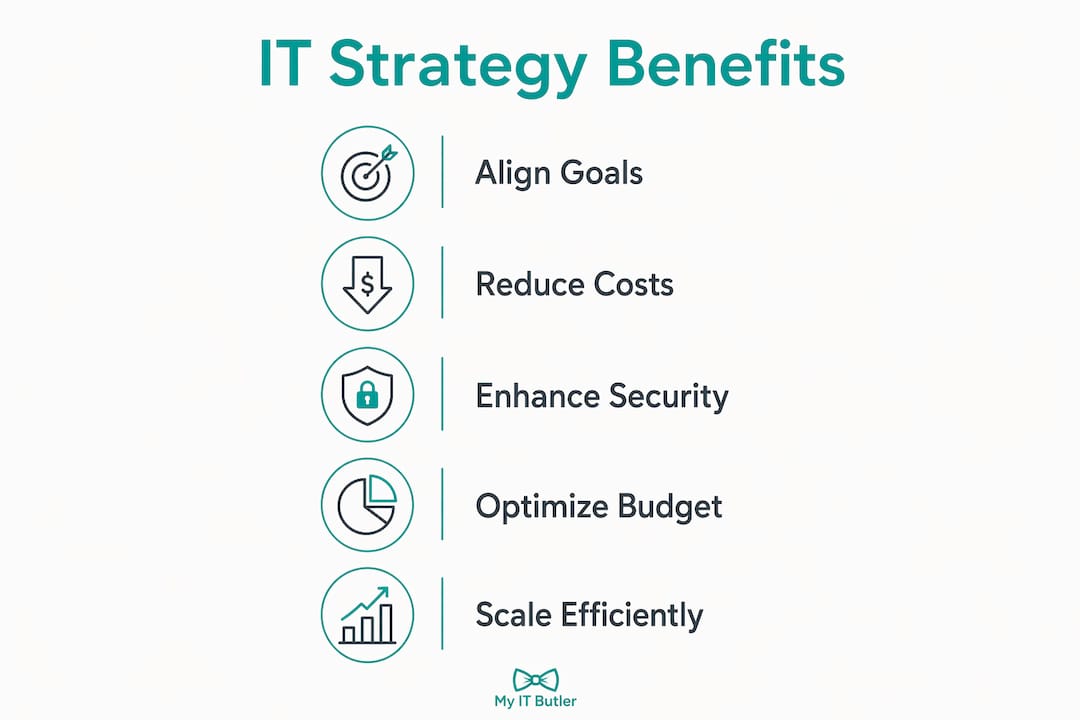
- Cost control: A formal IT roadmap can cut unnecessary IT spending by up to 50%, freeing capital for product and sales.
- Growth without headcount: Structured IT planning supports 20% capacity growth without hiring additional IT staff.
- Better accuracy: Process improvements tied to IT planning produce measurable gains in order and data accuracy.
- Risk reduction: A documented IT strategy gives founders a clear view of security gaps before they become incidents.
- Competitive positioning: Startups with formal IT governance win enterprise clients that require proof of security and compliance.
The importance of IT strategy for startups becomes clearest when you compare two founders at the same growth stage. One has a documented technology roadmap. The other makes IT decisions as problems arise. The first founder spends less, scales faster, and closes bigger contracts.
How do startups know when they need a formal IT strategy?
Most founders delay IT planning because the business feels too small to need it. That instinct is wrong, and it is expensive. Four clear signals indicate a startup needs a formal IT strategy now.
- Growth is hitting a ceiling. Existing systems cannot support new customers, new markets, or new team members without breaking down. This is the most common trigger.
- Founders cannot assess security trade-offs. When the team lacks the expertise to evaluate whether a tool or vendor is safe, decisions get made on price alone. That creates risk.
- Workarounds are eating time. Staff spending hours on manual fixes or duplicate data entry signals that the underlying tools are wrong for the job.
- Enterprise clients are asking questions. Large customers increasingly require formal IT governance, security certifications, and documented incident response plans before signing contracts.
A fifth signal worth watching is frequent downtime. If the same systems fail repeatedly, the business is absorbing the cost of poor IT planning in lost productivity and customer trust.
Pro Tip: If your team has built more than three recurring workarounds in the past six months, that is a reliable sign your IT setup has outgrown your current approach. Document each workaround and use the list as the starting point for your IT strategy.
Recognising these signals early is the difference between a planned IT upgrade and an emergency rebuild. Founders who wait for a crisis pay far more, in both money and time, than those who act on the early signs. For a practical breakdown of what early IT support looks like, the founder's guide to early IT support covers the key decisions in plain language.
What are the core components of an effective IT strategy?
A startup IT strategy is not a static document. It is a living plan that connects technology decisions to business outcomes at every stage of growth. The components below form the foundation of any plan worth building.
Technology roadmap
A technology roadmap turns scattered IT decisions into a shared, prioritised plan. Effective roadmaps clarify priorities, manage dependencies between systems, and make risk visible before it becomes a problem. The roadmap should cover a 12–24 month horizon and be reviewed quarterly.
Security and privacy from day one
Security built into early IT strategy is a competitive advantage. Startups that skip this step face expensive fixes when they try to scale and lose enterprise opportunities to competitors who can demonstrate security maturity. The minimum baseline includes multi-factor authentication, role-based access controls, and a documented data handling policy.
Budget allocation
Effective IT strategy budgets follow a proven split: 60% to operations, 25% to improvements, and 15% to new capabilities. This ratio keeps the business running while still investing in growth. Founders who invert this ratio, spending heavily on new tools while neglecting core systems, create instability.
| Budget category | Allocation | Purpose |
|---|---|---|
| Operations | 60% | Keep existing systems running reliably |
| Improvements | 25% | Upgrade and refine current tools |
| Innovation | 15% | Build new capabilities for growth |
Lean, modular tech stack
Over-engineering for future scale is a common and costly mistake. A lean approach means choosing tools that handle today's needs well, with clear upgrade paths for tomorrow. Cloud-native and modular architecture gives startups the flexibility to add or swap components without rebuilding from scratch.
Pro Tip: When evaluating any new tool, ask one question before signing up: "Can we replace this in six months without losing our data or breaking another system?" If the answer is no, the tool creates lock-in risk.
Business capability framing
Translating IT investments into business outcomes helps founders communicate value to CFOs and investors. Instead of reporting "we upgraded the CRM," report "we increased lead conversion by improving the sales team's response time." The technology is the same. The framing makes the value clear.
How can startups implement and maintain their IT strategy as they grow?
Building an IT strategy is one thing. Keeping it relevant as the business changes is harder. These are the practices that make the difference between a strategy that guides decisions and one that sits in a folder.
- Founder-level ownership is non-negotiable. Founders who delegate IT strategy entirely accumulate technical debt and face costly refactoring later. The founder does not need to make every technical decision, but they must understand how IT connects to business goals.
- Review the strategy quarterly. Markets change, products change, and team size changes. An IT strategy reviewed only once a year is out of date within months.
- Manage technical debt deliberately. Every shortcut taken during rapid growth creates future cost. Track technical debt as a line item and allocate part of the improvement budget to paying it down each quarter.
- Partner with specialists for complexity. Outsourcing specific IT functions, such as security monitoring, vendor management, or infrastructure oversight, reduces internal complexity without sacrificing control. This is where IT support options for startups become genuinely useful.
- Build a security culture, not just security tools. Staff training on phishing, password hygiene, and data handling reduces incident risk more reliably than any single software purchase. Schedule training twice a year and make it mandatory.
- Use cloud-native architecture where possible. Cloud platforms allow startups to scale individual components independently, pay for what they use, and avoid large capital expenditure on hardware.
The IT strategy impact on startup success compounds over time. Founders who embed these habits early find that their systems support growth rather than constrain it. Those who do not find themselves rebuilding under pressure, which is always more expensive than building it right the first time.
Key takeaways
A startup's IT strategy is the single most cost-effective way to align technology spending with business growth, reduce security risk, and win enterprise clients before the competition does.
| Point | Details |
|---|---|
| IT strategy cuts costs | A formal IT roadmap can reduce unnecessary IT spending by up to 50%. |
| Security must come first | Integrating security from day one prevents expensive fixes and lost enterprise contracts later. |
| Budget allocation matters | Splitting IT spend 60% operations, 25% improvements, 15% innovation keeps growth stable. |
| Founders must stay involved | Delegating IT strategy entirely leads to technical debt and costly rebuilds. |
| Frame IT in business terms | Communicating IT value as business outcomes wins CFO and investor support. |
Why I think most startups get IT strategy backwards
Founders tend to treat IT strategy as something you build once you have traction. I have seen this pattern repeatedly, and it almost always ends the same way: a fast-growing startup hits a wall because its systems cannot keep up, and the fix costs three times what prevention would have.
The misconception is that IT strategy is a big-company problem. It is not. The decisions made in the first 12 months of a startup's life, which tools to use, how data is stored, who has access to what, create the architecture that everything else is built on. Changing that architecture later is like renovating a house while people are living in it.
What I find most valuable about early IT planning is not the cost savings, though those are real. It is the clarity. A technology roadmap forces founders to think about where the business is going, not just where it is today. That thinking improves every other decision, from hiring to fundraising. The role of IT in startup fundraising is more significant than most founders realise until they are sitting across from an investor who asks about their security posture.
Treat IT as a core business function from day one. Not because it is fashionable, but because the data is clear: startups that do this grow faster, spend less, and close bigger deals.
— Thomas
How Myitbutler supports startup IT strategy
Myitbutler works with startups that need expert IT guidance without the cost of a full-time IT team. With over 15 years of enterprise experience and certifications including CCNA, CompTIA Security+, and PRINCE2, the team delivers remote IT support built to Australian standards and available globally.
Whether your startup needs a technology roadmap, ongoing IT supervision, vendor management, or a security review, Myitbutler provides fixed-price services with no long-term contracts. The team coordinates across time zones via WhatsApp, email, and direct messaging, making it practical for distributed and international teams. If you are ready to put a proper IT strategy in place, book a free consultation and get a clear picture of where your startup stands.
FAQ
What is an IT strategy for a startup?
An IT strategy is a documented plan that connects a startup's technology decisions to its business goals. It covers budget allocation, security, tooling, and a roadmap for scaling systems as the business grows.
When should a startup create a formal IT strategy?
A startup needs a formal IT strategy when growth is constrained by existing systems, founders cannot assess security risks, or enterprise clients begin asking for proof of IT governance.
How does IT strategy reduce costs for startups?
A formal IT roadmap can cut unnecessary IT spending by up to 50% by eliminating redundant tools, preventing costly security incidents, and prioritising spending on systems that directly support growth.
What is the right IT budget split for a startup?
Effective IT strategy budgets allocate 60% to keeping systems running, 25% to improvements, and 15% to building new capabilities. This balance maintains stability while still investing in growth.
Does a startup need an internal IT team to have an IT strategy?
No. Many startups implement and maintain an effective IT strategy by partnering with a managed IT provider. This approach reduces cost and complexity while still delivering expert-level planning and support.