
What is IT compliance for startups?
IT compliance is the ongoing process of meeting legal, regulatory, and industry standards for how your business handles data and technology systems. For startups in Australia, this means building systems and policies that protect customer data, satisfy regulators, and prove to enterprise buyers that you can be trusted.
The core frameworks you will encounter are:
- GDPR — applies the moment you collect data from EU residents, regardless of where your startup is based
- SOC 2 — a market-driven requirement for B2B SaaS companies selling to enterprise customers
- PCI DSS — mandatory if you store or process payment card data
- ISO 27001 — the international standard for information security management, critical for global expansion
One distinction worth understanding early: compliance differs from security. Compliance proves you follow rules through documentation and audits. Security actively protects your systems. You need both, but they are not the same thing.
Compliance also builds the trust that closes enterprise deals and satisfies investor due diligence. Treat it as a growth tool, not a legal chore.
Key IT compliance frameworks for Australian startups
Each framework serves a different purpose depending on your market and data type.
- GDPR — if you handle EU resident data, GDPR applies to you regardless of your Australian address. A breach notification is required within 72 hours.
- SOC 2 — widely required for enterprise deals in North America. Assesses five Trust Services Criteria: security, availability, processing integrity, confidentiality, and privacy.
- PCI DSS — non-negotiable for any startup processing card payments. Requires encryption, access controls, and annual assessments.
- ISO 27001 — preferred by European and Asian buyers. Built around a formal information security management system, it signals credibility to international clients. See the IT compliance requirements guide for a practical breakdown of each framework's scope.
For distributed teams handling international customer data, GDPR-compliant data handling is a practical starting point worth reviewing.
How compliance maturity grows with your startup
Compliance scales with your stage, starting simple and building from there.
Stage 1 — Foundations: Multi-factor authentication, encryption, a basic privacy policy, and documented access controls. This is your pre-launch baseline.

Stage 2 — Operational: Data Processing Agreements with vendors, a breach response plan, internal audit processes, and employee training.
Stage 3 — Attestation: Formal certifications such as SOC 2 Type II or ISO 27001, a comprehensive vendor DPA registry, and full audit readiness. This is where enterprise deals open up.
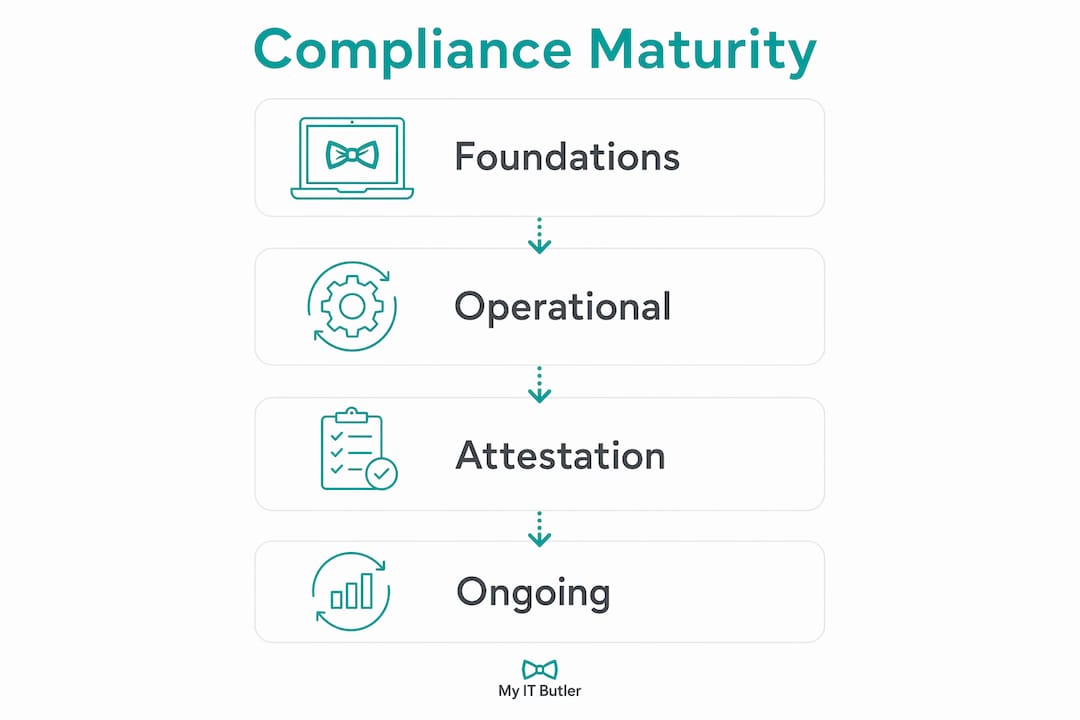
The Minimum Viable Compliance approach works well for early-stage teams: implement only the controls that address your highest current risks, then build out as you grow.
Common IT compliance challenges Australian startups face
Resource constraints are the biggest hurdle. Most early-stage teams have no dedicated compliance person, which means founders carry the load alongside product and sales. Regulations also shift, and keeping pace without a system in place is genuinely difficult.
For distributed or international teams, obligations multiply fast. Your compliance requirements depend heavily on where your customers are located, not just where you are registered. A Sydney-based SaaS startup with users in Germany faces GDPR obligations from day one.
Employee turnover creates gaps too. When a team member leaves, access credentials, policy acknowledgements, and training records need immediate attention.
Practical steps to implement IT compliance
A startup compliance checklist does not need to be complicated. Work through these in order:
- Map your data — document what personal data you collect, from whom, and where it goes.
- Identify applicable frameworks — based on your industry, customer locations, and data types.
- Implement baseline controls — MFA, encryption, access management, secure backups.
- Write your policies — privacy policy, incident response plan, acceptable use policy.
- Sign vendor agreements — Data Processing Agreements with every third-party tool that touches customer data.
- Run internal audits — internal audits are how you build the evidence trail that investors and enterprise buyers actually examine.
- Train your team — policies only work when people follow them.
IT compliance in practice: Australian startup examples
A Brisbane-based SaaS startup targeting US enterprise clients typically pursues SOC 2 Type II before approaching procurement teams. Without it, deals stall at the security review stage. The internal audit process is what most founders underestimate: auditors want a continuous evidence history, not a last-minute document sprint.
A Sydney fintech processing card payments must achieve PCI DSS compliance before any payment processor will activate their merchant account. This is not optional and cannot be deferred.
A Melbourne healthtech startup handling patient data faces both Australian Privacy Act obligations and, if serving international users, GDPR requirements simultaneously.
Tools and resources for managing IT compliance
Governance, risk, and compliance (GRC) platforms centralise policy tracking, evidence collection, and audit readiness in one place. For early-stage IT infrastructure, cloud providers such as AWS and Microsoft Azure offer inherited compliance controls that reduce your baseline workload.
The Australian Office of the Australian Information Commissioner (OAIC) publishes free privacy guidance tailored to startups. NIST frameworks provide crosswalks between standards like ISO 27001 and SOC 2, helping you avoid duplicating effort when pursuing multiple certifications.
For vendor selection, always request compliance certifications and assurance reports before signing contracts.
Why employee training is central to compliance
Policies sitting in a shared drive do nothing. Compliance only holds when your team understands their obligations and follows them consistently. Training should cover data handling procedures, phishing awareness, incident reporting, and acceptable use of company systems.
For distributed teams across multiple time zones, asynchronous training modules work better than live sessions. Document every training completion and keep records, because auditors will ask for them.
Compliance is ongoing, not a one-time project
Passing an audit does not mean you are done. Regulations change, your vendor stack evolves, new team members join, and your customer base expands into new jurisdictions. Each of these events can shift your compliance obligations.
Continuous monitoring, regular internal audits, and annual policy reviews are the mechanics that keep you compliant as you grow. Build these into your calendar from the start rather than scrambling before each renewal.
Myitbutler supports distributed startups and international teams with remote IT compliance management backed by over 15 years of enterprise experience and certifications including CCNA, CompTIA Security+, and PRINCE2. Fixed pricing, no lock-in contracts, and support across time zones via WhatsApp, email, and direct messaging. Book a free consultation to get your compliance baseline assessed.
Key takeaways
IT compliance for startups is an ongoing, staged process that protects data, enables enterprise sales, and satisfies investor due diligence from day one.
| Point | Details |
|---|---|
| Compliance enables growth | Enterprise deals and investor rounds depend on a documented, auditable compliance posture. |
| Start with Minimum Viable Compliance | Implement controls for your highest current risks first, then build as your startup scales. |
| Frameworks depend on your market | GDPR applies if you have EU users; SOC 2 is expected for US enterprise sales; ISO 27001 opens international markets. |
| Internal audits build the evidence trail | Auditors and investors want continuous compliance history, not a last-minute document sprint. |
| Compliance is never finished | Continuous monitoring and regular policy reviews keep you aligned as regulations and your business evolve. |
FAQ
What is IT compliance for startups in simple terms?
IT compliance means your startup follows the legal and industry rules for handling data and technology systems, and can prove it through documentation and audits.
When should an Australian startup start thinking about compliance?
From day one. GDPR applies the moment you collect your first EU user's email, and payment processors require a privacy policy before activating merchant accounts.
Is SOC 2 mandatory for Australian startups?
SOC 2 is voluntary, but enterprise customers in North America routinely require it before signing contracts, making it a practical market requirement for B2B SaaS startups.
How does IT compliance differ from IT security?
Compliance proves you follow defined rules through documentation and audits; security actively protects your systems from threats. Both are necessary and work best together.
How much does startup compliance cost?
Costs vary widely depending on the frameworks pursued and whether you use automation tools, managed services, or external auditors. Starting with foundational controls like MFA, encryption, and documented policies keeps early-stage costs manageable.