
TL;DR:
- International remote work compliance involves meeting legal and regulatory obligations across multiple jurisdictions when employees work abroad.
- It encompasses employment law, payroll tax, social security, immigration, and data privacy, posing risks if not properly managed.
International remote work compliance is the set of legal and regulatory obligations businesses must meet when employees work from countries other than their home base. It covers employment law, payroll tax, social security, immigration, and data privacy, all at once, across multiple jurisdictions. Getting it wrong exposes your business to retroactive tax assessments, deportation of staff, and significant financial penalties. This guide gives HR professionals and business leaders a clear framework for managing cross-border remote employment in 2026, with practical steps to reduce risk and keep your team working legally wherever they are.
What is remote work compliance internationally?
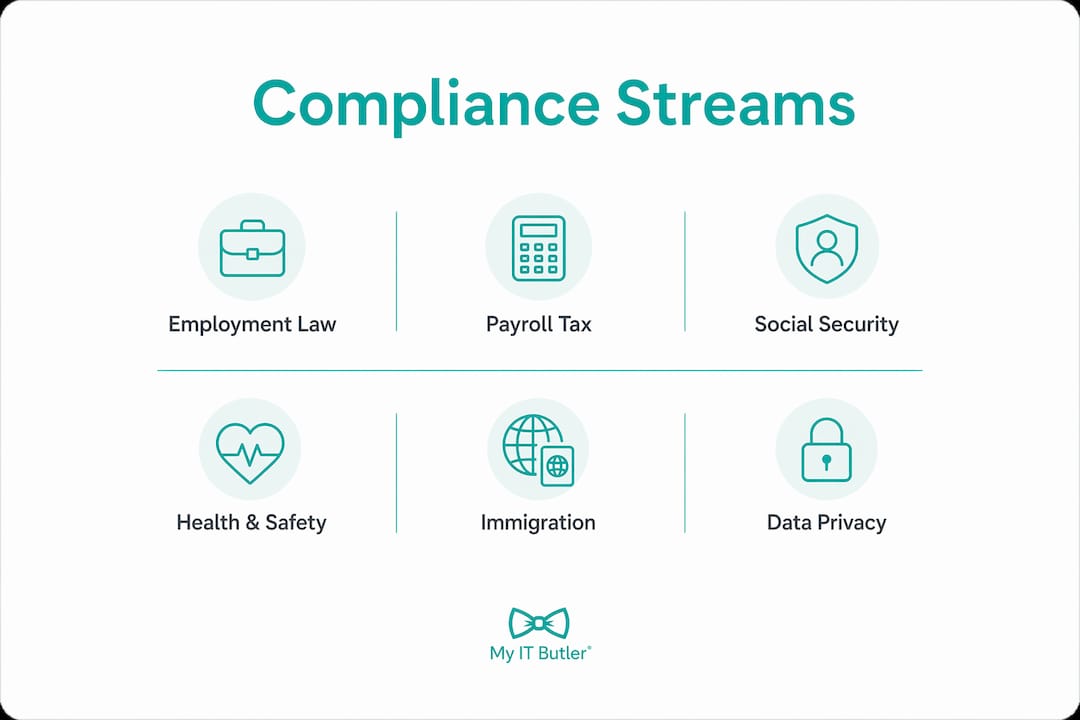
International remote work compliance is the practice of meeting every legal obligation that arises when an employee performs work from a country other than their primary workplace. The industry term for this discipline is "multi-jurisdictional employment compliance," and it covers six distinct streams: employment law, payroll tax withholding, social security contributions, health and safety, data privacy, and immigration.

Employers in Europe typically manage five compliance streams per worker location. That figure does not include immigration, which adds a sixth layer for workers crossing borders. Each stream carries its own regulator, its own deadlines, and its own penalties for non-compliance.
The OECD has published guidelines that shape how tax authorities assess cross-border remote work, particularly around corporate tax exposure. Immigration authorities in most countries have also sharpened their scrutiny of remote workers since 2022. Compliance is no longer a matter of informal tolerance. It is documented regulatory scrutiny based on actual time spent and commercial activity in a host country.
Pro Tip: Build a compliance register that maps each remote employee to their physical location, not just their contract location. The gap between the two is where most compliance failures begin.
What legal obligations do employers face for remote workers abroad?
Host country law governs remote workers, not home country law. Local labour laws override home country employment laws when employees work semi-permanently abroad. This applies to termination rights, overtime rules, discrimination protections, and minimum leave entitlements. An Australian business employing someone who relocates to Germany must comply with German employment law, regardless of what the employment contract says.
The six compliance streams every employer must manage are:
- Employment law: Host country rules on termination, working hours, leave, and discrimination apply once an employee establishes a regular work presence abroad.
- Payroll tax withholding: Employers may need to register locally and withhold income tax in the host country from day one of employment there.
- Social security contributions: Bilateral social security treaties determine which country receives contributions. Without a treaty, double contributions are possible.
- Health and safety: Many jurisdictions extend workplace health and safety obligations to home offices, requiring employers to assess and document remote work environments.
- Data privacy: Regulations such as the EU's General Data Protection Regulation (GDPR) apply based on where data is processed, not where the employer is based.
- Immigration: Employees must hold the correct visa or work authorisation for the country where they physically perform work.
Employee location reporting within five business days of any move is the governance standard recommended by international employment advisors. That tight timeframe exists because compliance obligations can trigger immediately when an employee crosses a border and starts working.
Pro Tip: Require employees to notify HR before relocating, not after. A five-business-day reporting window only works if the process starts before the move happens.
Good remote workforce cybersecurity practices sit inside the data privacy stream. GDPR and equivalent laws in Brazil (LGPD) and Australia (Privacy Act 1988) all require employers to protect personal data regardless of where it is accessed.
How do tax and corporate risks arise from cross-border remote work?
Tax risk is the most financially significant compliance exposure in international remote work. Two distinct risks apply: Permanent Establishment (PE) risk for the employer, and individual income tax residency risk for the employee.
Permanent Establishment risk
PE risk arises when an employee's activity in a foreign country creates a taxable corporate presence there. The OECD benchmark is clear: if less than 50% of total working time is spent remotely in a treaty country over any 12-month period, no fixed place of business is established for corporate tax purposes. Exceeding that threshold can make your business liable for corporate tax in that country, including retroactively.
Individual income tax and payroll obligations
- Tax residency triggers: Most countries apply residency rules based on days spent in the country, commonly 183 days per year. An employee who exceeds this threshold becomes a tax resident and owes income tax locally.
- Double taxation risk: Without a bilateral tax treaty between the home and host country, both countries may tax the same income. Failure to register for local payroll tax risks retroactive assessments covering multiple years.
- Employer registration obligations: As soon as an employee starts work in a new country, the employer may need to register with local tax authorities and begin withholding income tax from that employee's pay.
- Occasional remote work days: Even 10–20 remote working days per year can trigger social security and tax residency liabilities. This is the most commonly overlooked compliance risk.
- Employer of Record (EOR) limitations: An EOR handles local employment law compliance but does not cover PE risk, corporate tax nexus, or data privacy compliance. Employers remain responsible for those streams even when using an EOR.
Tax, social security, immigration, and employment systems do not synchronise with each other. Coordinated compliance across all four is the only way to avoid gaps that regulators exploit during audits.
What immigration considerations impact international remote work compliance?
Immigration is the compliance stream most frequently misunderstood by both employers and employees. Any income-generating activity performed physically in a host country can require a work visa, even if the employee remains on a foreign payroll and works for a foreign employer.
The key distinctions employers must communicate to their teams are:
- Tourist and visitor visas prohibit gainful employment in almost every country. An employee working remotely on a tourist visa risks deportation, fines, and a ban on re-entry.
- Remote work and digital nomad visas provide legal authorisation to work remotely from a host country. More than 60 countries offered dedicated remote work or digital nomad visas as of early 2026. Portugal, Croatia, Costa Rica, and Thailand are among the most established programmes.
- Standard work permits remain necessary when an employee is performing work that benefits a local entity or client, regardless of where their employer is incorporated.
Immigration authorities increasingly treat any productive work on foreign soil as requiring authorisation. The fact that an employee is paid from abroad does not change this assessment.
Pro Tip: Before approving any international remote work request, ask the employee to confirm their visa type and its specific work permissions in writing. Keep that record in their HR file.
How can businesses build effective international compliance policies?
Effective governance starts with a written remote work policy that specifies which jurisdictions employees may work from, for how long, and under what conditions. Policies that lack these specifics create the ambiguity that compliance failures grow in.
The table below outlines the core policy elements every business should address.
| Policy element | What to specify |
|---|---|
| Location reporting | Employees notify HR within five business days of any move to a new country |
| Approved countries | List of countries where remote work is pre-approved, with day limits |
| Maximum remote days | Annual cap on days worked in any single foreign country (commonly 30–60 days) |
| Visa responsibility | Employee confirms visa authorisation before commencing work abroad |
| Data security requirements | Mandatory use of VPN, encrypted devices, and approved communication tools |
| Review trigger | Any change in location triggers a compliance review with HR and legal |
Technology plays a direct role in making these policies work. IT tools for managing remote employees can track employee locations in real time, flag when day thresholds are approaching, and maintain audit trails that satisfy tax authorities. Without that infrastructure, policies exist only on paper.
Engaging local legal and tax advisors in each jurisdiction where you have remote workers is not optional at scale. EOR services cover employment law compliance in many markets, but they do not replace the need for corporate tax and immigration advice. Businesses with workers in more than three countries typically need a coordinated advisory team, not a single provider.
Pro Tip: Set your internal day-limit alerts at 80% of the legal threshold, not 100%. That buffer gives HR time to act before a compliance breach occurs.
Training matters as much as policy. Employees who understand why location reporting exists are far more likely to comply than those who see it as administrative overhead. Run a short annual briefing that explains the tax and immigration consequences of unreported moves.
Key takeaways
International remote work compliance requires managing six simultaneous legal streams across every country where employees physically work, and no single tool or service covers all of them.
| Point | Details |
|---|---|
| Six compliance streams | Employment law, payroll tax, social security, health and safety, data privacy, and immigration all apply simultaneously. |
| Host country law governs | Local labour laws override home country contracts when employees work semi-permanently abroad. |
| PE risk threshold | Working more than 50% of time in a treaty country over 12 months can create corporate tax liability there. |
| Occasional days still count | Even 10–20 remote days per year can trigger social security and tax residency obligations. |
| EORs have limits | An Employer of Record covers local employment law but does not manage PE risk, corporate tax, or data privacy. |
The compliance risk hiding in plain sight
The part of international remote work compliance that catches most businesses off guard is not the big, obvious stuff. It is not the employee who moves to Berlin for two years. HR usually catches that. The real exposure sits in the grey zone: the employee who works from Bali for six weeks, the one who extends a holiday in Portugal and keeps answering emails, the one who visits family in the Philippines and joins every Zoom call from there.
Those situations feel informal. They are not. Tax authorities and immigration officials increasingly define compliance triggers by actual time spent and actual work performed, not by intent or payroll location. I have seen businesses receive retroactive payroll tax assessments covering three years because a single employee worked from a country without proper registration. The amount owed was not the issue. The penalties and interest on top of it were.
The other thing I would push back on is the assumption that an EOR solves the problem. EORs are genuinely useful for employment law compliance in new markets. But they do not touch PE risk, corporate tax nexus, or data privacy obligations. Businesses that treat an EOR as a complete compliance solution are leaving significant exposure unmanaged.
The practical answer is a layered approach: a clear written policy, a technology system that tracks locations and flags thresholds, local legal and tax advisors in key markets, and a culture where employees report moves without hesitation. None of those elements works without the others.
Getting remote IT support set up correctly for international teams is part of that infrastructure. Secure access, location-aware systems, and audit-ready data management are not separate from compliance. They are compliance.
— Thomas
Myitbutler supports your international remote team
Managing a distributed team across multiple countries means your IT infrastructure has to carry some of the compliance load. Secure access controls, location tracking, encrypted communications, and audit-ready systems are not nice-to-haves. They are part of what keeps your business on the right side of data privacy laws and internal governance requirements.

Myitbutler provides remote IT support for Australian businesses and international teams, with over 15 years of enterprise experience and certifications including CCNA, CompTIA Security+, and PRINCE2. The team works across time zones with no long-term contracts and transparent fixed pricing. If your business is managing remote workers in multiple countries and you want IT systems that support your compliance framework, book a free chat to talk through what you need.
FAQ
What is international remote work compliance?
International remote work compliance is the practice of meeting all legal obligations across employment law, tax, social security, immigration, and data privacy when employees work from a country other than their home base. It requires managing multiple regulatory streams simultaneously across each jurisdiction where employees are physically located.
Does host country law apply to my remote employees?
Local labour laws generally override home country employment contracts when employees work semi-permanently abroad. This means termination rules, overtime entitlements, and discrimination protections in the host country apply to your employees, regardless of where your business is incorporated.
What is Permanent Establishment risk in remote work?
Permanent Establishment (PE) risk is the exposure a business faces when an employee's activity in a foreign country creates a taxable corporate presence there. The OECD benchmark is that working more than 50% of total time in a treaty country over 12 months can establish a fixed place of business for corporate tax purposes.
Can employees work remotely abroad on a tourist visa?
Tourist and visitor visas prohibit gainful employment in almost every country. An employee performing remote work on a tourist visa risks deportation, financial penalties, and re-entry bans. More than 60 countries now offer dedicated remote work or digital nomad visas that provide legal authorisation.
Does an Employer of Record cover all compliance risks?
An EOR covers local employment law compliance but does not manage Permanent Establishment risk, corporate tax nexus, or data privacy obligations. Employers remain responsible for those streams and need separate legal and tax advice to address them fully.