

IT turns borders into channels. Done well, it creates scalable, localised go-to-market capability, repeatable operations, and measurable governance that lets your business grow across markets without rebuilding from scratch each time.
The University of Richmond research puts it plainly: IT expenditure correlates with higher foreign revenues and foreign profits, primarily through improved foreign responsiveness rather than cost reduction. That distinction matters for how you budget. You are not buying efficiency. You are buying reach.
The rest of this guide unpacks each priority in depth, with a 90-day checklist and clear signals for when to bring in external IT support.
Key takeaways
IT investment in global expansion pays off through improved foreign responsiveness, not cost reduction alone. Leaders who align IT strategy with market-entry planning from the start consistently outperform those who treat IT as a downstream dependency.
| Point | Details |
|---|---|
| IT drives foreign revenue | Research shows IT spending raises foreign revenues primarily through improved responsiveness to overseas customers. |
| Cloud architecture decisions are hard to reverse | Choose a multi-region cloud provider and establish IAM and logging before entering each new market. |
| Data governance must precede analytics | Map data flows and establish transfer mechanisms for each jurisdiction before deploying cross-market analytics or AI tools. |
| Distributed teams need operating agreements, not just tools | Follow-the-sun support models and documented escalation paths prevent SLA gaps across time zones. |
| Myitbutler covers the gaps | Remote IT support, vendor liaison, and security assessments with fixed pricing and no lock-in for businesses expanding internationally. |
Table of Contents
- How does IT remove geographic friction and open new markets?
- Can cloud infrastructure really support multi-market operations at scale?
- How do data, analytics and AI accelerate international market entry?
- How do you run distributed teams across time zones without losing service quality?
- What security and privacy controls matter most for cross-border operations?
- How do you align IT investments with your international expansion timeline?
- Your practical 90-day IT checklist for global expansion
- IT is not a cost centre. It is where your expansion either works or doesn't.
- Myitbutler: remote IT support built for businesses expanding globally
- Sources
- FAQ
How does IT remove geographic friction and open new markets?
Geography used to mean cost. Reaching a customer in another country required physical presence, local staff, and local infrastructure. Digital channels have changed that equation, though not completely.
E-commerce platforms, global marketplaces, and payment rails are the most visible layer. A business selling through Shopify or a regional marketplace can reach buyers in dozens of countries with a single product catalogue. The decisions that follow, though, are where most leaders underestimate the work: local payment methods (SEPA transfers in Europe, PIX in Brazil, PromptPay in Thailand), tax registration thresholds, cross-border returns logistics, and consumer protection compliance. Getting the storefront live is the easy part.
Platform and API strategies let firms enter multiple markets without building separate technology stacks for each one. A well-designed API layer means your core product can connect to local payment processors, local identity verification services, and local logistics providers without rewriting the underlying system. Research on digital strategies and internationalisation identifies three common approaches: owning a digital platform, participating in an existing platform, or digitally transforming a traditional business model. Each carries different capital requirements and speed-to-market trade-offs.
Localisation goes deeper than translation. A Japanese customer expects a different information density on a product page than an Australian one. Currency display, date formats, address fields, and checkout flows all need market-specific treatment. Firms that treat localisation as a final step before launch consistently underperform those that build it into the product architecture from the start.

A short example: A mid-sized software company entering Southeast Asia used a single multi-tenant SaaS platform with localised front-ends for each market, connected to regional payment gateways via API. Rather than standing up separate instances per country, they maintained one codebase and pushed market-specific configuration through a content management layer. Time to launch in each new market dropped from six months to under eight weeks by the third country.
Key investment areas that reduce geographic friction:
- Local payment gateway integrations (not just card rails)
- Automated tax calculation tools (Avalara, Vertex, or equivalent)
- Content delivery networks (CDNs) to reduce page-load latency for distant users
- Localisation management platforms for strings, currencies, and date formats
- API-first architecture to connect regional third-party services without core system changes
Pro Tip: The most common localisation trap is translating copy without adapting the UX. Run usability tests with five users in each target market before launch. You will find checkout abandonment issues that no translation review would catch.
Can cloud infrastructure really support multi-market operations at scale?
Yes, but the architecture decisions you make in the first six months are hard to undo. The three patterns that work for international operations are a single global cloud tenancy with multi-region deployments, a hub-and-spoke model with a primary region and satellite regions for latency-sensitive workloads, and a fully distributed edge architecture for content-heavy or real-time applications.
For most businesses entering two to five new markets, a multi-region deployment on a major cloud provider (AWS, Azure, or Google Cloud) covers the majority of requirements. You get availability zones for redundancy, data residency options to satisfy local regulations, and managed services that reduce the operational burden on a small IT team.
The trade-offs leaders need to budget for:
- Latency vs. residency: Keeping data in a local region reduces latency and satisfies residency rules, but increases complexity and cost. You cannot always have both at the lowest price point.
- Vendor lock-in: Managed services from a single cloud provider accelerate delivery but create dependency. Build abstraction layers where the switching cost would be prohibitive.
- SLA coverage: Cloud providers publish uptime SLAs per service and per region. Verify that the SLA for your specific region and service tier matches your customer commitments before you sign.
- Backup and disaster recovery across jurisdictions: A backup stored in a different country may trigger data transfer regulations. Map your DR architecture against your data governance policy before you build it.
Operational priorities for multi-market cloud infrastructure:
- Choose a cloud provider with availability zones in or near each target market.
- Implement identity and access management (IAM) centrally, with role-based access for regional teams.
- Set up centralised logging and monitoring before you go live in each new market.
- Define recovery time objectives (RTOs) and recovery point objectives (RPOs) per market and test them quarterly.
- Review platform-as-a-service (PaaS) options for databases, queuing, and authentication to reduce the operational surface area your team needs to manage.
The IMF notes that deploying AI at scale is capital-intensive and dependent on physical infrastructure, including data centres and power. The same logic applies to cloud infrastructure generally: the cost of getting the architecture right early is a fraction of the cost of re-platforming after you have customers in five countries.
How do data, analytics and AI accelerate international market entry?
Data is where the role of IT in global expansion becomes genuinely competitive. Firms that build cross-border data pipelines early can segment local markets, forecast demand by region, and adjust pricing faster than competitors relying on quarterly reports.
Practical use cases where this pays off quickly:
- Local market segmentation: Combining web analytics, CRM data, and third-party demographic data to identify which customer segments in a new market behave like your best existing customers.
- Demand forecasting: Using historical sales data from comparable markets to model inventory and staffing needs before you have local data of your own.
- Sentiment analysis: Running natural language processing across local social media and review platforms to identify product-fit gaps before they show up in churn.
- Localisation automation: AI-assisted translation and content adaptation tools (DeepL, Google Cloud Translation API, and similar) reduce the cost and time of localising marketing assets across multiple languages.
Research on digital-intelligent synergy finds that the combination of data assets, AI, and their coordination is positively associated with overseas revenue and internationalisation outcomes. The key word is coordination: data and AI tools that operate in silos do not produce the same results as those connected to a shared governance framework.
Data quality is the constraint most leaders overlook. A demand forecast built on incomplete or inconsistently formatted data from three different markets is worse than no forecast at all. Before deploying analytics or AI models across markets, establish a data dictionary, a master data management process, and a clear owner for data quality in each region.
Statistic callout: McKinsey Global Institute analysis found that global data flows materially boost economic value, with participation in digital flows raising productivity across sectors. Data flows account for a significant share of the measured impact of global flows on GDP.
The World Bank's analysis of AI in developing economies adds an important caution: AI tools only deliver productivity gains when the underlying infrastructure, connectivity, and skills are in place. If you are entering markets where those foundations are weak, small, localised AI tools often outperform large-scale deployments that assume reliable connectivity and technical literacy.
How do you run distributed teams across time zones without losing service quality?
The answer is not more tools. It is clearer operating agreements, then the right tools to support them.
Distributed teams fail at handovers. A support ticket opened in Singapore at 5 PM local time falls into a gap if your Australian team does not pick it up until 9 AM the next day. A follow-the-sun support model, where responsibility passes explicitly from one regional team to the next at defined handover times, closes that gap. It requires documented handover procedures, a shared ticketing system, and a single source of truth for customer and system status.

For practical guidance on setting up the tooling side, the IT tools guide for managing remote employees covers the current options in detail. The short version: use one platform for async communication (Slack or Microsoft Teams), one for project tracking (Jira, Linear, or Asana), and one for documentation (Confluence or Notion). Resist the urge to add tools for every problem. Each additional platform is another place where context gets lost.
Operational readiness checklist for distributed teams:
- Define SLA tiers by customer segment and document them before you hire regional staff.
- Set up remote device management (Microsoft Intune or Jamf) before devices leave a central location.
- Establish a VPN or zero-trust network access (ZTNA) solution for secure remote access to internal systems.
- Create an onboarding checklist that works entirely remotely, including identity verification, device provisioning, and access provisioning.
- Run a time-zone coverage audit: map your customer locations against your team locations and identify gaps before they become SLA breaches.
- Document escalation paths in writing. Every team member should know who to contact at 2 AM if a critical system goes down.
The AMcis practitioner guidance on IT architecture recommends treating IT as a nervous system: centralise governance and policy enforcement while modularising execution so regional teams can act quickly without breaking global controls. That principle applies to operations as much as architecture.
Pro Tip: Measure support quality with three KPIs from day one: first response time by region, resolution time by ticket priority, and customer satisfaction score per market. Without these, you will not know which time zone is underperforming until a customer escalates.
What security and privacy controls matter most for cross-border operations?
Security in a multi-market environment is not harder than in a single market. It is more complex, because the threat surface is larger and the regulatory obligations multiply.
Core controls every international operation needs:
- Identity and access management: Multi-factor authentication (MFA) for all staff, single sign-on (SSO) across systems, and role-based access control (RBAC) with least-privilege principles.
- Encryption: Data encrypted at rest and in transit, with key management that satisfies the residency requirements of each market.
- Incident response: A documented incident response plan that covers notification timelines for each jurisdiction (GDPR requires 72-hour notification to supervisory authorities; Australia's Notifiable Data Breaches scheme has its own thresholds).
- Vendor security checks: Every third-party integration is a potential entry point. Require evidence of security certifications (ISO 27001, SOC 2) from vendors handling your customer data.
Cross-border data governance is where most leaders need external counsel. Data transfer mechanisms between jurisdictions (Standard Contractual Clauses under GDPR, adequacy decisions, binding corporate rules) are not set-and-forget. They change when political relationships change, as the EU-US Privacy Shield history demonstrated. Build a review cycle into your governance calendar, not just your legal onboarding.
The tension between performance and residency is real. Keeping data in a local region satisfies regulators but increases latency for users in other regions and adds cost. The practical resolution is to keep personal data local and aggregate, anonymised analytics data centrally. That satisfies most residency requirements without sacrificing the cross-market insights your analytics team needs.
Pro Tip: Start with the Centre for Internet Security (CIS) Controls as your security baseline. It is evidence-based, freely available, and maps to most regulatory frameworks. Implement the first six controls before you worry about anything more sophisticated. Over-engineering security before you have basic hygiene in place is a common and expensive mistake.
How do you align IT investments with your international expansion timeline?
The most common mistake is treating IT as a dependency rather than a co-author of the expansion plan. By the time the business has decided to enter a new market, the IT team is handed a launch date and told to make it work. That approach produces expensive shortcuts.
The better model is to translate market-entry objectives into IT priorities at the planning stage. If the objective is to acquire 500 paying customers in Germany within 12 months, the IT priorities are: local payment methods, GDPR-compliant data handling, German-language support capability, and a localised checkout flow. Each of those has a lead time. Working backwards from the launch date tells you when to start each workstream.
Typical phases and what to achieve in each:
- 0–90 days (foundation): Cloud infrastructure in target region, IAM and security baseline, core integrations with local payment and tax systems, localised staging environment for testing.
- 3–12 months (market activation): Full localisation of customer-facing systems, regional support coverage, data pipeline connecting local market data to central analytics, SLA monitoring in place.
- 12+ months (scale and optimise): Automation of localisation workflows, AI-assisted demand forecasting per market, cost-per-market-acquisition tracking, governance review cycle established.
Primary cost factors to budget for:
- Cloud infrastructure per region (compute, storage, data transfer, managed services)
- Localisation: translation, UX adaptation, legal review of local terms and privacy notices
- Compliance: legal counsel for data transfer mechanisms, local regulatory filings
- Staffing or outsourced support: regional IT support coverage, vendor management
KPIs worth tracking from the start: system uptime per region, time-to-localise for new markets, cost per market acquisition (IT spend divided by customers acquired in that market), and SLA compliance rate by region.
Research on digital-intelligent synergy confirms that data assets and AI coordination are positively associated with internationalisation outcomes, but the relationship is moderated by investor stability and governance quality. That is a research-backed argument for building governance structures early, not as an afterthought.
Your practical 90-day IT checklist for global expansion
The first 90 days set the pattern for everything that follows. Leaders who treat this period as a foundation phase, rather than a sprint to launch, consistently have fewer expensive problems at the 12-month mark.
First 90-day checklist:
- Complete an IT asset inventory: every device, every software licence, every cloud subscription, and every vendor contract.
- Audit backup coverage: verify that backups exist, are tested, and are stored in a location that satisfies the data residency rules of your target market.
- Review cloud hygiene: unused resources, overprivileged accounts, and unpatched systems are the three most common sources of both cost overruns and security incidents.
- Run a basic localisation test: load your website or application from an IP address in the target market and check payment flows, language rendering, and page-load speed.
- Map your data flows: document where customer data is created, stored, processed, and transferred, and check each step against the regulations of the target market.
- Establish a vendor shortlist for local services: payment gateways, tax calculation, identity verification, and local IT support.
For guidance on setting up remote IT support for global teams, the process of establishing coverage across jurisdictions is covered in detail, including the handover procedures and documentation that make it work in practice.
Vendor question list before you sign:
- What are your documented incident response times, and can you provide evidence of meeting them?
- What are your data export and deletion procedures if we end the contract?
- Which security certifications do you hold, and when were they last audited?
- What is your escalation path for a critical outage outside business hours?
- Which jurisdictions do you operate in, and what local legal entities do you use?
When to bring in external IT support:
- Your customer support volume in a new market exceeds what your current team can handle within SLA.
- A data residency requirement in a new market exceeds your team's regulatory knowledge.
- You have experienced an SLA breach in a new market and do not have the local coverage to prevent a repeat.
- Your IT team is spending more than 30% of their time on vendor management rather than strategic work.
- You are entering a market with materially different infrastructure reliability (power, connectivity) than your home market.
For a structured way to evaluate external partners, the guide on evaluating remote IT provider global coverage sets out the criteria that separate a genuinely capable partner from one that looks good on paper.
Pro Tip: Trial an external IT partner on a single, bounded workstream before committing to a broader engagement. A 30-day trial covering one market's support tickets gives you real performance data with minimal lock-in. Ask for weekly reporting against agreed KPIs from day one.
IT is not a cost centre. It is where your expansion either works or doesn't.
Most leaders I speak with have already accepted, intellectually, that IT matters for international growth. The gap is in how they fund and govern it. IT gets a budget line under "operations" and a seat at the table after the commercial decisions are made.
The evidence does not support that model. The University of Richmond research shows IT spending raises foreign revenues primarily through responsiveness, not cost reduction. That means the return on IT investment in a global context is a commercial return, not an operational one. It belongs in the same conversation as sales and marketing spend, not facilities.
The leaders who get this right treat their IT roadmap as a market-entry document. They ask: "What does IT need to be true for us to serve customers in this market?" before they ask: "What will IT cost?" That sequence changes the quality of the decisions that follow.
The mindset shift is not complicated. IT is the infrastructure your commercial ambitions run on. Fund it accordingly, govern it explicitly, and review it at the same cadence as your market-entry strategy. The 90-day checklist in this guide is a starting point, not a ceiling.
Myitbutler: remote IT support built for businesses expanding globally
Expanding into new markets generates a specific kind of IT pressure: more vendors to manage, more time zones to cover, more compliance obligations to track, and less margin for downtime. That is exactly the environment Myitbutler was built for.
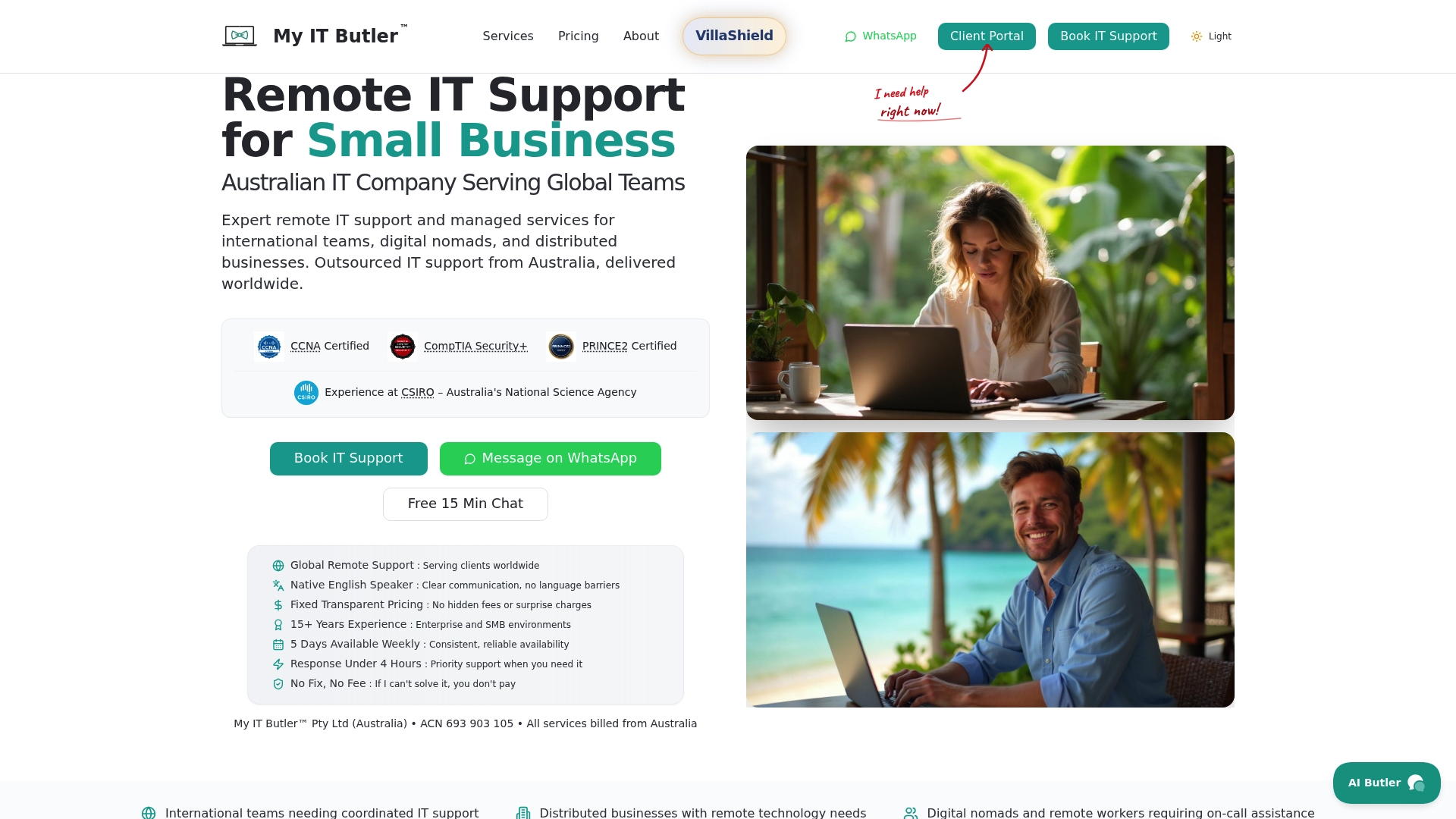
Myitbutler provides remote IT support and managed services for distributed businesses, international teams, and organisations operating across multiple jurisdictions. The team holds CCNA, CompTIA Security+, and PRINCE2 certifications, with over 15 years of enterprise experience delivered to a global client base. Services include on-demand troubleshooting, ongoing IT supervision, vendor liaison, security assessments, and strategic planning, all at transparent fixed pricing with no long-term contracts.
For leaders at the foundation stage of an international expansion, a low-commitment starting point is a free introductory conversation. Book a free chat to discuss your current IT setup, your target markets, and where the gaps are. No obligation, no sales script.
Sources
The following sources underpin the evidence and recommendations in this guide. Each is worth reading in full if you are making significant IT investment decisions for international expansion.
- International business in the digital age: Global strategies in a world of national institutions - PMC
- Digital globalization: The new era of global flows (McKinsey Global Institute)
- AI Can Lift Global Growth (IMF F&D article)
- AI offers lifeline to developing economies in an era of weak growth (World Bank Group press release)
- Digital–intelligent synergy and corporate internationalization (MDPI, Sustainability)
- How information technology (IT) enables firms to globalize their operations (University of Richmond research paper)
FAQ
What is the role of IT in global expansion?
IT enables global expansion by removing geographic barriers to distribution, creating scalable multi-market infrastructure, and generating the data insights that drive local market fit. Research shows IT spending raises foreign revenues primarily through improved responsiveness to overseas customers, not cost reduction.
How does technology contribute to globalisation?
Digital technologies reduce the cost and time of reaching international customers through e-commerce platforms, API-connected payment rails, and cloud infrastructure. McKinsey Global Institute analysis found that participation in global data flows raises productivity across sectors, with data flows accounting for a substantial share of the measured economic impact of global connectedness.
What are the key benefits of international expansion for companies?
International expansion increases total addressable market, reduces dependence on a single economy, and creates opportunities for product-market fit learnings that improve the core offering. IT accelerates each of these benefits by enabling faster localisation, better demand forecasting, and distributed operations that do not require proportional headcount growth.
When should a business hire external IT support for global operations?
External IT support becomes worth considering when customer support volume in a new market exceeds your team's SLA capacity, when data residency requirements exceed your team's regulatory knowledge, or when your IT team is spending more time on vendor management than strategic work. A 30-day trial on a bounded workstream is a low-risk way to evaluate a partner before committing.
How do you protect data when operating across multiple countries?
Start with multi-factor authentication, role-based access control, and encryption at rest and in transit. Then map your data transfer mechanisms for each jurisdiction (Standard Contractual Clauses for GDPR markets, local equivalents elsewhere) and build a review cycle into your governance calendar. The CIS Controls framework provides a practical, evidence-based baseline that maps to most regulatory requirements.