

TL;DR:
- Global businesses benefit from on-demand IT support through lower costs, scalable services, and 24/7 availability across regions. It provides certified expertise, proactive risk management, and seamless integration with existing infrastructure. Myitbutler offers this model with fixed pricing, no long-term contracts, and direct communication channels worldwide.
Running a business across multiple countries or time zones puts real pressure on your IT function. The benefits of on-demand IT support globally come down to six things that matter most to decision-makers: lower costs, the ability to scale fast, access to certified expertise, stronger service quality, round-the-clock availability, and genuine local presence wherever your teams operate.
Here is what that looks like in practice:
- Cost efficiency: Fixed, transparent pricing replaces unpredictable break-fix bills and internal staffing overhead.
- Scalability: Support capacity grows or shrinks with your workforce, not your org chart.
- Expert access: Certified professionals (CCNA, CompTIA Security+, PRINCE2) available without the hiring overhead.
- Service quality: Proactive monitoring and patching reduce unplanned downtime before it hits your bottom line.
- 24/7 availability: Your teams in Singapore, London, or São Paulo get help when they need it, not when your local office opens.
- Global reach: One provider manages multi-vendor complexity, logistics, and compliance across jurisdictions.
Myitbutler, an Australian-operated provider with over 15 years of enterprise experience, delivers exactly this model for international organisations and distributed teams worldwide.
Table of Contents
- 1. How on-demand IT support cuts costs for global businesses
- 2. Scaling your IT support as your workforce grows
- 3. What certified expertise actually gets you
- 4. Better service quality, risk management, and compliance
- 5. Round-the-clock support across every time zone
- 6. The strategic value you get back when IT stops being a distraction
- 7. How on-demand IT support fits your existing infrastructure
- 8. What to look for when choosing a global IT support provider
- 9. How on-demand IT support changes your internal team's role
- 10. Real-world examples of global organisations using on-demand IT support
- Myitbutler: expert global IT support, no lock-in required
- Key takeaways
- FAQ
1. How on-demand IT support cuts costs for global businesses
The most immediate benefit is financial. Traditional in-house IT requires salaries, hardware, software licences, and ongoing training across every region you operate in. On-demand support replaces that fixed overhead with a predictable monthly cost tied to what you actually use.
Transparent fixed pricing with no long-term contracts means you are never locked into a service level that no longer fits your business. That alone removes a common source of budget blowout for growing organisations.

Beyond the direct savings, consider what reactive IT costs you. Every hour a system is down, every hour a senior manager spends troubleshooting a connectivity issue instead of closing a deal, is money leaving the business. Proactive managed IT services prevent those incidents rather than responding to them after the damage is done.
Key cost savings include:
- Elimination of full-time IT headcount in every region
- No capital expenditure on hardware procurement or refresh cycles
- Reduced exposure to security breach costs through continuous monitoring
- Predictable monthly spend replacing unpredictable emergency callout fees
- Faster procurement through established vendor relationships
2. Scaling your IT support as your workforce grows
Growth should not be held up by IT logistics. One of the clearest global IT support benefits is the ability to onboard a new team member in Berlin or Bangkok without shipping hardware across borders or waiting weeks for local procurement.

Desktop-as-a-Service (DaaS) makes this possible by delivering a fully configured work environment through the cloud. A new hire logs in from any device, anywhere, and has everything they need from day one. When someone leaves, access is revoked instantly, with no asset recovery headache.
Flexible on-demand services also handle seasonal staffing spikes cleanly. A retail business ramping up for the holiday period or a consulting firm scaling for a major project can increase support capacity without committing to permanent IT hires.
Scalability benefits at a glance:
- Rapid global provisioning without physical hardware shipment
- Instant, secure offboarding regardless of geography
- Support capacity that adjusts to seasonal or project-based demand
- No fixed IT headcount required in each new market
- Cloud-based environments that travel with your workforce
3. What certified expertise actually gets you
Hiring a senior network engineer, a cybersecurity specialist, and a project manager in every country you operate in is not realistic for most organisations. On-demand IT support gives you access to that depth of expertise without the recruitment cost or the retention risk.
Myitbutler's team holds certifications including CCNA, CompTIA Security+, and PRINCE2. That is not just a credential list. It means the person handling your network configuration understands enterprise-grade architecture, the person managing your security posture is trained to current threat standards, and your IT projects are run with a structured methodology.
Staying current on international compliance requirements and emerging cyberthreats is a full-time job. A specialist provider does that work continuously across all their clients, which means your business benefits from knowledge that would cost considerably more to maintain in-house.
Expertise benefits include:
- Access to CCNA, CompTIA Security+, and PRINCE2 certified professionals
- Up-to-date knowledge of international compliance frameworks
- Proactive threat monitoring informed by cross-client intelligence
- Support for diverse IT environments, from legacy infrastructure to cloud-native stacks
- No recruitment delays when specialist skills are needed urgently
4. Better service quality, risk management, and compliance
Reactive IT, the traditional break-fix model, is fundamentally a risk management failure. You wait for something to go wrong, then pay to fix it, often at the worst possible moment. Proactive managed IT services with continuous monitoring and patching deliver higher business continuity by preventing incidents before they cause disruption.
For Australian businesses operating internationally, alignment with the ACSC Essential Eight is a practical baseline for cybersecurity. A quality on-demand provider builds these controls into their standard service rather than treating them as optional extras.
Continuous vulnerability management, automated patching, and tested disaster recovery plans are the difference between a minor incident and a business-stopping outage. These are not luxuries for enterprise organisations. They are table stakes for any business that depends on its systems being available.
Service quality and compliance improvements:
- Continuous monitoring catching issues before they escalate
- Alignment with ACSC Essential Eight and relevant data security frameworks
- Automated patching reducing the window of vulnerability
- Documented disaster recovery and business continuity procedures
- Consistent service levels across all regions, not just headquarters
5. Round-the-clock support across every time zone
A team member in Tokyo hitting a critical system error at 9 PM their time should not have to wait until Sydney business hours for help. 24/7 global IT support maintains productivity across time zones, reduces downtime, and keeps compliance with local regulations on track.
The productivity impact is direct. When IT issues are resolved quickly, people get back to work. When they drag on for hours because no one is available, frustration builds and output drops. Round-the-clock support also reduces staff attrition by removing one of the most common sources of workplace frustration for distributed teams.
Global reach with local sensitivity matters too. Support delivered in the right language, with an understanding of local business culture, lands very differently from a generic offshore helpdesk. Managing multi-vendor relationships, customs requirements, and regional logistics through a single provider removes enormous complexity.
Operational advantages of always-on global support:
- Immediate assistance regardless of the employee's time zone
- Reduced productivity loss from after-hours IT failures
- Local language support and cultural awareness in service delivery
- Single provider managing multi-vendor and logistics complexity
- Faster compliance with region-specific regulatory requirements
6. The strategic value you get back when IT stops being a distraction
Every hour your leadership team spends managing IT vendors, chasing support tickets, or troubleshooting infrastructure is an hour not spent on customers, product, or growth. On-demand IT support reduces this opportunity cost by putting a professional team in charge of the operational detail.
This is where the strategic case for on-demand IT support becomes clearest. Proactive management prevents the costly productivity losses that come from unplanned outages. It also creates the stable, secure foundation that digital transformation initiatives require. You cannot migrate to a new platform or roll out a global system if your current environment is constantly on fire.
Myitbutler's approach, built on Australian enterprise standards and delivered through direct channels including WhatsApp and email, means your leadership team has a real point of contact rather than a ticket queue. That relationship matters when decisions need to be made quickly.
Pro Tip: Before engaging any IT support provider, map out how many hours per month your senior staff currently spend on IT-related issues. That number, multiplied by their hourly cost, is your baseline for calculating the return on a managed support arrangement.
Strategic value summary:
- Management time reclaimed from IT operations and vendor management
- Proactive prevention of productivity-killing outages
- Stable IT foundation enabling digital transformation
- Direct, responsive communication channels with your support team
- Strategic IT planning aligned with business growth objectives
7. How on-demand IT support fits your existing infrastructure
A common concern is whether an external provider can work with what you already have. The short answer is yes, and a good provider will document your environment thoroughly before touching anything.
On-demand IT support integrates with existing infrastructure through remote monitoring and management (RMM) tools that sit alongside your current systems without requiring a full replacement. Whether you run Microsoft 365, Google Workspace, a mix of on-premises servers, or a hybrid cloud environment, a capable provider maps your stack and works within it.
The integration process typically starts with a discovery phase: auditing current hardware, software licences, network configurations, and security controls. From there, the provider establishes monitoring baselines and identifies gaps. For distributed organisations, this often surfaces inconsistencies between regional setups that have grown organically over time.
8. What to look for when choosing a global IT support provider
Not every provider that claims global coverage actually delivers it. The gap between "we support 24/7" and "we have engineers available in your time zone who understand your compliance environment" is significant.
Start with geographic coverage. Ask specifically how support is delivered across the time zones your teams work in, not just whether 24/7 is listed on the website. Then look at compliance capability. A provider supporting Australian businesses operating in Europe needs to understand both the Australian Privacy Act and GDPR requirements.
Certifications matter because they signal a structured, accountable approach. Pricing transparency matters because hidden fees erode the cost savings that made on-demand support attractive in the first place. And contract flexibility matters because your business will change, and your IT support arrangement needs to change with it.
For a detailed framework on assessing provider coverage, the guide to evaluating remote IT provider global coverage is a practical starting point.
Key evaluation criteria:
- Verified geographic coverage across your actual operating regions
- Compliance knowledge relevant to your jurisdictions
- Certified staff with documented credentials
- Transparent, fixed pricing with no long-term lock-in
- Clear escalation paths and communication channels
9. How on-demand IT support changes your internal team's role
Bringing in an external IT support provider does not make your internal IT staff redundant. It changes what they focus on. Routine helpdesk tickets, patch management, and vendor liaison shift to the provider. Your internal team moves toward governance, architecture decisions, and business-aligned IT strategy.
This is the co-managed model in practice. Internal teams retain ownership of the systems and decisions that are core to the business. The provider handles the operational volume that would otherwise consume their time. The result is an IT function that punches above its weight without requiring a proportional increase in headcount.
For organisations that do not yet have a dedicated internal IT team, on-demand support fills that gap entirely. For those that do, it extends capacity without the delays and costs associated with IT recruitment and placement.
10. Real-world examples of global organisations using on-demand IT support
The organisations that benefit most from on-demand IT support share a common profile: they are growing faster than their internal IT capacity, operating across multiple regions, or managing a distributed workforce that spans time zones.
A professional services firm expanding from Australia into Southeast Asia, for example, faces immediate challenges around device provisioning, local compliance, and after-hours support for new regional staff. An on-demand provider handles all three without the firm needing to establish a local IT presence in each new market.
Digital-first businesses, SaaS companies, and international NGOs are frequent adopters. So are Australian expatriate communities and remote-first companies where staff may be spread across a dozen countries. In each case, the driver is the same: the cost and complexity of replicating internal IT capability across every location is prohibitive, and on-demand support is the practical alternative.
Myitbutler: expert global IT support, no lock-in required
Most IT support arrangements ask you to commit before you know what you are getting. Myitbutler works differently. You get over 15 years of Australian enterprise IT experience, a team certified in CCNA, CompTIA Security+, and PRINCE2, and direct communication through WhatsApp, email, and messaging channels, without a long-term contract tying you in.
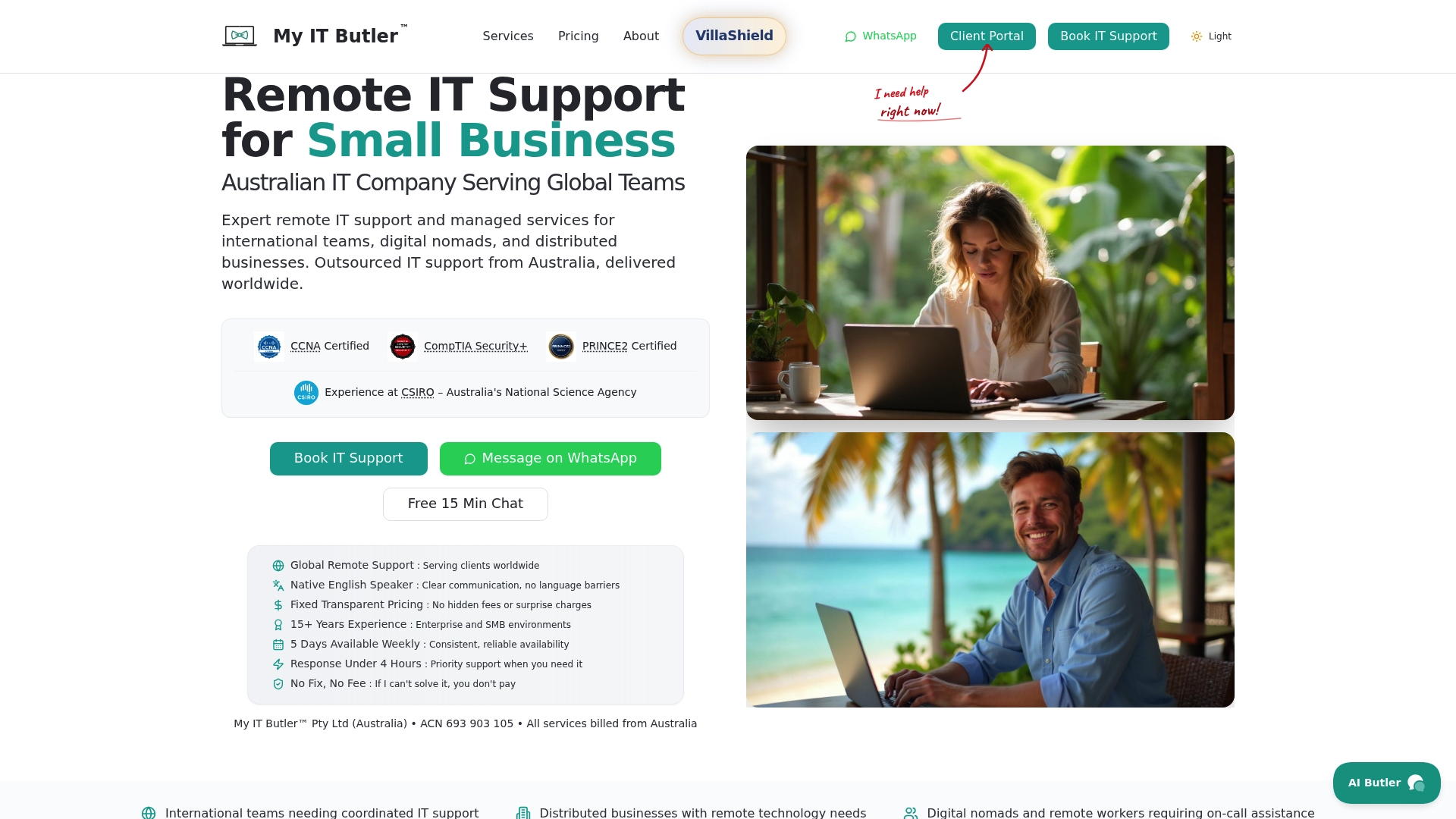
For distributed teams, international organisations, and businesses that have outgrown their current IT setup, Myitbutler delivers proactive remote IT support built to Australian standards and delivered wherever your teams are. Fixed pricing means no billing surprises. No lock-in means the arrangement works as long as it works for you.
Book a free consultation to talk through your current IT setup and find out what a properly managed, globally capable support arrangement would look like for your business.
Key takeaways
On-demand IT support globally reduces costs, scales with workforce demand, and gives distributed organisations access to certified expertise without the overhead of building internal teams in every region.
| Point | Details |
|---|---|
| Cost model | Fixed, transparent pricing replaces unpredictable break-fix costs and internal staffing overhead across regions. |
| Scalability | Desktop-as-a-Service enables rapid global provisioning and instant offboarding without physical hardware logistics. |
| Expert access | Certified professionals (CCNA, CompTIA Security+, PRINCE2) available on demand, without recruitment delays or retention risk. |
| Risk reduction | Proactive monitoring aligned with ACSC Essential Eight prevents incidents rather than responding to them after disruption occurs. |
| Myitbutler | Australian-operated, globally delivered, with fixed pricing, no long-term contracts, and direct communication channels for distributed teams. |
FAQ
What are the main advantages of outsourced IT support?
Outsourced IT support reduces staffing costs, provides access to certified expertise, and shifts IT management from reactive to proactive, preventing downtime rather than responding to it after the fact.
What is one of the greatest benefits of global IT outsourcing?
The ability to scale support capacity instantly across new regions without hiring local IT staff or establishing physical infrastructure in each market.
How does 24/7 IT support help distributed teams?
Round-the-clock availability means employees in any time zone get timely help, reducing productivity losses from after-hours IT failures and improving staff satisfaction across distributed workforces.
What should I look for when choosing a global IT support provider?
Prioritise verified geographic coverage, compliance knowledge relevant to your operating jurisdictions, certified staff, transparent fixed pricing, and contract flexibility with no long-term lock-in.
How does Myitbutler support international organisations?
Myitbutler delivers remote IT support and managed services globally, built on Australian enterprise standards, with certified professionals, fixed pricing, no long-term contracts, and direct communication via WhatsApp and email.