

TL;DR:
- Choosing a remote IT provider requires a structured process focused on operational capability, security, and communication. Evaluating true global coverage involves ensuring follow-the-sun support, security compliance, and measurable incident response quality. Rushing the process risks locking organizations into providers unable to meet their multi-region needs.
Evaluating a remote IT provider for global coverage means testing whether they can deliver consistent, compliant, and responsive IT support across every time zone your organisation operates in. The HappySignals Global Benchmark 2026 found that employees lose an average of 3 hours and 18 minutes of productive time per IT incident. That figure, drawn from nearly 2 million responses across 130+ countries, makes the case plainly: a provider who cannot resolve issues quickly across regions is not a global provider. Structured evaluation, grounded in clear criteria and a defined process, is the only way to tell the difference.
How to evaluate remote IT provider global coverage: core capabilities
Global coverage in remote IT support is not simply a matter of having offices on multiple continents. A provider with true global reach delivers what the industry calls "follow-the-sun" support. Regional teams hand off active incidents as business hours shift from the US to Europe to Asia, so support never stops between time zones. Providers who cannot demonstrate this typically operate siloed local helpdesks that go dark overnight.

The security baseline matters just as much as the coverage map. Providers should operate under frameworks such as Zero Trust architecture and multi-factor authentication (MFA), and they must be able to explain their incident response procedures in plain language. Security frameworks must be testable, not just listed in a brochure. Compliance obligations including GDPR, HIPAA, and CMMC vary by industry and geography, so confirm that the provider has direct experience with the regulations your organisation faces.
Look for these capabilities when assessing any candidate:
- Follow-the-sun handoffs: Regional teams pass incidents without gaps, so your staff never wait hours for a shift to start.
- Infrastructure redundancy: Provider redundancy reroutes traffic automatically during regional outages, which is the mark of genuine risk mitigation.
- 24/7/365 availability: Confirm this covers public holidays in every region you operate, not just standard business hours.
- Onsite support options: Some incidents require a local technician. Ask whether the provider has vetted field partners in your key locations.
- Compliance coverage: The provider must hold or support the specific certifications your industry requires.
- Business continuity planning: Disaster recovery procedures should be documented, tested, and available for your review.
Pro Tip: Ask every candidate to describe their last major regional outage and how the handoff between teams was managed. The quality of that answer tells you more than any SLA document.
Defining your requirements before you assess IT service providers
The most common reason an evaluation fails is that the organisation never defined what it actually needed. Before you contact a single provider, map your own environment first.
Start with the basics: how many users need support, across how many locations, and on what mix of devices and operating systems? Document your cloud platforms, your critical software, and any integrations that cannot afford downtime. This inventory becomes the foundation of every request for proposal (RFP) you send. Understanding why remote teams face IT challenges before you start evaluating providers will sharpen your criteria considerably.
Work through these steps before approaching any provider:
- List every location and time zone where your staff work, including home offices, co-working spaces, and travel destinations.
- Catalogue your tech stack including cloud services, line-of-business applications, and hardware types.
- Identify compliance obligations by industry and country, noting which regulations carry the heaviest penalties for non-compliance.
- Define support hours and specify whether after-hours coverage is a hard requirement or a preference.
- Set response time expectations for critical, high, medium, and low-priority incidents separately.
- Account for travelling staff and digital nomads who may need support from locations not on your primary list.
- Set a budget range and a decision timeline so you can filter providers who are clearly out of scope early.
Pro Tip: Write a one-page "non-negotiables" document before you start. Any provider who cannot meet every item on that list is out, regardless of how impressive their pitch is.
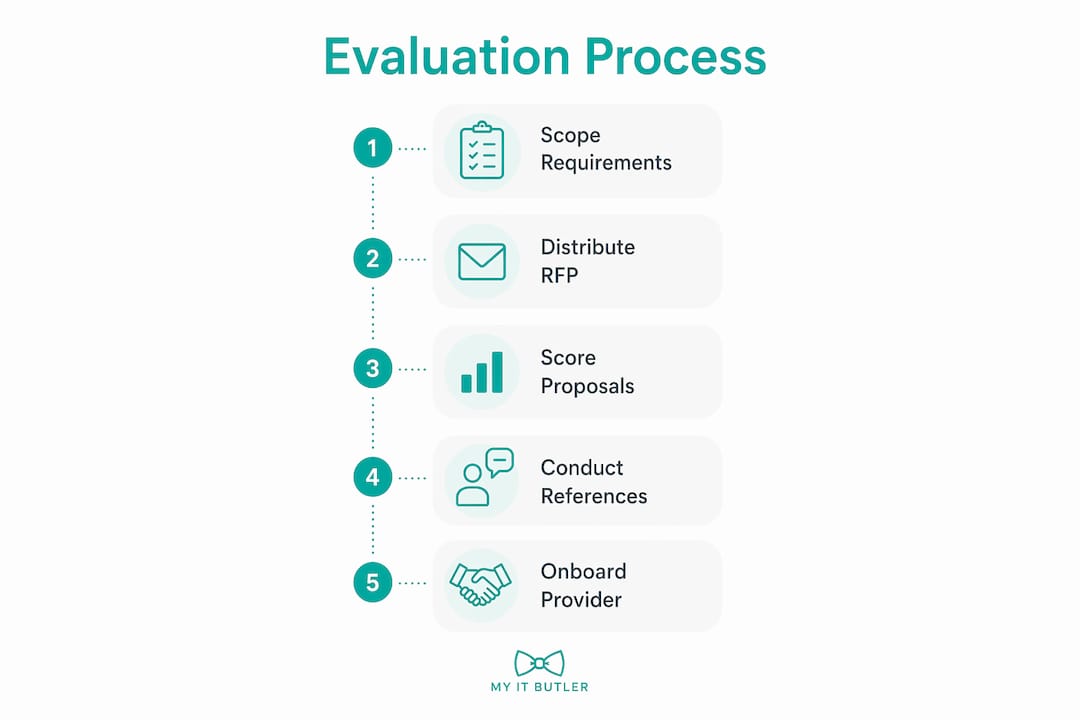
Step-by-step process to score a remote IT solutions review
A rigorous evaluation of a global IT provider typically takes 8–12 weeks and covers scoping, RFP distribution, proposal scoring, reference checks, and contract negotiation. Rushing this process is the single most reliable way to end up locked into a provider who cannot actually deliver.
Start with a candidate pool of three to five providers. At least three proposals give you a genuine baseline for comparison and negotiation leverage. Fewer than three and you lose perspective; more than five and the process becomes unmanageable.
Send identical questions to every candidate. Consistency is what makes proposals comparable. Score each response against the same criteria, weighted by your non-negotiables. The table below shows a practical scoring framework.
| Evaluation criterion | What to look for | Weight |
|---|---|---|
| Follow-the-sun support | Named regional teams, documented handoff procedures | High |
| SLA terms and penalties | Enforceable service credits or termination rights | High |
| Security and compliance | Zero Trust, MFA, relevant certifications | High |
| Client-to-technician ratio | Lower ratios mean faster, more personal support | Medium |
| Onboarding timeline | 30–90 days is standard; shorter claims deserve scrutiny | Medium |
| Communication model | Named account manager, defined escalation path | Medium |
| Contract exit terms | Data portability, notice periods, no lock-in clauses | High |
Pay close attention to SLA penalty clauses. Without enforceable penalties, an SLA is a marketing document, not a commitment. Service credits or termination rights must be written into the contract before you sign.
Conduct structured reference interviews with at least two clients per shortlisted provider. Ask specifically about how the provider handled a major incident, not just routine support. The role of IT in remote productivity is significant enough that a poor incident response from your provider can cost your organisation days of lost output.
Onboarding a global managed service provider typically takes 30–90 days for infrastructure auditing, security hardening, and staff training. Build that timeline into your planning so the transition does not create a coverage gap.
Common pitfalls when assessing IT provider worldwide coverage
Most evaluation mistakes are predictable. Knowing them in advance saves you from signing a contract you will regret.
The most frequent error is confusing an aggregated local helpdesk with genuine global coverage. A provider may list offices in ten countries while each office operates independently with no shared ticketing system or handoff process. That is not global coverage. It is ten separate local services sold under one brand.
Watch for these red flags during your evaluation:
- No named account manager: Cultural and communication misalignment is the leading cause of service breakdown in global provider relationships. A named contact who knows your environment is the practical fix.
- Vague follow-the-sun claims: Ask for a live demonstration or a detailed written description of the handoff process. Vague answers mean the capability does not exist.
- No SLA reporting: Providers who cannot produce monthly SLA performance reports have no accountability mechanism.
- Weak exit terms: Contracts without clear data portability rights and reasonable notice periods create lock-in by default.
- Underestimating onboarding: Providers who promise a one-week onboarding for a complex global environment are either inexperienced or not being honest.
- Ignoring employee experience metrics: The HappySignals benchmark shows that employees rank direct human support higher than automated or portal-based channels. A provider who relies entirely on self-service ticketing will frustrate your staff.
- Skipping the security audit: Ask to see the provider's own security posture, not just their client-facing policies. A provider with weak internal security is a liability.
Understanding why IT response time matters for distributed teams will help you frame the right questions when you push back on vague SLA commitments.
Key takeaways
Choosing the right remote IT provider for global coverage requires a structured, criteria-driven process that tests operational capability, security posture, and communication quality before any contract is signed.
| Point | Details |
|---|---|
| Define requirements first | Document your locations, tech stack, compliance needs, and response time expectations before contacting any provider. |
| Test follow-the-sun support | Ask for documented handoff procedures between regional teams, not just a claim of 24/7 availability. |
| Enforce SLA penalties | Contracts without service credits or termination rights offer no real accountability. |
| Allow 8–12 weeks to evaluate | A thorough evaluation covering RFPs, scoring, references, and negotiation takes time and cannot be safely rushed. |
| Prioritise human support quality | Employees lose over 3 hours per IT incident; providers who rely on self-service portals alone will compound that loss. |
What I have learned from watching organisations get this wrong
After years of working with distributed teams and international organisations, the pattern I see most often is this: the evaluation process starts with the right intentions and then collapses under time pressure. A deadline appears, the shortlist gets cut to two providers, reference checks get skipped, and the contract gets signed without anyone reading the exit clauses. Six months later, the organisation is locked in with a provider who cannot actually cover their Asia-Pacific users after 6PM.
The uncomfortable truth about choosing a remote IT partner with global reach is that the cheapest option almost always has a hidden cost. That cost shows up in the form of unresolved overnight tickets, staff who learn to work around IT rather than with it, and compliance gaps that only surface during an audit.
What actually works is patience and specificity. The organisations I have seen get this right treat the evaluation like a procurement process, not a vendor beauty contest. They write their non-negotiables down. They ask hard questions about incident handling. They check references with the same rigour they would apply to hiring a senior staff member.
Myitbutler operates under Australian enterprise standards with CCNA, CompTIA Security+, and PRINCE2 certifications, and delivers support globally with transparent fixed pricing and no lock-in contracts. That combination of accountability and reach is exactly what the evaluation process should be designed to find. If you approach the process with the same rigour, you will find the right partner.
— Thomas
Myitbutler: global IT support, Australian standards
Selecting the right remote IT partner is a significant decision. Myitbutler works with international organisations and distributed teams to cut through the complexity of that process.
With over 15 years of enterprise experience and certifications including CCNA, CompTIA Security+, and PRINCE2, Myitbutler delivers remote IT support built for organisations operating across multiple time zones. Services include on-demand troubleshooting, ongoing IT supervision, vendor liaison, and compliance-aware planning, all at transparent fixed pricing with no long-term contracts. Whether you need help preparing an RFP, scoring provider proposals, or simply want a trusted partner who already meets the criteria, book a free consultation to talk through your requirements.
FAQ
What does global coverage mean for a remote IT provider?
Global coverage means a provider delivers consistent, uninterrupted support across all time zones through coordinated regional teams. True global coverage includes follow-the-sun handoffs, infrastructure redundancy, and compliance capability in every region you operate.
How long does it take to evaluate a remote IT provider?
A thorough evaluation typically takes 8–12 weeks, covering requirements scoping, RFP distribution, proposal scoring, reference interviews, and contract negotiation. Rushing this process increases the risk of signing with a provider who cannot meet your actual needs.
What SLA terms should I require from a global IT provider?
Require enforceable penalty clauses, including service credits or termination rights, tied to specific response and resolution time targets. SLA commitments without penalties are not contractually binding and offer no real protection.
How do I verify a provider's follow-the-sun support claims?
Ask the provider to describe their regional handoff process in writing and request contact details for references in each region. A provider with genuine follow-the-sun capability will describe named teams, shared ticketing systems, and documented escalation paths.
Why does employee experience matter when I assess IT service providers?
The HappySignals Global Benchmark 2026 found employees lose over 3 hours of productive time per IT incident. Providers who rely on self-service portals rather than direct human support consistently score lower on employee satisfaction, which compounds that productivity loss over time.