
TL;DR:
- Outsourced IT support helps SMBs reduce costs, enhance security, and scale operations by providing proactive, round-the-clock management from external specialists. It addresses internal capacity gaps in monitoring, incident response, and cybersecurity expertise, which most SMB internal teams struggle to meet effectively. Choosing the right model and provider is essential to ensure reliable, compliant, and scalable technology support as businesses grow.
Outsourced IT support is defined as the practice of engaging external specialists to manage your business's technology infrastructure, security, and day-to-day technical needs in place of an internal team. The global IT outsourcing market is valued at $617.69 billion in 2026 and projected to reach $806.53 billion by 2029, which tells you this is not a niche workaround. It is the dominant model for how businesses manage technology. For Australian SMBs, the drivers are specific: rising cybersecurity threats, a shortage of skilled IT staff, and the operational complexity of managing cloud tools, SaaS platforms, and remote teams. This article explains why SMBs outsource IT support, what the different models look like, and how to choose the right approach for your business.
What are the main benefits SMBs gain from outsourcing IT support?
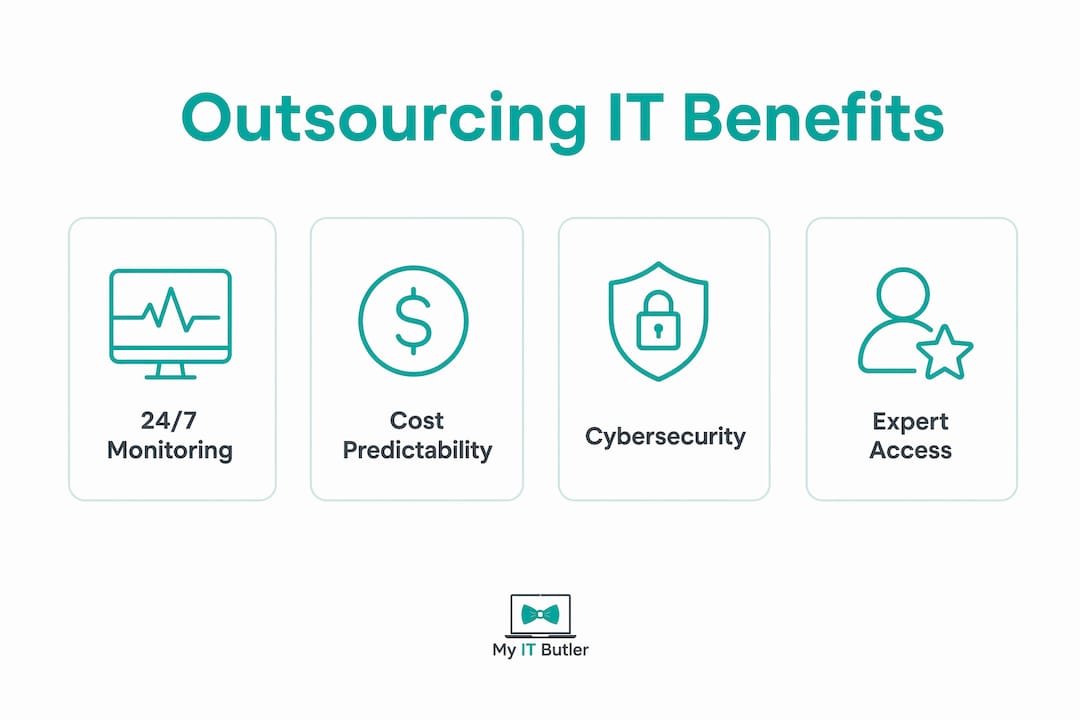
The core advantage of outsourcing IT support is cost predictability. Hiring a single entry-level IT technician costs an average of $51,408 per year before you factor in superannuation, training, equipment, and leave entitlements. A managed IT service provider typically delivers broader coverage at a fixed monthly fee, which makes budgeting far more straightforward for a small business owner.
Beyond cost, the benefits stack up quickly:
- 24/7 monitoring and incident response. Most SMBs cannot staff a round-the-clock IT function internally. An outsourced provider monitors your systems continuously, catching issues before they become outages.
- Access to specialised skills. A managed service provider (MSP) brings a team with expertise across cybersecurity, cloud architecture, networking, and compliance. No single in-house hire can match that breadth.
- Improved security posture. 52% of SMBs ranked cybersecurity as a top business priority, yet half experienced a security incident in the prior year. Outsourced providers close that gap with consistent monitoring and response.
- Scalability. Outsourced IT scales from 5 to 500 employees without requiring you to hire, train, or restructure an internal team.
Pro Tip: Ask any prospective IT provider to show you their average incident response time and their process for after-hours escalation. A provider who cannot answer that question clearly is not ready to support your business.
The shift from reactive to proactive IT management is where the real value lies. When your IT is managed externally by specialists, you stop spending your week chasing technical problems and start focusing on running your business.
Why do internal IT teams often struggle to meet SMB needs?
The honest answer is that most SMBs are not structured to run effective IT operations internally, and the gap between buying technology and actually managing it well is wider than most owners realise.
Consider what effective IT management actually requires in 2026:
- Continuous monitoring. Only 54% of SMBs reported being able to provide 24/7 monitoring and response on their own. That means nearly half of small businesses have blind spots in their security coverage every single night.
- Incident response planning. Only 36% of SMBs test their incident response plans, and 43% do not regularly monitor third-party vendors. Buying a firewall or antivirus software is not the same as having a tested response plan.
- Vendor and cloud management. Growth in SaaS reliance adds security and management overhead that most internal IT generalists cannot handle alongside their daily support duties.
- Cybersecurity expertise. AI-driven threats are evolving faster than most SMB IT staff can keep pace with. Specialised cybersecurity skills require ongoing training and certification that is expensive to maintain in-house.
- Staff retention. Skilled IT professionals in Australia are in high demand. Retaining a qualified IT person in a small business environment, where career progression is limited, is genuinely difficult.
"SMB cybersecurity risk is less about tools and more about consistent operational practices and monitoring." — Sage SMB Research, 2026
The operational capacity gap is the key driver behind why businesses choose IT outsourcing. It is not that SMB owners are unaware of the risks. It is that they do not have the structure, headcount, or budget to address those risks consistently on their own. Understanding the IT risks small businesses overlook is often the first step toward recognising that internal IT has real limits.
How do different IT outsourcing models compare for SMBs?
IT outsourcing for SMBs is not a single product. There are three primary models, and choosing the wrong one is a common and costly mistake.
| Model | What it covers | Best for | Cost level | Control level |
|---|---|---|---|---|
| Fully managed IT services | All IT functions: monitoring, security, helpdesk, vendor management, strategy | SMBs with no internal IT staff | Fixed monthly fee | Low internal burden |
| Selective help desk support | Day-to-day troubleshooting and user support only | SMBs with some internal IT capacity | Lower monthly cost | Higher internal involvement |
| IT consulting | Project-based advice, strategy, and implementation | SMBs planning a specific change or upgrade | Per-project fee | Full internal control |
Fully managed IT services are the most comprehensive option. Providers like Myitbutler deliver ongoing monitoring, security management, vendor liaison, and strategic planning under a single fixed-price arrangement. This model suits businesses that want to hand off IT entirely and focus on their core operations.
Selective help desk support works well when you have someone internally who handles basic IT but needs backup for complex issues or after-hours incidents. It is a lower-cost entry point, but it leaves gaps in proactive monitoring and strategic planning.
IT consulting is project-based and suits businesses that are migrating to the cloud, implementing a new system, or preparing for a compliance audit. It is not a substitute for ongoing managed support.
Pro Tip: If you are unsure which model fits your business, review your types of IT support packages before speaking to any provider. Knowing the terminology puts you in a stronger position during those conversations.
Most growing SMBs eventually move toward fully managed services as their technology stack becomes more complex. Starting with a help desk arrangement and scaling up is a legitimate path, provided your provider can grow with you.
What should SMBs consider when selecting an IT support provider?
Choosing the right provider is where many SMBs make avoidable mistakes. The lowest price is rarely the right price, and a provider who cannot explain their security practices clearly is a liability, not an asset.
Here is what to evaluate before signing anything:
- Cybersecurity credentials. Look for certifications such as CompTIA Security+, CCNA, or equivalent. These signal that the provider's staff have been formally assessed against industry standards, not just self-trained.
- 24/7 support availability. Confirm exactly what "24/7" means in their contract. Some providers offer after-hours monitoring but not after-hours response. That distinction matters enormously when something breaks at 11pm on a Friday.
- Transparent, fixed pricing. Variable pricing models create budget uncertainty. A reputable provider offers clear monthly fees with defined service inclusions. Ask for a written service level agreement (SLA) that specifies response times for different incident types.
- Incident response readiness. Ask the provider to walk you through what happens when a ransomware attack is detected on your network. Their answer will tell you more than any brochure.
- No lock-in contracts. Long-term contracts with heavy exit penalties are a red flag. Providers who are confident in their service quality do not need to trap clients.
- Local knowledge and compliance awareness. For Australian businesses, your provider should understand the Privacy Act, the Australian Cyber Security Centre (ACSC) Essential Eight framework, and any industry-specific compliance requirements relevant to your sector.
Pro Tip: Request a trial period or a short-term initial engagement before committing to a long-term arrangement. A provider worth keeping will welcome the opportunity to demonstrate their value.
Understanding how to create an IT budget before you approach providers will also help you evaluate proposals on equal terms. Going in without a budget framework means you are negotiating blind.
How does outsourcing IT support help SMBs scale and grow?
Outsourced IT is one of the few business functions that genuinely gets more valuable as your business grows. The shift from reactive to proactive IT management means your systems are maintained and monitored continuously, which reduces the frequency and severity of disruptions as your team and customer base expand.
The scaling benefits are concrete:
- Remote and hybrid workforce support. Outsourced providers manage remote access, VPN configurations, and device management across multiple locations and time zones without requiring you to hire locally in each market.
- Cloud tool deployment. Migrating to Microsoft 365, Google Workspace, or industry-specific SaaS platforms is far smoother when managed by specialists who have done it dozens of times. Managed IT providers also unify network, communication, and security functions into a single oversight model, which reduces the fragmentation that kills productivity in growing businesses.
- Reduced downtime risk. Proactive monitoring catches hardware failures, software vulnerabilities, and configuration errors before they cause outages. For a business processing customer transactions or managing client data, every hour of downtime has a direct financial cost.
- Focus on core business. When IT is handled externally, your leadership team stops spending time on technical problems and redirects that energy toward sales, product development, and customer relationships.
The advantages of outsourced IT support become most visible at growth inflection points, when you are adding staff, entering new markets, or adopting new technology. That is precisely when internal IT teams become overwhelmed and external specialists become indispensable.
Key takeaways
SMBs outsource IT support primarily because internal teams cannot deliver the 24/7 monitoring, cybersecurity expertise, and operational consistency that modern business technology demands at a cost that makes financial sense.
| Point | Details |
|---|---|
| Cost predictability | Fixed monthly fees replace unpredictable salary, training, and infrastructure costs. |
| Security gap is real | 52% of SMBs experienced a security incident despite ranking cybersecurity as a top priority. |
| Internal capacity limits | Only 54% of SMBs can provide 24/7 monitoring independently, leaving significant coverage gaps. |
| Model selection matters | Fully managed services, help desk support, and IT consulting suit different business sizes and needs. |
| Scalability is built in | Outsourced IT adjusts with your workforce and technology stack without requiring new hires. |
Why I think most SMBs wait too long to outsource IT
After more than 15 years working in enterprise IT and supporting businesses across Australia and internationally, the pattern I see most often is this: SMBs outsource IT after something goes wrong, not before. A ransomware attack, a data breach, a critical system failure during a busy period. That reactive trigger is expensive and avoidable.
The businesses I have seen get the most value from outsourced IT are the ones that made the decision proactively, before a crisis forced their hand. They chose a provider who understood their industry, asked hard questions about compliance and incident response, and treated IT as a business function rather than a technical afterthought.
The common pitfall I see is choosing a provider based on price alone. A cheap IT contract that delivers slow response times and no proactive monitoring is not a bargain. It is a liability with a monthly invoice attached. The right provider should feel like a genuine extension of your business, not a call centre you ring when things break.
For Australian SMBs specifically, I would also urge you to consider whether your provider understands local compliance obligations. The ACSC Essential Eight framework is the baseline for Australian cybersecurity practice, and any provider who cannot speak to it fluently is not the right fit for a business operating under Australian law.
Outsourcing IT is not a cost-cutting exercise. It is a decision to run your technology properly, with people who do it every day.
— Thomas
How Myitbutler supports Australian SMBs with remote IT
If you have been weighing up the costs and benefits of outsourcing your IT support, Myitbutler offers a straightforward starting point.
Myitbutler is an Australian-operated remote IT support and managed services provider with over 15 years of enterprise experience. The team holds certifications including CCNA, CompTIA Security+, and PRINCE2, and delivers support to SMBs, distributed teams, and international organisations across multiple time zones. Services include on-demand troubleshooting, ongoing IT supervision, vendor liaison, and strategic planning, all at transparent fixed pricing with no long-term contracts. If you are ready to move from reactive IT firefighting to proactive management, book a consultation to discuss your specific needs. You can also explore remote IT support options for Australian businesses directly on the Myitbutler website.
FAQ
Why do SMBs outsource IT support instead of hiring in-house?
Outsourcing IT support gives SMBs access to a full team of specialists, including cybersecurity experts, network engineers, and help desk staff, at a fraction of the cost of a single in-house hire. The average entry-level IT technician salary alone exceeds $51,000 per year before overheads, making outsourcing the more cost-effective option for most small businesses.
What is the difference between managed IT services and a help desk?
Managed IT services cover your entire IT function proactively, including monitoring, security, vendor management, and strategy. A help desk service handles reactive support requests only, meaning issues are addressed after they occur rather than prevented in advance.
How much can outsourcing IT save an SMB?
Savings vary by business size and current IT spend, but outsourcing eliminates salary, training, infrastructure, and unplanned IT expense costs. For most SMBs, a fixed-price managed IT arrangement costs significantly less than maintaining equivalent in-house capability.
What should I look for in an IT outsourcing provider?
Prioritise providers with verified certifications such as CompTIA Security+ or CCNA, clear service level agreements with defined response times, transparent fixed pricing, and demonstrated knowledge of Australian compliance frameworks such as the ACSC Essential Eight.
Is outsourced IT support suitable for very small businesses?
Outsourced IT support is particularly well-suited to small businesses because it provides enterprise-grade capability without enterprise-level headcount. Providers like Myitbutler offer scalable arrangements that work for businesses with as few as five employees and grow alongside the business as it expands.