
TL;DR:
- Managing IT vendor contracts helps small businesses control costs and avoid auto-renewal pitfalls.
- Effective tracking, clear ownership, and timely negotiation are essential for minimizing operational risks.
IT vendor contract management is the process of organising, negotiating, and monitoring agreements with technology suppliers to control costs and secure reliable service for your small business. For most small businesses, vendor agreements represent 20–30% of operating costs. That is a significant slice of your budget to leave on autopilot. Poor management alone can drain up to 11% of total contract value after signing. This guide covers how to manage IT vendor contracts in your small business, from what to track and which tools to use, through to negotiation tactics that actually move the needle in 2026.
What must you track in every IT vendor contract?
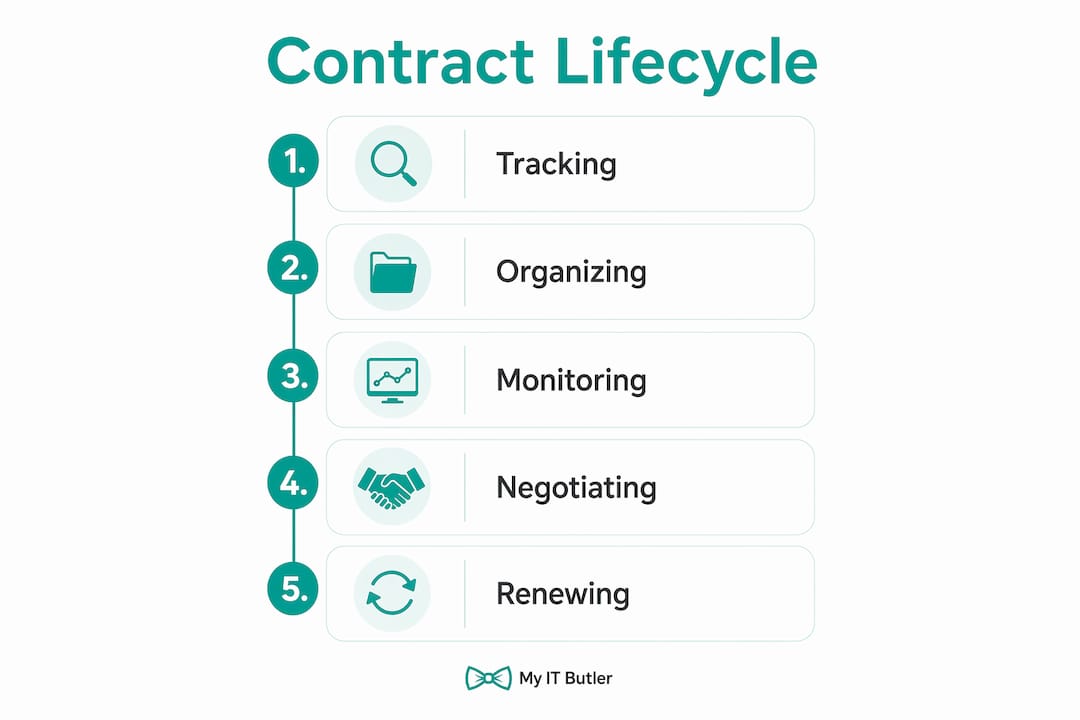
The industry term for this discipline is vendor contract lifecycle management. Most small business owners call it something less formal, but the practice is the same: knowing exactly what you have agreed to, with whom, and when it matters.

Every IT vendor contract contains a handful of terms that carry real financial and operational weight. Miss one, and you are either locked into a service you no longer need or exposed to a penalty you did not see coming.
The core fields to track for every contract:
- Vendor name and contract owner — who inside your business is accountable for this agreement
- Start date, end date, and notice period — especially the cancellation notice window, which is often 60–90 days before expiry
- Pricing and payment terms — including any volume discounts or annual prepayment options
- Auto-renewal clause — flag this separately from the expiry date so it never catches you off guard
- Service Level Agreement (SLA) commitments — uptime guarantees, response times, and remedies for failure
- Data ownership and portability — who owns your data if you leave, and how you get it back
- Exit and early termination clauses — penalties, notice requirements, and transition support
Short initial contract terms of 12 months give you far more flexibility than standard three-year lock-ins. A 12-month term means you can exit cleanly if service quality drops or your needs change, without negotiating your way out of a multi-year commitment.
Proportional discipline is the principle that high-value, high-risk contracts deserve the most management attention. Your Microsoft 365 or AWS agreement warrants a quarterly review. Your $29-per-month project tool does not need the same scrutiny. Prioritise your effort accordingly.
Pro Tip: Set calendar reminders 90 days and 60 days before each contract's notice period deadline, not just the expiry date. Auto-renewal traps are the single most common and costly mistake small businesses make.
How should you organise and monitor IT vendor contracts?
The right tracking method depends entirely on how many contracts you are managing. There is no single correct answer, but there is a clear decision framework.
Manual tracking: when it works
For fewer than 20 vendors, a metadata spreadsheet combined with a centralised shared folder is the most practical and cost-effective approach. Store all contract PDFs in a shared drive such as Microsoft SharePoint or Google Drive. Maintain a single spreadsheet with one row per contract and columns for every critical field listed above. This setup costs nothing extra and works well when one person owns the process.
Manual spreadsheet tracking remains viable up to around 100 contracts. Beyond 500 contracts, specialised software is necessary to avoid gaps and maintain audit readiness. Most small businesses sit well below that threshold, which means a disciplined spreadsheet approach is genuinely sufficient for years.
When to move to vendor management software
The signs that manual tracking is failing are usually obvious: missed renewal dates, confusion over who owns a contract, or no clear record of what was agreed during the last negotiation. When those problems appear, vendor management software (VMS) earns its keep.
Tools like License Logic and Signeasy offer centralised contract repositories, automated renewal reminders, role-based access controls, and spend tracking integrations. IT vendor contracts also carry compliance and security obligations, so role-based access is not just convenient. It protects sensitive vendor data from being accessed by the wrong people inside your own organisation.
The table below compares the two approaches at a glance.
| Approach | Best For | Key Benefit | Main Limitation |
|---|---|---|---|
| Spreadsheet + shared folder | Fewer than 20 vendors | Zero added cost, simple to maintain | Relies on manual discipline |
| SharePoint or Google Drive with metadata sheet | 20–100 contracts | Searchable, accessible to team | No automated alerts |
| Vendor Management Software (e.g., License Logic) | 100+ contracts | Automated reminders, audit trail | Monthly software cost |
Pro Tip: Assign a named contract owner for every vendor agreement, even in a small team. Shared ownership means no ownership. One person must be responsible for each renewal decision.
You can also explore remote IT management tools that integrate contract tracking with broader IT oversight, which is useful if you are managing distributed teams or multiple vendor relationships across time zones.
How do you negotiate IT vendor contracts effectively?
Negotiation is where small businesses consistently leave money on the table. Most owners accept the first proposal or renew on autopilot. A few targeted tactics change that outcome significantly.
-
Start 90 days before expiry. Beginning renegotiation 90 days out aligns with vendor sales team quarterly quotas. Vendors are more motivated to offer concessions when they need to close deals before quarter end. Waiting until two weeks before expiry removes all your leverage.
-
Request annual prepayment discounts. Annual prepayment on IT contracts typically secures discounts of 10–20%. That is a meaningful saving on any software licence or managed service agreement. Ask for it directly. Most vendors have this option but will not volunteer it.
-
Push for a 12-month initial term. Multi-year contracts favour the vendor, not you. A 12-month term gives you a genuine exit point if the service underperforms. Once you have a track record with a vendor, you can consider longer terms in exchange for better pricing.
-
Negotiate exit clauses before you sign. Early termination penalties are far easier to reduce during initial negotiations than after a dispute arises. Aim for a maximum of 30 days written notice with no financial penalty after the first term.
-
Define SLAs with teeth. An SLA that promises 99.9% uptime means nothing without a clear remedy. Negotiate service credits or refund provisions that apply automatically when the vendor misses their targets.
-
Secure data portability in writing. Confirm exactly how you will receive your data if you leave, in what format, and within what timeframe. This is especially critical for cloud storage, CRM, and accounting platforms.
-
Document every negotiation outcome. Keep a written record of what was discussed, agreed, and declined. This protects you in disputes and creates a useful reference for the next renewal cycle.
Pro Tip: Use the hidden fees in contracts checklist approach during every negotiation. Ask vendors to itemise all fees, including implementation, support, overage, and exit costs, before you sign anything.
Understanding your broader IT budget before entering negotiations gives you a clear ceiling and prevents vendors from upselling you into tiers you do not need.
What goes wrong with IT vendor contract management?
Most contract problems in small businesses are predictable. They follow the same patterns repeatedly, and nearly all of them are avoidable with a simple system.
The most common pitfalls:
- Missing auto-renewal windows. Auto-renewal cancellation windows of 60–90 days are the primary trap. If you miss the window, you are locked in for another full term. Track notice periods as a separate calendar event from the contract expiry date.
- Scope creep and contract patches. Vendors often add services or increase pricing through amendments that get buried in email threads. Every change to a contract must be documented formally and attached to the original agreement.
- No clear internal ownership. When multiple team members deal with the same vendor, no one takes responsibility for renewal decisions. Assign one owner per contract and make that accountability visible.
- Treating all contracts equally. Spending the same effort on a $50-per-month tool as on your $2,000-per-month cloud infrastructure contract is a poor use of time. Focus your energy where the financial and operational risk is highest.
- Ignoring SLA performance until there is a crisis. Review SLA performance quarterly, not only when something breaks. Documented underperformance gives you negotiating power at renewal time.
"The businesses that manage vendor contracts well are not the ones with the most sophisticated software. They are the ones with the clearest ownership and the most consistent review habits."
When a genuine dispute arises over SLA performance or contract terms, start with a written record of the issue and your contract's remedies clause. If the vendor is unresponsive, a brief consultation with a commercial solicitor is far cheaper than the cost of an unresolved dispute. Understanding your IT compliance obligations also matters here, particularly when vendor contracts involve data processing or security responsibilities.
Key takeaways
Effective IT vendor contract management for small businesses requires consistent tracking, proportional effort, and proactive negotiation timed to vendor sales cycles.
| Point | Details |
|---|---|
| Track notice periods separately | Flag auto-renewal cancellation windows as distinct calendar events to avoid unwanted lock-ins. |
| Match tools to contract volume | Use a spreadsheet and shared folder for under 20 vendors; adopt VMS software beyond 100 contracts. |
| Start negotiations 90 days early | Approaching vendors before quarter end improves your leverage and discount outcomes. |
| Prioritise high-value contracts | Direct your management effort toward agreements with the greatest financial and operational impact. |
| Secure exit terms before signing | Negotiate clear termination clauses and data portability rights at the start, not during a dispute. |
The contracts nobody reads until it's too late
I have worked with dozens of small business owners who discovered their IT vendor contract problems at the worst possible moment: three days before an auto-renewal locked them in for another year, or the day after a cloud provider deleted their data because the exit clause was never negotiated.
The honest truth is that most small businesses do not have a contract management problem. They have a contract attention problem. The documents exist. The terms are written down. Nobody reads them until something goes wrong.
What I have seen work consistently is embarrassingly simple. One spreadsheet. One shared folder. One named owner per contract. A calendar reminder set 90 days before every notice period. That system, applied with discipline, prevents the vast majority of costly surprises.
Where I see businesses genuinely struggle is in negotiation. Owners assume the vendor's first proposal is the standard rate. It rarely is. Annual prepayment discounts of 10–20% are available on most software and managed service agreements. You simply have to ask, and you have to ask at the right time.
The other mistake I see regularly is treating IT contracts as purely a pricing exercise. The SLA terms, the data ownership clauses, and the exit provisions matter just as much as the monthly fee. A cheap contract with no exit clause and vague data portability terms can cost you far more than a slightly more expensive agreement with clear protections built in.
If you are managing more than a handful of IT vendors and you do not have a clear system in place, start today with a spreadsheet. You can always scale up to dedicated software later. The habit matters more than the tool.
— Thomas
How Myitbutler helps small businesses take control of IT vendor relationships
Managing IT vendor contracts takes time, attention, and the kind of technical knowledge that most small business owners are too busy to develop on their own.

Myitbutler provides remote IT support for small businesses with over 15 years of enterprise experience, delivered to Australian standards globally. The team handles vendor liaison, contract oversight, and ongoing IT supervision so you can focus on running your business rather than chasing renewal dates. With transparent fixed pricing and no long-term lock-in contracts of their own, Myitbutler practises exactly what this guide preaches. Book a consultation to discuss your current vendor agreements and find out where you are exposed.
FAQ
What does IT vendor contract management mean for small businesses?
IT vendor contract management is the process of tracking, negotiating, and monitoring agreements with technology suppliers. For small businesses, the goal is to control costs, maintain service quality, and avoid costly auto-renewal traps.
How many IT vendor contracts can i manage with a spreadsheet?
Manual spreadsheet tracking is viable for up to around 100 contracts. For fewer than 20 vendors, a metadata spreadsheet combined with a shared folder such as Google Drive or SharePoint is the most practical approach.
When should i start renegotiating an IT vendor contract?
Begin renegotiation 90 days before the contract expiry date. This timing aligns with vendor sales quotas and gives you the strongest negotiating position for discounts and improved terms.
What is the biggest risk in IT vendor contracts?
Missing the auto-renewal cancellation window is the most common and costly risk. Many contracts require 60–90 days written notice to cancel, so tracking that deadline separately from the expiry date is critical.
Can i negotiate a discount on annual IT contracts?
Annual prepayment on IT contracts typically secures discounts of 10–20%. Ask your vendor directly for an annual prepayment option, particularly during renewal negotiations when they are motivated to retain your business.