

If you're managing IT across borders, six standards cover almost everything you need: ISO/IEC 38500, ISO/IEC 27001, the NIST Cybersecurity Framework (CSF), COBIT (from ISACA), ITIL, and IT4IT (from The Open Group). Each solves a different problem, and most mature global operations end up running two or three together rather than picking just one.
ISO/IEC 38500 sets the governing body accountability principles for how organisations direct and monitor IT use. ISO/IEC 27001 gives you a certifiable information security management system. NIST CSF offers a flexible way to assess and communicate cybersecurity posture without requiring formal certification. COBIT supplies detailed control objectives that link IT activity back to business goals. ITIL governs how you actually deliver IT services day to day. IT4IT maps the full lifecycle of a digital product, from idea to retirement.
Your next move is straightforward: map what you already have against this list, then flag the gaps that need urgent policy work or remediation.
- ISO/IEC 38500 – governance principles and board accountability
- ISO/IEC 27001 – certifiable information security management
- NIST CSF – flexible cybersecurity risk assessment
- COBIT – control objectives tied to business goals
- ITIL – service management and delivery
- IT4IT – digital product lifecycle architecture
Key Takeaways
Effective IT governance for global operations combines a governance principle (ISO/IEC 38500), a security baseline (ISO/IEC 27001 or NIST CSF), and consistent local execution.
| Point | Details |
|---|---|
| Start with governance, not tools | Adopt ISO/IEC 38500 first to set board-level accountability before choosing technical controls. |
| Pair voluntary and certifiable standards | Combine NIST CSF's flexible risk lens with ISO/IEC 27001's auditable certification. |
| Build one control framework | Map overlapping requirements across standards so subsidiaries avoid duplicate compliance work. |
| Standardise outcomes, not mechanisms | Let regions adapt controls to local law while reporting against the same global KPIs. |
| Budget beyond software | Jurisdiction count, third-party audits and staff time drive cost more than tooling does. |
Table of Contents
- Core IT governance standards for global operations, explained
- How to apply governance standards across global operations
- Choosing and mapping frameworks together
- Governance bodies, roles and KPIs that actually work
- Timeline and cost drivers for a global rollout
- Where an Australian remote IT partner fits into global governance
- A decision-maker's take on making these standards actually work
- Sources
- FAQ
Core IT governance standards for global operations, explained
Each of these standards was built to solve a specific problem, and knowing which one fits which gap saves months of wasted effort.
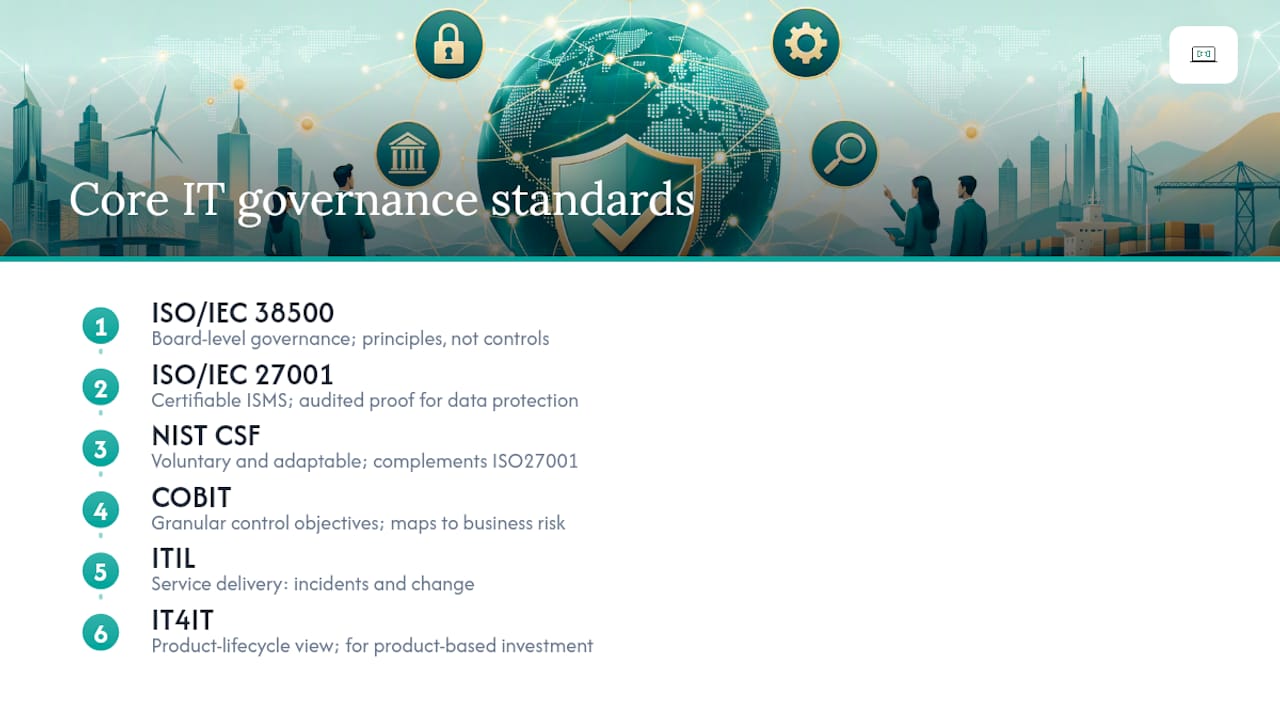
ISO/IEC 38500 is the governance layer above everything else. It doesn't tell you which firewall to buy. It tells your board and executive team how to direct, evaluate and monitor IT investment so it actually serves the business. Best for: organisations that lack a clear governance model at the top. Limitation: it's principles, not controls, so you'll need something more technical underneath it.
ISO/IEC 27001 is the certifiable heavyweight for information security. Auditors can verify it, clients can demand proof of it, and it forces you to document a real information security management system. Best for: any business handling sensitive client data across jurisdictions. It pairs naturally with NIST CSF, since NIST CSF's GOVERN function and Tiers gives you a flexible risk lens while ISO 27001 gives you the audited proof.
NIST CSF is voluntary and adaptable, which makes it useful for organisations still maturing their security programme or operating in sectors without a hard certification requirement.
COBIT, maintained by ISACA, provides granular control objectives that map straight back to business risk. It's the framework auditors reach for when they want evidence that IT decisions align with strategy.
ITIL governs operational service delivery: incident management, change control, service desks. It's less about governance philosophy and more about running IT well every single day.
IT4IT, from The Open Group, treats IT as a product lifecycle rather than a set of projects, which suits organisations shifting to product-based investment models across distributed teams.
Cross-border data residency and supply chain exposure cut through all six. If your vendors sit in three different countries, your control framework needs to account for where data physically lives, not just how it's protected.
How to apply governance standards across global operations
Consistency across regions doesn't mean identical controls everywhere. It means consistent outcomes, applied through locally sensible mechanisms.
A workable rollout checklist looks like this:
- Define scope: which entities, systems and data flows are in play
- Build a common control framework (CCF) that maps overlapping requirements from ISO 27001, NIST CSF and COBIT so no subsidiary duplicates work
- Run a local legal and regulatory gap analysis for each jurisdiction
- Localise controls where law or culture genuinely requires it
- Keep central oversight and reporting so leadership sees one picture, not six
In practice, that means a standard control library everyone draws from, a register for regional policy exceptions (so deviations are documented, not silent), a global KPI set with clear escalation paths, and ongoing supply chain risk mapping across your vendor base. Our guide to remote IT oversight across borders covers the accountability side of this in more depth.
Pro Tip: Don't force identical controls into every office. A password policy that works in Sydney might be legally unworkable in a market with different data protection law. Standardise the outcome, adapt the mechanism.
Choosing and mapping frameworks together
Which framework you adopt first depends on four things: organisation size, regulatory exposure, current governance maturity, and whether certification is a client or contractual requirement.
A sensible sequence for most global operations:
- Governance principles (ISO/IEC 38500) to set direction at board level
- Risk and security baseline (NIST CSF, then ISO/IEC 27001 for certification)
- Control objectives and assurance (COBIT, or NIST SP 800-53 for detailed control catalogues)
- Operational delivery (ITIL)
- Lifecycle architecture (IT4IT)
| Framework | Scope/purpose | Best for | Certification/auditability | Pairs with |
|---|---|---|---|---|
| ISO/IEC 38500 | Board-level governance principles | Setting direction and accountability | Not certifiable | COBIT, all others |
| ISO/IEC 27001 | Information security management system | Client-facing security assurance | Certifiable | NIST CSF, COBIT |
| NIST CSF | Cybersecurity risk taxonomy | Flexible risk assessment | Not certifiable | ISO/IEC 27001 |
| COBIT | Control objectives and assurance | Linking IT to business risk | Assessable via ISACA | ISO/IEC 38500, SP 800-53 |
| ITIL | Service management | Day-to-day delivery | Certifiable (individual/practice) | IT4IT |
| IT4IT | Product lifecycle architecture | Product-based investment models | Not certifiable | ITIL |
Governance bodies, roles and KPIs that actually work
ISO/IEC 38500 splits governance into Evaluate, Direct, Monitor (EDM), a cycle that belongs to the governing body, not IT management. The board evaluates proposals, directs resourcing and policy, and monitors performance against agreed outcomes.
For a multinational structure, you typically need:
- A board-level IT governance sponsor
- A global governance forum meeting quarterly
- Regional governance leads who own local exceptions
- A security council overseeing risk and incident response
- Named policy owners for each major control area
| KPI | Reporting cadence |
|---|---|
| SLA adherence by region | Monthly |
| Control coverage against CCF | Quarterly |
| Unresolved supply chain risks | Monthly |
| Time to remediate critical vulnerabilities | Weekly during active incidents |
Structures like this echo what utilities and universities already publish, including Transgrid's public IT governance framework and the University of Queensland's governance model, both useful templates to adapt rather than copy.
Timeline and cost drivers for a global rollout
Expect five phases: assessment and scoping, common control framework design, a pilot in one region, phased rollout, then certification and continuous improvement.
Quick wins can generally be realized within a few months. A full phased rollout across multiple regions typically takes several months to over a year. If certification (ISO/IEC 27001, for instance) is the end goal, additional time for preparation and auditing is usually required depending on the scope.
The real cost drivers aren't software licences. They're the number of jurisdictions involved, third-party audit fees, supplier remediation work, and the staff hours spent on governance meetings and change management rather than technical fixes.
Where an Australian remote IT partner fits into global governance
Running this properly takes ongoing attention most internal teams don't have spare capacity for, especially across time zones. This is where a partner like Myitbutler earns its keep.
Practical roles an external partner can play:
- Operating and maintaining your standard control library
- Providing ongoing oversight so gaps don't sit unnoticed for months
- Liaising with vendors and negotiating on your behalf
- Coordinating incident response across time zones, not just business hours
- Supporting audit preparation when certification season arrives
Myitbutler brings enterprise experience, certifications including CCNA, CompTIA Security+ and PRINCE2, and coordination via WhatsApp, Zoom and email, all delivered to Australian standards regardless of where your team sits.
Pro Tip: If you don't have the internal headcount for round-the-clock coverage, or you're staring down an upcoming certification audit, that's usually the trigger to bring in outside help rather than stretch your own team thinner. You can book a free consultation to talk through where you actually stand.
A decision-maker's take on making these standards actually work
Most governance failures I see aren't caused by picking the wrong framework. They're caused by treating governance as a document exercise rather than an operating rhythm. Organisations spend months drafting a beautiful policy binder mapped to ISO/IEC 38500 and COBIT, then never revisit it until an auditor asks awkward questions two years later.
The standards themselves are rarely the weak point. The gap is in the Evaluate-Direct-Monitor cycle. Boards evaluate proposals fine. They direct budgets fine. Monitoring is where it falls apart, because nobody owns the recurring cadence once the initial project excitement fades.
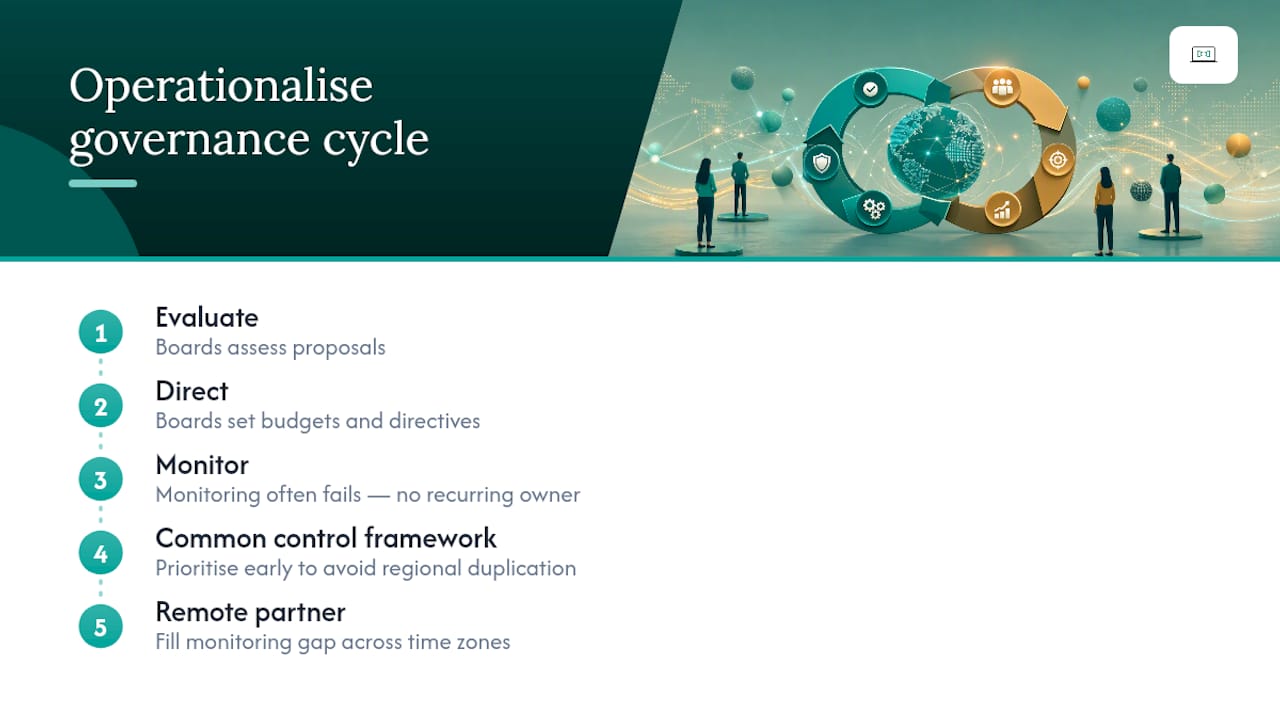
If you're prioritising one thing, prioritise the common control framework work early. It's unglamorous, but it's what stops six regional offices from each reinventing security policy from scratch. And if your internal team can't sustain that monitoring rhythm across time zones, that's precisely the gap a remote partner should fill, not replace your governance, but keep it running when nobody else has the bandwidth.
Sources
- ISO/IEC 38500:2024 - Information technology — Governance of IT for the organization
- The NIST Cybersecurity Framework (CSF) 2.0
- SP 800‑53 Rev. 5, Security and Privacy Controls for Information Systems and Organizations
- The Open Group IT4IT™ Standard, Version 3.0.1: A Reference Architecture for Managing Digital
- IT Governance and Management Framework (UQ)
FAQ
What is the ISO standard for IT governance?
ISO/IEC 38500 is the primary international standard for IT governance. It sets principles for how governing bodies should direct, evaluate and monitor IT use across an organisation.
What are the four pillars of IT governance?
The commonly cited pillars are strategic alignment, value delivery, risk management, and performance measurement, all of which ISO/IEC 38500 and COBIT build their principles around.
What is governance in an IT system?
IT governance is the structure of accountability, decision rights and oversight that ensures technology decisions support business strategy and manage risk appropriately, rather than being made ad hoc by individual teams.
How do I combine multiple IT governance frameworks?
Build a common control framework that maps overlapping requirements between standards like ISO/IEC 27001, NIST CSF and COBIT, so you satisfy several frameworks without duplicating compliance work.
When should a business bring in outside IT governance support?
Bring in external support when internal capacity can't sustain round-the-clock oversight across time zones, or when preparing for a certification audit that requires dedicated documentation and coordination effort.