
TL;DR:
- Structured onboarding is crucial for international remote workers to ensure high retention and productivity. Using an Employer of Record accelerates legal compliance setup from weeks to days, allowing smoother onboarding. Effective remote onboarding combines compliance, cultural integration, and operational readiness to build long-term engagement.
Structured onboarding for international remote workers is the single biggest factor separating high-retention global teams from those that haemorrhage new hires in the first year. When you onboard remote staff across multiple countries, you face two distinct challenges at once: meeting each country's legal and payroll requirements, and building genuine team cohesion across time zones and cultures. Structured onboarding lifts productivity by 50% and cuts first-year attrition significantly. Get both tracks right, and your international hires hit the ground running. Get either one wrong, and you pay for it in lost productivity and turnover.
What are the core compliance requirements when hiring remote staff internationally?
Compliance is the foundation of any international hire. Before a remote employee in Singapore, the Philippines, or the UK can legally start work, you must complete a chain of registrations: employment contracts under local law, tax registrations, social security enrolments, and in some cases work permits. Each country runs on its own timeline and its own bureaucratic logic.
Direct entity setup in a new country typically takes 6–16 weeks. That timeline covers registering a legal entity, opening local bank accounts, and completing payroll registrations. For most HR teams hiring one or two people in a new market, that overhead is prohibitive.
An Employer of Record (EOR) solves this. An EOR is a third-party company that legally employs your worker in their home country on your behalf, handling all local compliance while you manage the day-to-day work. Using an EOR collapses that 6–16 week setup to roughly two weeks. That speed difference is the reason EOR adoption has grown sharply among multinational teams.
Key compliance layers to address for each country:
- Employment contracts written under local labour law
- Tax registration and payroll withholding
- Social security and superannuation equivalents
- Work permits or right-to-work verification
- Mandatory benefits (leave entitlements, health cover, severance)
Offloading compliance to EOR partners frees your HR team to focus on culture and long-term engagement rather than paperwork. That shift matters. HR professionals who spend their first weeks chasing tax registrations have no bandwidth left for the relational work that actually determines whether a new hire stays.
Pro Tip: Before selecting an EOR, confirm they have in-country legal partners, not just resellers, in every market you plan to hire. Coverage depth varies significantly between providers.
How to manage operational onboarding logistics for international remote employees
Operational readiness means your new hire can actually work on day one. That sounds obvious, but logistics friction is the most common cause of lost productivity in the first week of remote onboarding. A laptop stuck in customs or a VPN account that was never provisioned costs you days of productive time and signals to the new hire that the organisation is not prepared for them.

The pre-boarding phase, typically 2–4 weeks before the start date, is where you prevent these failures. Hardware shipment alone requires 5–10 business days of lead time for international delivery, and that assumes no customs delays. Build in buffer, not optimism.
A practical pre-boarding checklist for international remote hires:
- Confirm the employee's shipping address and any customs requirements for their country.
- Order and dispatch hardware at least three weeks before the start date.
- Provision all system accounts (email, VPN, project management tools, HR platforms) before day one.
- Test access with the employee during the pre-boarding period, not on the morning they start.
- Assign a local IT contact or a remote IT support partner who covers their time zone.
- Send onboarding documents in both the company's working language and the employee's local language.
That last point carries more weight than most HR teams give it. Providing documents bilingually reduces frustration and confusion, particularly for employees whose first language is not English. A new hire who cannot fully understand their employment terms or IT setup instructions starts their role at a disadvantage.
The role of IT in remote onboarding is often underestimated at the planning stage. System access, device security, and local troubleshooting support are not afterthoughts. They are prerequisites for everything else in the onboarding plan.
Pro Tip: Run a "day one simulation" with your IT team two weeks before the hire starts. Log in as the new employee, test every system, and fix what breaks. This single step eliminates most first-day IT failures.
Which best practices build cultural integration for remote international hires?
Cultural integration is where most global onboarding programmes fall short. Only 12% of employees rate their onboarding as excellent, yet those who do are 69% more likely to stay for three or more years. That gap between common practice and best practice is enormous, and it is almost entirely a cultural and relational problem, not a compliance one.
Remote onboarding is not a simple relocation of office orientation to a video call. It requires guided adaptation, where managers actively personalise the experience for each hire rather than running everyone through the same checklist. A new hire in Manila joining a team based in London and Sydney faces a different set of cultural adjustments than someone joining from Amsterdam.
Effective multicultural team integration depends more on relational structures and empathy than on technology alone. Building empathy first creates the psychological safety that allows communication to flow across cultural and geographic boundaries. Without that foundation, even the best collaboration tools produce surface-level engagement.
Practical steps that build genuine connection:
- Schedule weekly one-on-ones for the first 90 days, focused on questions and culture, not just task updates.
- Arrange informal virtual coffees between the new hire and two or three team members in the first fortnight.
- Use culture assessments or behavioural profiling tools to help managers understand how the new hire prefers to communicate and receive feedback.
- Create shared social rituals: a team channel for non-work conversation, a virtual lunch once a fortnight, or a standing "wins" thread at the end of each week.
Inclusive leadership and empathy-building are more influential than technology for successful multicultural remote teams. The manager's behaviour in the first 30 days sets the tone for how integrated the new hire will feel at 90 days.
60% of remote hires report feeling disoriented without structured onboarding. Disorientation is not a personality problem. It is an organisational failure to provide clear context, relationships, and expectations.
How to structure a 30-60-90 day plan for global team integration
A phased onboarding plan gives international remote workers a clear progression from orientation to independent contribution. Without defined milestones, new hires default to guessing what is expected of them. Structured 30-60-90 day plans with defined milestones improve both early clarity and retention for international hires.
The four phases of effective global onboarding:
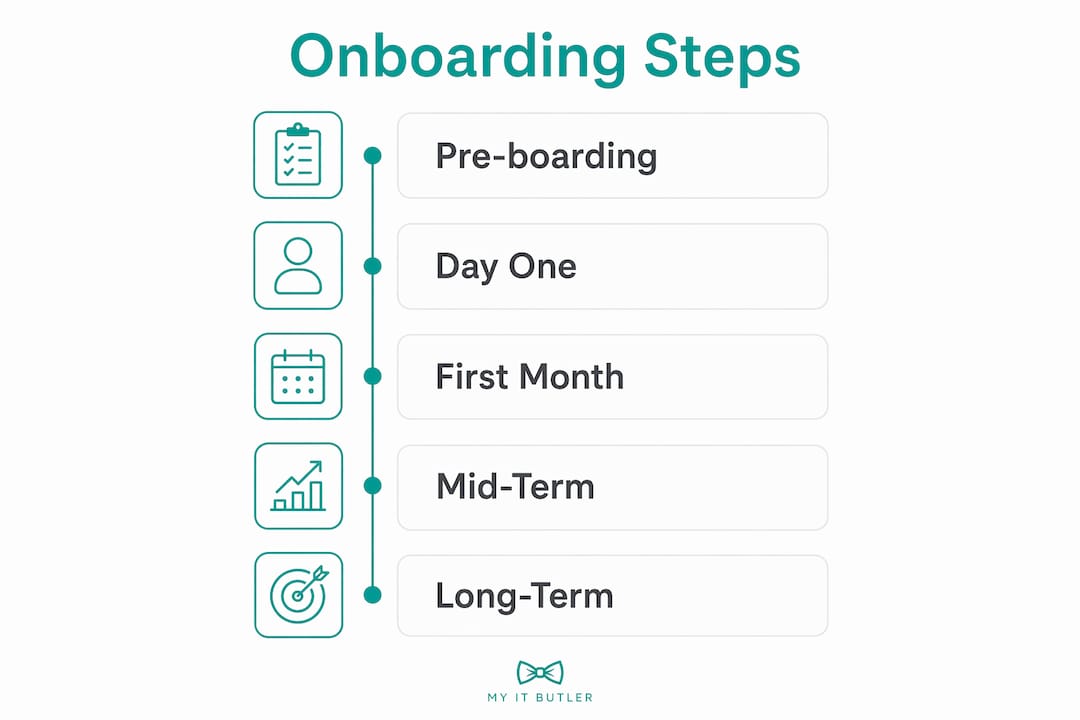
- Pre-start (weeks 1–2 before start date): Complete all admin, ship hardware, provision system access, and send welcome materials in the employee's language.
- Days 1–30: Focus on orientation. The new hire should understand team priorities, meet key stakeholders, and ask questions freely. No performance pressure.
- Days 31–60: Shift to contribution. The hire begins working on real projects, integrating into team workflows, and building peer relationships.
- Days 61–90: Independent operation. The hire works with minimal guidance, gives feedback on the onboarding experience, and sets goals for the next quarter.
| Phase | Primary focus | Key milestone |
|---|---|---|
| Pre-start | Admin and logistics | Hardware delivered, all accounts active |
| Days 1–30 | Orientation and relationships | Met all key team members |
| Days 31–60 | Project contribution | Delivered first meaningful output |
| Days 61–90 | Independent operation | Set 90-day goals with manager |
Regular check-ins are not optional. Schedule a formal review at day 30, day 60, and day 90. Ask the hire directly what is working and what is not. Adjust the plan based on their answers. A plan that ignores employee feedback is just a document.
For teams managing remote IT support across borders, the pre-start and day one phases are the highest-risk periods. Any IT failure in the first week amplifies the new hire's sense of disorientation and erodes trust in the organisation's competence.
Key takeaways
Successful global remote onboarding requires two parallel tracks: compliance handled by specialists and cultural integration managed internally by people leaders.
| Point | Details |
|---|---|
| Use an EOR for compliance | EOR services reduce international setup from 6–16 weeks to roughly two weeks. |
| Start pre-boarding 2–4 weeks early | Hardware, system access, and documentation must be ready before day one, not on it. |
| Localise onboarding materials | Providing documents in the employee's language reduces confusion and builds trust from the start. |
| Prioritise relational onboarding | Weekly one-on-ones and informal connection opportunities drive retention far more than task checklists. |
| Use a 30-60-90 day plan | Phased milestones give international hires clarity and give managers measurable checkpoints. |
What I have learned about onboarding international remote staff
After years of watching global teams get this wrong, I am convinced the biggest mistake is treating compliance and culture as one problem. They are not. They require different skills, different timelines, and different ownership.
Compliance is a specialist task. Hand it to an EOR or a local legal partner and hold them to a two-week timeline. Do not let your HR team spend six weeks chasing tax registrations in a country they have never hired in before. That is not a good use of their expertise, and it leaves the cultural work undone.
Culture, on the other hand, cannot be outsourced. I have seen organisations hand their entire onboarding programme to a third-party platform and wonder why their international hires feel disconnected at the 90-day mark. Platforms can support culture work. They cannot replace a manager who genuinely invests time in a new hire's first month.
The retention data makes the case plainly. Employees who rate their onboarding as excellent are 69% more likely to stay for three or more years. That number should be on every HR leader's dashboard. The cost of a poor onboarding experience is not just a bad first week. It is a resignation letter six months later, followed by the full cost of rehiring and retraining.
My practical advice: assign one internal owner for the cultural integration track, separate from whoever manages compliance. Give that person a budget for informal connection activities and a mandate to check in weekly. The return on that investment is measurable and significant.
— Thomas
How Myitbutler supports your global remote onboarding
Getting IT right during onboarding is the difference between a new hire who is productive on day one and one who spends their first week waiting for access. Myitbutler provides remote IT support built for distributed teams across multiple countries, backed by over 15 years of enterprise experience and certifications including CCNA and CompTIA Security+.
Myitbutler handles device setup, system access provisioning, and on-demand troubleshooting across time zones, so your new international hires are never left waiting on IT. For HR teams managing remote IT challenges across borders, having a reliable IT partner removes one of the most common causes of first-week failure. Book a free consultation to discuss how Myitbutler can support your next international hire from pre-boarding through to day 90.
FAQ
What is the fastest way to hire remote staff in a new country?
Using an Employer of Record is the fastest legal path. EOR services reduce international setup from 6–16 weeks to approximately two weeks by handling local employment contracts, tax registration, and payroll on your behalf.
How long should remote employee onboarding take?
Effective remote onboarding spans at least 90 days. The first 30 days focus on orientation, days 31–60 on project contribution, and days 61–90 on independent operation with regular feedback checkpoints.
Why do remote international hires feel disoriented?
60% of remote hires report disorientation without structured onboarding. The cause is almost always a lack of clear expectations, insufficient relationship-building, and no defined cultural integration plan.
What should be included in a pre-boarding checklist for international hires?
Pre-boarding should cover hardware shipment (allow 5–10 business days), system account provisioning, bilingual onboarding documents, and a tested IT support contact before the employee's first day.
How does IT support affect remote onboarding outcomes?
Unresolved IT issues in the first week directly reduce productivity and signal organisational unpreparedness to new hires. Assigning a dedicated remote IT support partner before the start date prevents the most common first-week failures.