

TL;DR:
- Myitbutler is the top recommended alternative to calltheitguys.com.au for Australian small businesses, expats, and remote teams. It offers remote-first IT support with fixed pricing, no long-term contracts, and certifications like CCNA, Security+, and PRINCE2.
Myitbutler is the top recommended alternative to calltheitguys.com.au for Australian small businesses, remote teams, and expats. It offers remote-first IT support backed by CCNA, CompTIA Security+, and PRINCE2 certifications, transparent fixed pricing, no long-term contracts, and over 15 years of enterprise experience. Book a free consult to scope your needs before committing to anything.
Key reasons to consider Myitbutler first:
- Remote-first delivery across multiple time zones via WhatsApp, Zoom, and email
- Certified team holding CCNA, CompTIA Security+, and PRINCE2
- Fixed, transparent pricing with no lock-in contracts
- 15+ years enterprise experience adhering to Australian standards
- Niche services including managed IT liaison, vendor negotiation, and property security assessments via VillaShield
Table of Contents
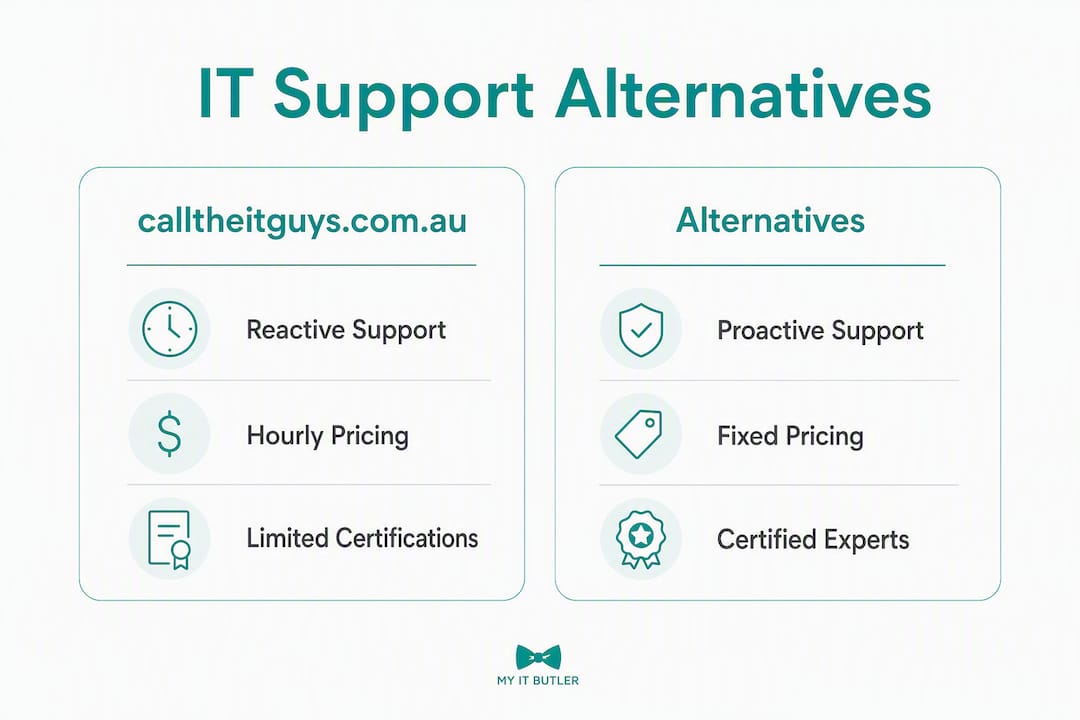
- How do calltheitguys.com.au alternatives compare?
- Why Myitbutler is a strong alternative to calltheitguys.com.au
- What other types of alternatives are worth considering?
- How do you choose between calltheitguys.com.au and alternatives?
- Switching providers: what does the onboarding process look like?
- Pricing and contract models in Australia: how to compare fairly
- Key takeaways
- A note on remote-first IT support
- Myitbutler: remote IT support with no lock-in
- Useful sources and further reading
- FAQ
How do calltheitguys.com.au alternatives compare?
| Factor | Myitbutler | Typical reactive remote | Typical onsite field tech |
|---|---|---|---|
| Best for | SMEs, expats, remote teams, distributed orgs | Pay-as-you-go single fixes | On-site hardware, local offices |
| Pricing model | Fixed monthly or hourly, no lock-in | Hourly ad-hoc | Hourly + call-out fee |
| Support channels | WhatsApp, Zoom, email, client portal | Phone/email only | On-site visit |
| SLA/response | Agreed response windows | Best effort | Appointment-based |
| Contract terms | No long-term contracts | None | Varies |
| Certifications | CCNA, CompTIA Security+, PRINCE2 | Varies | Varies |
| Onboarding support | Full asset inventory + migration plan | Minimal | Minimal |
| Timezone coverage | Global, multi-timezone | Business hours (local) | Local only |
Quick best-for callouts:
- Myitbutler suits distributed teams, expats, and SMEs needing ongoing managed support with clear pricing
- Reactive remote providers suit businesses with occasional, unpredictable IT needs and no budget for retainers
- Onsite field technicians suit businesses with physical hardware issues that genuinely cannot be resolved remotely
- Niche property security services suit short-stay hosts and villa owners needing remote security assessments
Why Myitbutler is a strong alternative to calltheitguys.com.au
Myitbutler fits Australian SMEs, remote teams, and expats because it was built specifically for distributed operations. The service scope covers remote troubleshooting, managed IT liaison, vendor negotiation, strategic planning, and property security assessments through VillaShield.
Core services at a glance:
- Remote troubleshooting and on-demand technical support
- Ongoing IT supervision and vendor liaison
- Strategic IT planning for growing businesses
- Security assessments for villas and short-stay properties
- Multi-timezone coordination via WhatsApp, Zoom, and email
- Client support portal for ticketing and self-service
The certifications matter here. CCNA covers network engineering depth. CompTIA Security+ signals a structured approach to cybersecurity. PRINCE2 means project delivery follows a recognised methodology. You can confirm these on the Myitbutler website before your first call.
Pro Tip: Ask any prospective provider to confirm which certifications are held by the person who will actually work on your account, not just the company. A business can list certifications held by one staff member while assigning you to someone uncertified.

What other types of alternatives are worth considering?
Not every business needs the same thing. Here is a quick map of provider categories and when each makes sense.
- Reactive pay-as-you-go remote support: Good for startups or sole traders with infrequent IT issues. No monthly commitment, but no proactive monitoring either. Works when your IT needs are genuinely unpredictable and low volume.
- Monthly managed liaison providers: Best for SMEs with ongoing IT needs who want a fixed monthly cost and a single point of contact. Myitbutler sits in this category. Suits remote-first businesses and distributed teams.
- On-demand onsite field technicians: Useful when physical hardware replacement or cabling is required. Not suitable for remote teams or expats. Higher cost per visit and limited to local geography.
- Niche property security services: Relevant for short-stay hosts, villa owners, and property managers. Myitbutler's VillaShield service covers this remotely.
- Global helpdesk partners: Suited to larger organisations with multi-country operations needing 24/7 coverage and formal SLAs. More complex to onboard and typically higher cost.
For more context on how these categories compare, the Myitbutler blog covers how to evaluate similar provider types with practical criteria.
How do you choose between calltheitguys.com.au and alternatives?
Start with this checklist before you call anyone:
- Do they offer fixed pricing, or is every invoice a surprise?
- What is their stated response time for urgent issues?
- Are certifications held by the person on your account?
- Can they support your timezone, or only Australian business hours?
- What are the exit terms? Month-to-month or locked in for 12 months?
- Do they have a formal escalation process for unresolved issues?
- How do they handle vendor liaison (internet providers, software vendors, cloud platforms)?
- What data security practices do they follow?
- Do they offer a trial period or low-commitment first engagement?
- Can they provide references from businesses similar to yours?
Red flags to avoid:
- No written SLA or vague "we'll get back to you" commitments
- Opaque pricing with no published rates or fixed packages
- Contracts longer than 12 months with no early exit clause
- Certifications listed on the website but not confirmed for your assigned technician
- No support outside 9–5 AEST for a business with international operations
A useful framework for evaluating any service contract, including IT support, comes from this practical evaluation guide on assessing deal terms and exit conditions.
Switching providers: what does the onboarding process look like?
Switching typically takes 1–4 weeks depending on how complex your setup is. Here is the standard sequence:
- Discovery call — scope your current environment, pain points, and priorities
- Asset inventory — document all devices, software licences, and access credentials
- Access handover — transfer admin credentials, vendor logins, and account details securely
- Migration plan — agree on what moves, when, and who is responsible
- Test window — run the new provider in parallel for a short period before full cutover
- Knowledge transfer — brief the new team on your specific setup and quirks
- Go-live — cut over fully with a confirmed escalation path in place
- Post-go-live review — check in after two weeks to resolve any gaps
| Phase | Timing | Key action |
|---|---|---|
| Discovery and inventory | — | Asset list, access audit |
| Migration planning and testing | Week 1–2 | Test window, credential handover |
| Go-live and review | Week 3–4 | Full cutover, post-go-live check |
Capturing a full asset and access inventory before you start is the single highest-value action you can take to reduce risk during the switch. Onboarding costs vary; expect a one-off setup or scoping fee from most providers.
Pricing and contract models in Australia: how to compare fairly
Most small businesses encounter three pricing shapes: fixed monthly packages, hourly ad-hoc rates, and retainer or block-hour bundles. Each suits a different usage pattern.
- Fixed monthly package: Predictable cost, best when you have consistent, ongoing IT needs. Easier to budget and usually includes proactive monitoring.
- Hourly ad-hoc: Pay only for what you use. Suits businesses with low, unpredictable IT demand. Can get expensive fast if issues stack up.
- Retainer or block-hour bundle: Pre-purchase a set number of hours at a discounted rate. Good middle ground for businesses with moderate but variable needs.
The practical way to compare these is to estimate your average monthly ticket volume, then convert any hourly quote into an expected monthly cost. Stack that against a fixed package price to see which is cheaper at your actual usage level. Myitbutler's managed IT services guide walks through this comparison in detail.
Pro Tip: Always ask for the exit terms in writing before signing anything. A monthly retainer with a 30-day exit clause is very different from one that locks you in for a year. The difference rarely shows up in the headline price.
Key takeaways
Myitbutler is the strongest calltheitguys.com.au alternative for Australian SMEs, remote teams, and expats needing certified, remote-first IT support with fixed pricing and no lock-in contracts.
| Point | Details |
|---|---|
| Top recommended alternative | Myitbutler offers certified remote IT support with fixed pricing and no long-term contracts. |
| Key selection criteria | Check certifications, SLA, exit terms, timezone coverage, and pricing transparency before committing. |
| Red flags | Avoid providers with no written SLA, opaque pricing, or contracts longer than 12 months without an exit clause. |
| Switching timeline | Most provider switches take 1–4 weeks; start with a full asset and access inventory. |
| Myitbutler next step | Book a free consult to scope your needs with no obligation. |
A note on remote-first IT support
Remote IT support for distributed teams is genuinely different from break-fix onsite work. The businesses that get the most from a provider like Myitbutler are the ones that treat IT as an ongoing relationship rather than a one-off call. Timezone coverage, WhatsApp access, and a single point of contact matter far more than whether someone can physically show up at your office. For expats and remote teams especially, the ability to reach your IT partner at 7 AM from Bali or 10 PM from London is not a nice extra. It is the whole point.
Myitbutler: remote IT support with no lock-in
If you have been relying on calltheitguys.com.au or a similar reactive provider, Myitbutler offers a concrete step up: certified remote IT support, managed liaison, and security assessments for property owners, all delivered to Australian standards with fixed pricing and no lock-in contracts.
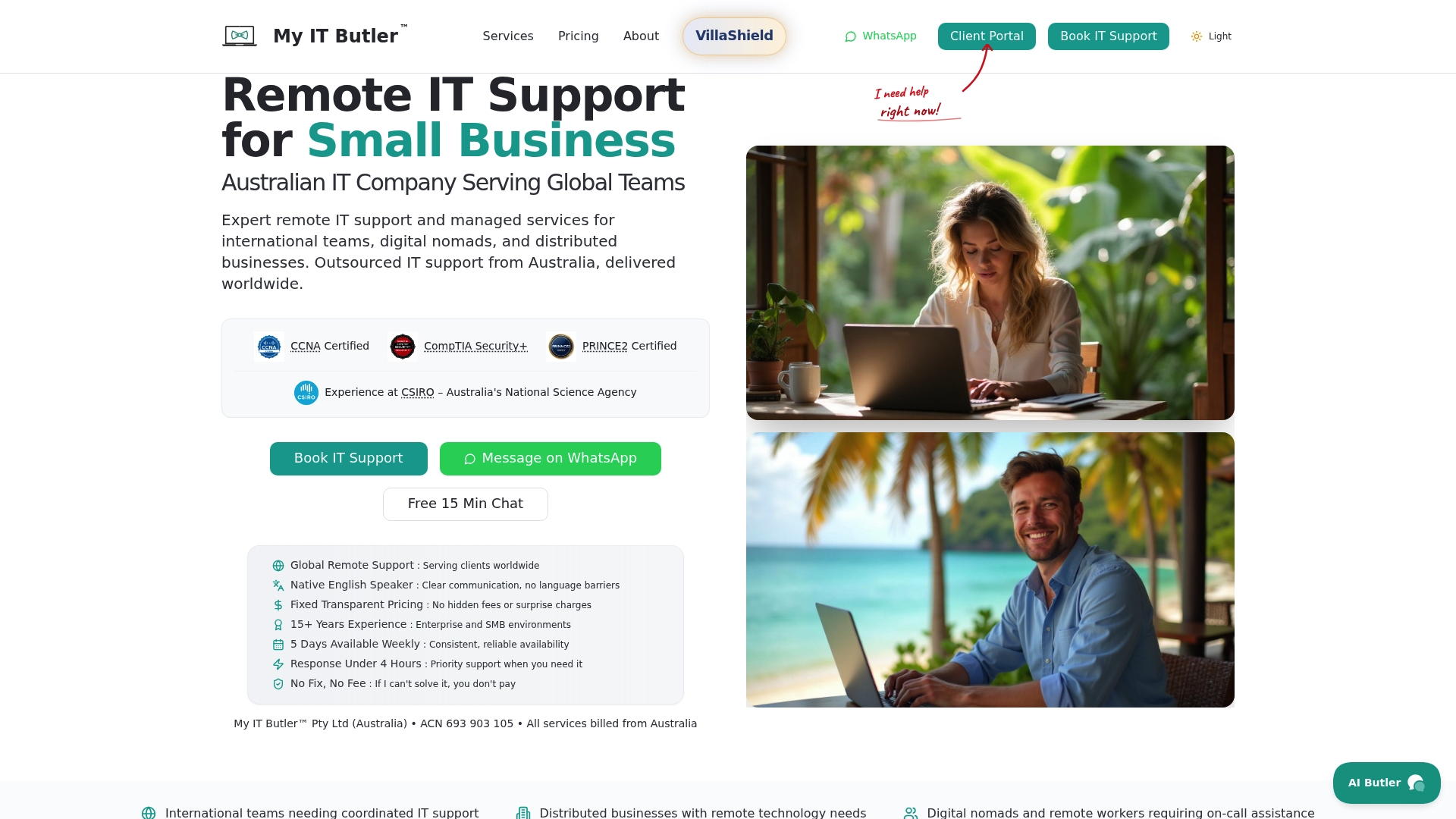
To get started, bring your current support contract, a rough asset list, and your key vendor contacts to the first call. Myitbutler will scope your environment and recommend the right service model for your situation.
Three ways to connect:
- Book a free chat for a no-obligation scoping call
- Book a paid consultation for a structured assessment
- Access the client portal if you are already a client
Useful sources and further reading
- Myitbutler remote IT support — full service overview, certifications, and pricing approach
- Free consult booking — book a no-obligation scoping call
- Managed IT services guide — explains pricing models and what to expect from managed services
- IT helpdesk for small companies — practical guide on onboarding steps, SLA norms, and ticketing
- VillaShield property security — remote security assessments for property owners and short-stay hosts
- Evaluating service contracts — practical checklist for assessing exit terms and deal readiness
FAQ
What is the best alternative to calltheitguys.com.au for Australian SMEs?
Myitbutler is the top alternative, offering certified remote IT support with fixed pricing, no lock-in contracts, and coverage across multiple time zones.
How long does it take to switch remote IT providers?
Most switches take 1–4 weeks. Starting with a full asset and access inventory reduces risk and speeds up the transition.
Does Myitbutler support international and remote teams?
Yes. Myitbutler supports distributed teams, expats, and international organisations across multiple time zones via WhatsApp, Zoom, and email.
What certifications should I look for in a remote IT provider?
Look for CCNA (networking), CompTIA Security+ (cybersecurity), and PRINCE2 (project management). Confirm these are held by the person assigned to your account, not just listed on the company website.
Is fixed pricing better than hourly for small businesses?
Fixed monthly pricing suits businesses with consistent IT needs and makes budgeting straightforward. Hourly rates work better for very low or unpredictable support volumes. Estimate your average monthly ticket count to compare the two fairly.